

Note: This essay is a compressed and re-worked version of one of the first major writings I published to Substack back in September, 2025: “The Temple Occupation”.
The so-called “Cleansing of the Temple” has long been treated as a curious episode in the life of Yehoshua of Nazareth. Preachers portray it as a flash of holy indignation, a symbolic protest against hypocrisy. Scholars debate whether it happened once or twice, whether it was early or late in his ministry, whether it was a small act of prophetic street theater or an exaggerated memory later colored by apocalyptic expectation. Both readings often tend to flatten the event into either a tantrum or a metaphor.
Both miss what a Yahwist audience would have recognized immediately.
A “cleansing” of the Temple, in the long history of Israel, was never a minor outburst. When Hezekiah, Josiah, or even Judah ha-Makabi (Judas Maccabee) cleansed the sanctuary, they did so not to tidy its precincts but to reorder the covenantal constitution of the people. To cleanse the Temple was to suspend its operations, expel its compromised authorities, and reestablish its liturgy and treasury on different terms. It was a deeply political act, a restructuring of sovereignty.
From an Ebyonim hermeneutic, Yehoshua’s Temple action must be read in this same lineage. His cleansing was not a solitary protest but an extended occupation of the Temple courts during the high festival of Passover. From Sunday’s entry into Jerusalem until his arrest on Wednesday night, Yehoshua and his followers effectively held the Temple complex in lockdown, disrupting its sacrificial economy, teaching daily in its courts, confounding the administrators who dared not move against him publicly for fear of the crowds.
In this space, he suspended the Temple’s revenue streams and enacted a commonwealth economy rooted in Jubilee: a treasury for the poor, a table for the multitude.
Our reading seeks to recast the entire final week of his life. Instead of a sequence of detached vignettes (a triumphal entry here, a fig tree there, a cleansing somewhere in between), we see a coherent campaign: a covenantal seizure of Israel’s most potent institution. Yehoshua’s crucifixion, then, cannot be explained simply as Rome reacting to vague messianic claims or local priests offended by insults. It was the swift and brutal suppression of a Temple coup that threatened to reorder the covenantal constitution itself.
This essay argues that the Temple Action was the central political-theological act of Yehoshua’s Commonwealth campaign. It traces the historical precedents of Temple purges, situates Yehoshua’s act within that lineage, reconstructs the occupation of Passover week, and interprets its consequences for the revolts that followed. Our method, in keeping with Ebyonim tradition, will not spiritualize the event into metaphor alone, nor reduce it to archaeology of fragments. We read it as constitutional action: a bid to restore Yahwism’s covenantal economy of justice and mercy against the twin powers of Rome and the priestly elite.
The Lineage of Cleansings and Some Causes
When we speak of Yehoshua’s Temple Action as a coup of Jubilee, we are not speaking in metaphor alone. We are placing him within a long genealogy of Temple purges, reforms, and seizures that punctuate Israel’s history like seismic shocks. These events were never simply about liturgy or priestly decorum. They were about sovereignty: who holds the keys of covenant, who commands the treasury, and whose vision of Yahwism will be enacted at the altar.
The Twin Prototypes of Hezekiah and Josiah
The pattern of Temple cleansing was already etched into Israel’s memory long before the Hasmoneans. Hezekiah, son of Ahaz, began his reign with a radical reset: doors repaired, Levites consecrated, sanctuary purified after years of idolatry and neglect. The chroniclers describe a sixteen-day reconstitution that amounted to a new founding. Josiah, a century later, amplified the impulse but with fiercer edge. During renovations, the Book of the Law was uncovered, and its words catalyzed a violent purge: idols smashed, altars razed, heterodox priests deposed.
The two men set two templates. Hezekiah’s reform carried the fragrance of Jubilee, mercy as covenantal reset. Josiah’s bore the heat of zeal, fidelity weaponized into national spectacle. All later purges, from Maccabees to Zealots, echo one or the other. Yehoshua’s action would draw on both: audacious as Josiah, merciful as Hezekiah, and yet distinct from either.
The Maccabean Cleansing and the Hasmonean Betrayal
The Second Temple’s most famous cleansing came in 164 BCE, when Judah Maccabee retook Jerusalem from the Seleucids, purified the sanctuary, and rebuilt the altar. The Feast of Hanukkah marks the moment.
But the ambiguity of cleansing became stark almost immediately. Less than a decade later, Judah’s younger brother Jonathan Apphus seized the high priesthood despite lacking Zadokite lineage, enforced by Hasmonean arms and Seleucid alliance. The Zadokite priesthood, descended from the ancient covenantal line reserved by Ezekiel’s constitutional amendment, was purged from the sanctuary. Under leaders remembered in fragments as the Teacher of Righteousness, the Zadokite remnant withdrew into the Judean wilderness, established a Temple-in-Exile at Qumran, and drafted what amounted to a covenantal constitution in waiting.
The Hasmonean dynasty, meanwhile, appropriated the very name “Zadok” for itself. The aristocrats who would come to be called Sadducees were not descendants of Zadok’s line. They were bureaucrats and courtiers who had reduced sacred lineage to a job title. Yehoshua himself never dignified them with the title “Sadducees”; in the Gospel record he calls them only “scribes,” in keeping with the Essene, Shammaite, and Zadokite habit of denying their pretensions.
Note: For the full Hasmonean-Zadokite fracture, the Onias IV exile to Leontopolis, and the “Wicked Priest” identification in the Qumran pesharim, see “Who Were the Sadducees?” and “Who Were the Essenes?”
Pompey’s Desecration (63 BCE)
In 63 BCE, the Roman general Pompeius Magnus entered Jerusalem under the pretext of settling a Hasmonean succession dispute and marched directly into the Holy of Holies. He reportedly looted nothing. But his presence inside the innermost chamber was itself desecration: the profanation of the one space that even Israel’s High Priest entered only once per year.
From that moment, Judea’s autonomy was finished. The Hasmonean dynasty became Roman client-ethnarchy, and the priesthood, already corrupted from within by Hasmonean usurpation, was now doubly compromised: installed by Rome, serving at the pleasure of empire. For the Essenes and Zadokite exiles, this validated the secession. The sanctuary was no longer merely corrupted from within. It was now subjugated from without.
Hezekiah the Zealous One and Judah the Galilean
The Hasidim of the Galilean hinterland nurtured a memory of Judah Maccabee’s guerrilla campaign against Antiochus IV. To them, Herod’s ascension under Roman patronage in the 40s BCE was the new Antiochene desecration: foreign overlordship propped up by compromised priests.
Hezekiah the Zealot gathered a band of hill fighters. Their campaign was harassment, not pitched battle: ambushing Herod’s patrols, raiding supply lines, redistributing captured wealth to sustain fighters and communities. Herod, with Roman backing, crossed into Galilee and executed Hezekiah and his followers without trial. To the Hasidim, Herod was now marked as both usurper and butcher.
Decades later, when Archelaus was removed and Judea placed under direct Roman administration, Quirinius ordered a census. This was not bookkeeping. It was the formal inscription of Judea into Caesar’s tax apparatus, the legal transfer of propriety over the Land from the covenantal community to empire. Hezekiah’s son Judah the Galilean, partnering with Zadok the Pharisee of Beit Shammai, refused enrollment. Ein melech ela YHWH. No king but YHWH. Their movement became what Josephus called the Fourth Philosophy, and Judah’s sons Jacob and Simon would each die crucified in turn for carrying it forward.
The family ran four generations, from Sepphoris in 47 BCE to Masada in 73 CE. It is in these very hills, within living memory of Hezekiah’s death, that Yehoshua of Nazareth grew up. To preach Jubilee in Galilee was to speak in a land already soaked with the blood of covenantal rebellion.
Note: For the four-generation Galilean Zealot dynasty (Hezekiah, Judah, the brothers Jacob and Simon, and Eleazar ben Yair at Masada), see “Who Were the Zealots?” For the Roman procedural frame of the census-as-asset-registry, see “Who Were the Romans?”
The Ezekiel Canon Flashpoint (c. 0-6 CE)
The cultural fracture deepened in the years around the turn of the century. The prophet Ezekiel’s visions of the restored Temple (chapters 40-48) had been preserved at Qumran as a constitutional charter. To canonize Ezekiel in the Jerusalem corpus was, implicitly, to delegitimize the Hasmonean-Sadducean priesthood that now dominated Zion. Ezekiel’s blueprints described a sanctuary not controlled by aristocrats but reconstituted according to Zadokite lineage and covenantal rigor.
The Sadducees and their Hillelite allies, anxious to preserve the Temple’s fragile legitimacy under Roman oversight, sought to keep Ezekiel marginalized. The Samaritans, Essenes, and Hasidim, including the Shammaite Pharisees, regarded Ezekiel as indispensable: the true map of the Temple in exile, the divine counter-blueprint that exposed the corruption of Zion’s altar.
The debate was never resolved in its own time. Ezekiel survived, canonized but contested, hovering as both wound and weapon. For the Pharisees, the controversy widened the breach already opening between Shammai and Hillel: Shammai leaning toward the rigorist coalition of Qumran, Samaria, and the Hasidim; Hillel tilting toward uneasy accommodation with Zion’s aristocracy in hopes of preserving unity under Rome’s watch.
The Wilderness Campaign of Yohan the Immerser
After the failure of Judah the Galilean’s revolt, Judea lay fractured. Into this vacuum stepped Yohan ha-Matbil, John the Immerser, son of a priest of the Avi’yah course, dwelling in the wilderness, conducting a campaign of teshuva and immersion along the Jordan.
Yohan’s campaign was deliberate, not eccentric. It was staged at the threshold where Joshua once carried the Ark into the Land. Like Moses, he led people into the wilderness to prepare them; like Elijah, he stood at the Jordan summoning Israel to repentance. Crowds streamed from Judea, Samaria, and Galilee. To the Essenes at Qumran, Yohan was kin. To the Samaritans, his wilderness base recalled their own Gerizim hopes. To Galileans, he was the living continuation of Hezekiah and Judah’s insurgency, reframed without the sword.
Yehoshua came into the movement through this gate. The Gospels describe that he was baptized into Yohan’s network, that several of his earliest disciples came from Yohan’s own inner circle, and that even after the elder’s execution Yehoshua continued to point back to him: was John’s baptism from heaven or from men? The Commonwealth did not begin in the Temple courts. It began at the Jordan’s banks. Yehoshua carried it forward. He never disavowed his elder.
Note: For the full Wilderness Campaign, Yohan’s role as the priestly Masch’yah of House Aaron, and the inheritor community that became the Mandeans of southern Mesopotamia, see “Who Were the Nasoreans?”
The Samaritan Uprising (36 CE)
In the final years of Pilate’s governorship, a Samaritan prophet claimed to be a new Moses, promising to reveal sacred vessels hidden on Mount Gerizim. Crowds gathered at Tirathana, armed and expectant. Pilate intercepted them with Roman troops, slaughtered many, and executed the leaders. The Samaritan elders appealed to Vitellius, the Syrian legate, and Pilate was recalled to Rome.
The episode looks regional on the surface. In context, it was something else. Pilate’s response was not just brutality. It was a trauma reflex. Five or six years earlier, a Galilean teacher had occupied the Temple complex during Passover, and Pilate had moved too slowly to suppress him in real time. The execution had not ended the movement; the “sect of the Nazarenes” had multiplied through Jerusalem, Galilee, and the diaspora. When a Samaritan prophet gathered crowds on Gerizim with promises of sacred vessels, Pilate moved swiftly, almost certainly briefed by the Jerusalem aristocracy on the pattern they wanted preempted. Samaria was the other pole of Yahwist resistance, a rival sanctuary with deep roots. Pilate’s overreaction was the lesson he had learned in 30 CE applied in 36 CE.
Note: For the Samaritan tradition’s continuous indigenous Yahwism, the Mount Gerizim sanctuary’s six-century constitutional history, and the Taheb expectation Yehoshua engages at Jacob’s well, see “Who Were the Samaritans?”
The Sectarian Cold War (44-50 CE)
After Herod Agrippa I’s sudden death in 44, the high priesthood became a revolving door at Rome’s pleasure. The cold war between Shammaite rigorists and Hillelite accommodationists turned hot. In 47 CE, the Eighteen Decrees of Shammai codified purity boundaries with nationalist edge. Pharisees clashed with Pharisees, and blood was spilled in the Temple courts. The sanctuary had become a battlefield within Israel itself.
In 48 CE, Judah the Galilean’s sons Jacob and Simon were crucified by the prefect Tiberius Julius Alexander. The Sicarii first appear in the historical record around this time. Within a decade, the Temple courts would see the murder of a tzadik, and within twenty years, the city itself would burn.
The Murder of a Tzadik (62 CE)
The Sadducean aristocracy of Beit Hinan still controlled the Temple in the early 60s, but their legitimacy was threadbare. The newly appointed high priest Ananus II, exploiting the procuratorial vacuum between Festus and Albinus, convened an irregular Sanhedrin and condemned Ya’akov ha-Tzaddik, the brother of Yehoshua, to death by stoning.
Ya’akov was not a priest by bloodline, but he had become a priest in fact: a steward (nasi) recognized by Pharisees, Essenes, and even many common Sadducees as the last righteous one of his generation. He spent his days in the Temple courts on his knees, praying for the people, serving as adjudicator. His murder horrified the city. Even moderate Pharisees protested to Agrippa II, who removed Ananus. But the damage was done. The Temple itself had become the crime scene of covenant’s last righteous witness.
Within five years, Eleazar ben Hananiah, captain of the Temple guard, halted the daily sacrifices offered on Rome’s behalf. The Sicarii murdered his own father. The revolt was on.
Note: For the Yovel declaration of 62 CE, the constitutional grammar of Ya’akov’s office, and the Ebyonim refusal to participate in the Zealot revolt that followed, see “Who Were the Ebionites?”
Looking Forward
Two more cleansings would follow within a century: the Zealot seizure of the Temple in 66 CE, and Bar Kokhba’s reconquest of Jerusalem in 132. Both replayed Yehoshua’s precedent. Both stripped it of its content. Part IV returns to them.
Across the centuries, the pattern is unmistakable. To cleanse the Temple was always to attempt regime change. The Temple was the locus of sovereignty, the beating heart of Yahwism. Whoever held its courts held the Covenant, or claimed to. Every cleansing was a bid to redraft Israel’s constitution.
Yehoshua stands in this line, yet also apart from it. His action was no less audacious, no less public, no less political. Like his predecessors, he disrupted commerce, suspended priestly power, and staked a claim in the name of covenant. Yet his occupation bore a different spirit. It was distinguished by its Jubilee ethic: nonviolent, merciful, oriented to the poor rather than the powerful. Where others purified with sword or decree, Yehoshua cleansed with teaching, table-fellowship, and a treasury for the commons.
The Occupation Reconstructed
If Part II established the lineage, Part III turns to the week itself. The Gospel record, read not as detached vignettes but as fragments of a continuous campaign, yields a coherent picture: a multi-day occupation that climaxed in arrest under cover of night.
Sunday | The Procession
The week begins with insurgent theater. Yehoshua’s entry into Jerusalem, cloaks and palm branches strewn before a donkey, echoes Zechariah’s vision of a humble king. But the gesture was sharpened to a blade’s edge. It was a counter-procession to Pilate’s cavalry, which entered the city from Caesarea at the same hour with full imperial regalia. Where Rome flaunted steel, Yehoshua staged a parody enthronement. His followers hailed him as Son of David, not to restore monarchy as bloodline but to reclaim covenant as constitution.
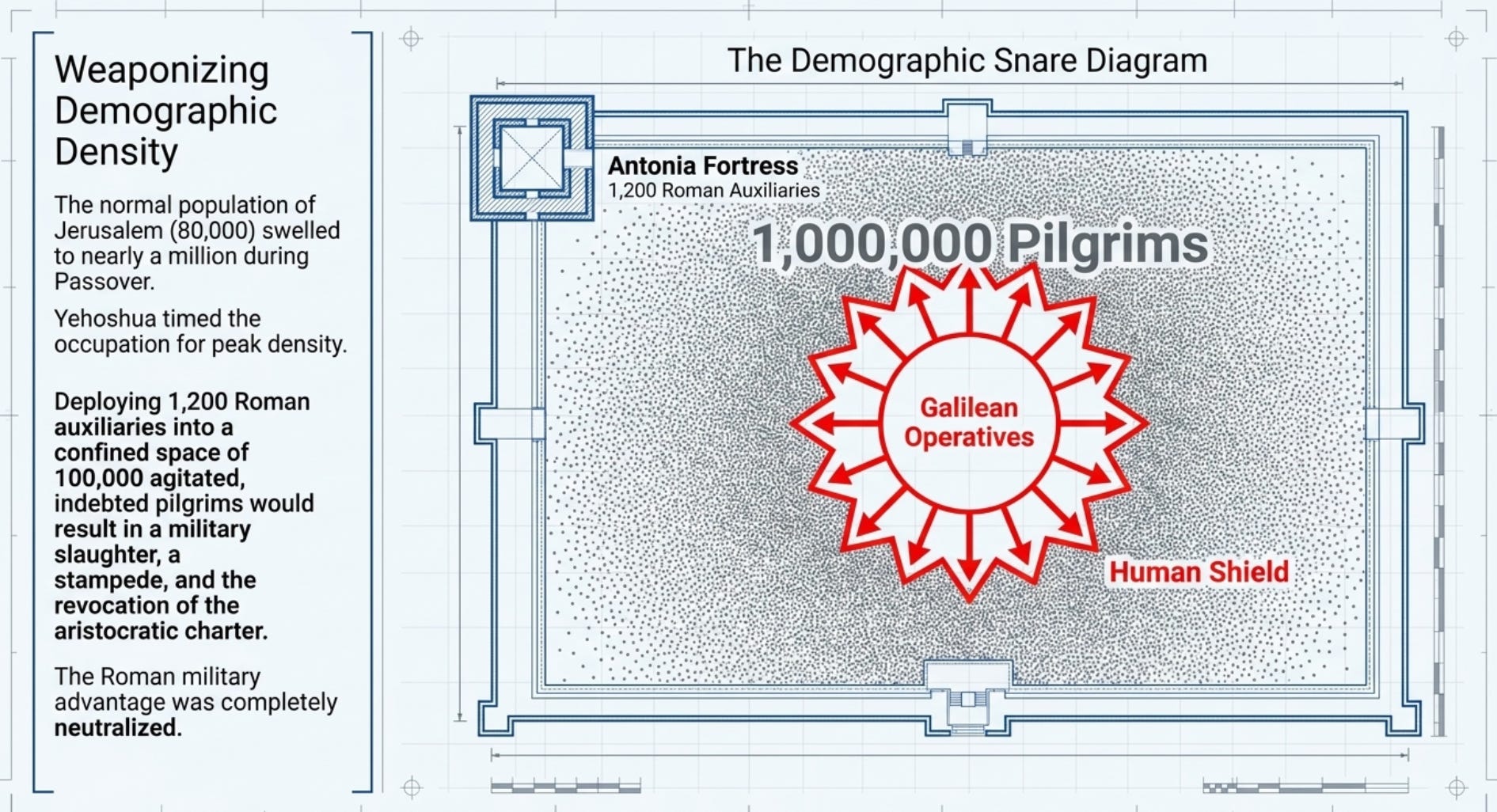
Beneath the theater lay logistics. Yehoshua had mobilized and sustained on the order of 10,000 followers in the Galilean countryside, all provisioned outside Rome’s grain dole. That number rivaled two full legions. Jerusalem at Passover was already a powder keg: a city of 40,000 swollen past 100,000, the Essene Quarter on Mount Zion buzzing a stone’s throw from the Sadducean palaces, pilgrims arriving from Alexandria and Antioch and Babylon. Yehoshua’s coordinated coalition slid into the city like a tide, indistinguishable from the festival crowd until the moment of declaration.
For one electrified afternoon, Jerusalem belonged not to Caesar, nor to the Temple aristocracy, but to the vision of a new Commonwealth.
Monday | The Strike at Commerce
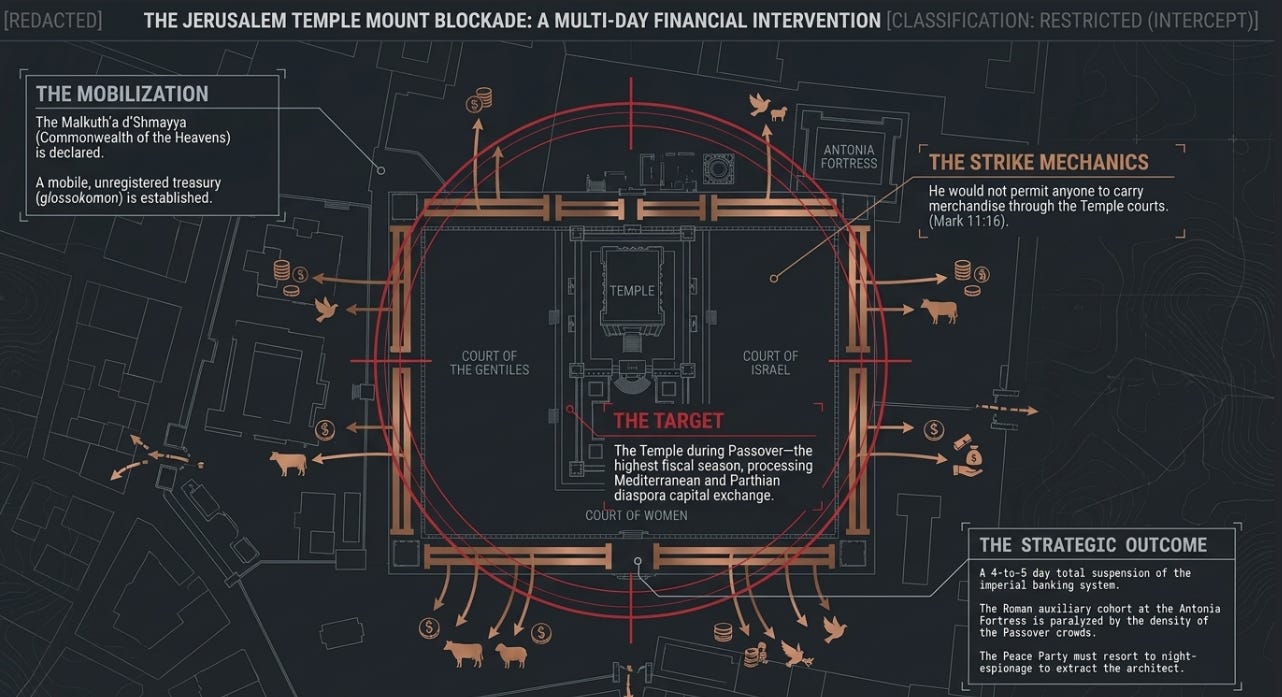
At first light, Yehoshua and his coalition pressed into the Temple courts. The Court of the Gentiles, normally a sea of noise (merchants hawking doves, currency exchangers shouting out the hour’s rates), shifted as the crowd parted.
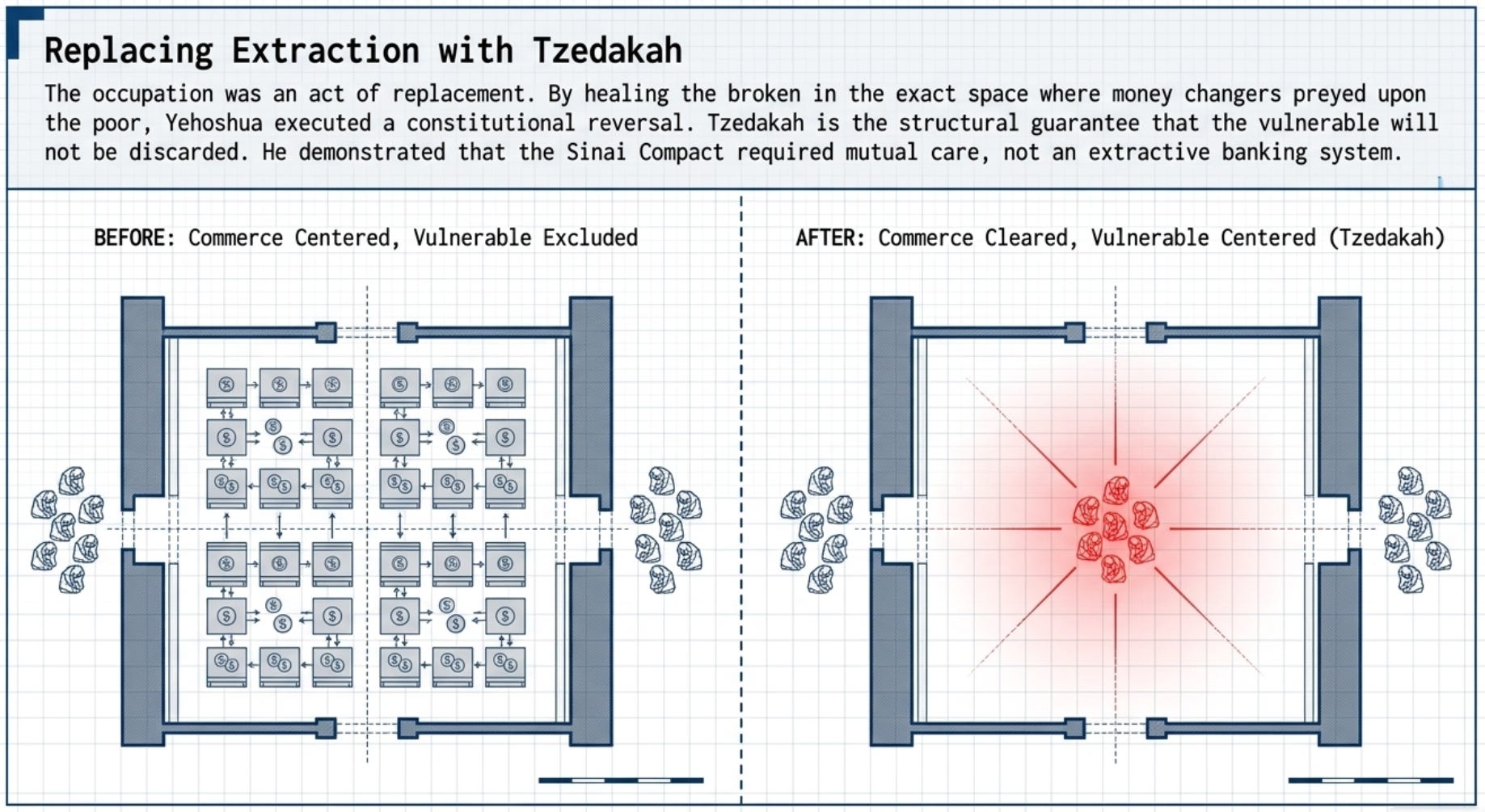
What followed was not a momentary outburst. It was a surgical strike against the financial heart of Judea. Yehoshua overturned the tables where Tyrian shekels gleamed. These were the coins legally required for offerings, the priestly cartel’s chokehold on devotion itself. Without exchange, no one could buy animals. Without animals, no sacrifices. Without sacrifices, the Temple treasury bled dry.
He shouted as he drove them out: My house shall be called a house of prayer for all peoples, but you have made it a den of robbers.
This was not anger at corruption. It was indictment of the entire extraction machine. The Temple, meant as covenantal commons (a sanctuary for liberation, a storehouse for Jubilee years, a dispensary for daily sufficiency) had been converted into Rome’s provincial mint, siphoning devotion into profit. To halt the exchanges was to halt the cash flow of the most powerful institution in the country, in the middle of its most lucrative week. A devastating general strike at the heart of the regional economic machinery.
Mark preserves a detail that matters. Yehoshua “refused to let anyone carry commercial merchandise anywhere within the Temple’s courts.” Read carefully, that sentence describes far more than a brief prophetic gesture. Preventing all commercial traffic through the outer courts required sustained physical control of the space. It required numbers.
The Antonia garrison, looking down from its towers, would have seen exactly what was happening, and chosen not to charge. They had perhaps 600 auxiliaries against a popularly-occupied Temple during the most volatile festival of the year. A frontal assault would have been suicide. Reinforcement from Ptolemais would take four to five days. Pilate dispatched runners and the clock began to tick.
Note: For the full forensic reconstruction of the Roman garrison math, the Ptolemais reinforcement window, and the logistical genius of the Passover timing, see “They Caught Rome Sleeping”.
Tuesday | Teaching in the Courts
By Tuesday the shock had settled into something more dangerous: normalcy. Yehoshua had not come and gone. He and his thousands of Hasidim were still there, embedded in the Temple courts.
The Gospels are conspicuously silent about any re-clearing of the space by authorities. Instead, they describe the priests, scribes, and elders trying to trap Yehoshua in legal debate, “but they feared the people.” This is the tell. If the establishment had cleared the courts, why keep sparring with him publicly? Why send the equivalent of a Supreme Court bench (the Adjudicators of Beit Hillel) to debate him in front of assembled crowds?
The answer is that Yehoshua had seized the stage. For the rest of the week, pilgrims arriving in Jerusalem would have seen a parallel order operating in plain view of the official one. Yehoshua teaching daily. Crowds of thousands listening. A reconstituted treasury forming, donations and alms flowing not into priestly coffers but into the common fund for the poor.
What the Synoptics call “controversies” were tactical probes. Questions about taxes, resurrection, the greatest commandment. At every turn Yehoshua outmaneuvered them.
Render unto Caesar only that which belongs to Caesar.
YHWH is not god of the dead, but of all that are living.
The greatest commandment is chesed.
Each answer was not just clever but constitutional, reaffirming his authority to interpret Covenant over and against the compromised priesthood.
The feeding miracles in Galilee had been proof-of-concept: the logistics of sustaining thousands outside Rome’s grain system. Now the system was enacted at the heart of Israel’s sanctuary. Bread and wine flowed freely. Yehoshua’s Thursday-night seder would contain no lamb. Whether because Essene-Ebionite practice excluded the lamb, or because no one could buy lambs in the disrupted markets, the symbolism cut sharp. This was a new order, rooted in covenantal sufficiency, not in priestly commerce.
The authorities’ desperation is the measure of his success. They circled, plotted, whispered of assassination. But in the courts themselves, Yehoshua moved unconcerned, teaching as if he were already the steward of a renewed Commonwealth rising from the heart of Zion.
Wednesday | Consolidation and Conspiracy
The canonical record leaves Wednesday almost blank. Silence in scripture often signals something else: events too dangerous, too politically charged, or too well known to need repeating.
By midweek, Jerusalem was combustible. The aristocracy understood the peril. A week of sustained disruption during the city’s largest festival could tip into open revolt. The Gospel note that “the chief priests and scribes sought a way to arrest him by stealth and kill him” rings with credibility here. They dared not challenge him in daylight. Only betrayal in the shadows would work. Somewhere in this swirl, Yehudah of Kerioth made his approach.
Yehoshua himself was not passive. He knew what was coming. Wednesday is the day of consolidation. The Last Supper belongs here, whether set by the Essene calendar or by anticipation of Passover. The meal is not simply farewell. It is investiture.
He breaks bread and shares wine not as tokens of mourning but as instruments of succession: the bread, sustenance shared in common; the wine, covenant poured out for the multitude; the command, do this in remembrance of me, a procedural transmission of authority. Dynastic monarchy passes through bloodline. Covenant stewardship passes through action. Yehoshua secured the movement not by enthroning a single heir but by enshrining a practice. A Common Table that would outlive the occupation, the crucifixion, and even the Temple itself.
Thursday | Betrayal and Cross
The arrest party that came for Yehoshua at Gat’Shemanim was a mixed force of Temple guards and servants, possibly with some Roman support, armed for resistance. The operation was designed to be deniable, an internal religious matter rather than a Roman action.
The rest moved fast. Interrogations before Annas and Caiaphas. Hand-off to Pilate by morning. Mockery of justice: accusations of blasphemy, claims of sedition, pressure to stamp out the problem before the crowds could organize a response. By Thursday afternoon, as lambs were being slaughtered for the Passover, Yehoshua was led outside the city gates and nailed to the cross. The timing was no coincidence. The insurgent rabbi was put to death at the same hour the lambs bled, a warning written in flesh that covenant rebellion would not be tolerated.
His followers would remember this day not only as defeat but as revelation. The bread and wine he had entrusted to them the night before became the enduring act of resistance: remembrance as reenactment, covenant handed down not by dynasty but by table fellowship and a common meal.
Note: For the Gethsemane interception, the Beit Anya safehouse, the early-warning logic of the Beit-Phaige watch position, and the Sicarian-cell reading of Yehudah’s betrayal, see “They Caught Rome Sleeping”.
The Shape of the Occupation
Reconstructed this way, Yehoshua’s final days form a coherent arc. Sunday claimed sovereignty in public. Monday struck at Temple commerce. Tuesday and Wednesday held the courts, established a rival treasury, taught the crowds, healed the sick. Wednesday night sealed the covenant succession at a common table. Thursday closed with arrest and crucifixion at the lamb-slaughter hour.
This was no tantrum, no symbolic flourish. It was an organized, multi-day regime-change attempt: a Jubilee coup carried out not with swords but with teaching, healing, and commonwealth economics.
The Stakes, and the Distortions That Followed
To see why the suppression was immediate and brutal, we have to see what the Temple actually was in 30 CE, and what its loss would have meant to the people who held it.
Why the Suppression Had to Be Fast
The Jerusalem Temple was the beating economic heart of Judea. Pilgrims brought half-shekel taxes, purchased animals for sacrifice, and exchanged foreign coins for Tyrian silver. Each day of disruption meant catastrophic losses, not only for the priestly elite but for the Roman-backed order that relied on Temple revenue as the engine of provincial stability. To halt the money-changing tables was to halt the flow of empire’s sanctioned economy.
Passover doubled the risk. No festival carried greater political weight. The feast celebrated Israel’s liberation from Pharaoh; under Roman occupation, its symbolism was combustible. Rome always reinforced its garrisons during the festival. Yehoshua’s occupation combined the memory of Exodus with the immediate reality of imperial rule, staged in the very courts where the priesthood collected Caesar’s revenue.
The popular shield was real. The Gospel refrain that the authorities “feared the crowd” was not narrative ornament. It was the central strategic reality. Arresting Yehoshua in broad daylight would have triggered the very riot Rome paid the priestly aristocracy to prevent.
The triple challenge was structural. Yehoshua’s occupation undermined the Sadducean priesthood on three fronts simultaneously. He disrupted their revenue by halting commerce and redirecting offerings. He suspended their sacrificial economy by shutting down transactions. And he usurped their interpretive authority by teaching publicly in the very courts where they ruled. If the people followed his Torah instead of theirs, their position collapsed.
Rome’s calculation was political. Pontius Pilate had a brutal record, but he was also vulnerable. His earlier violence had already provoked complaints to Vitellius in Syria; another massacre could mean recall, as it would six years later. Crucifying Yehoshua as “King of the Judahites” struck the balance Rome required: suppression decisive enough to end the threat, theatrical enough to warn other claimants, surgical enough to avoid open revolt.
The execution was political theater. Rome reserved crucifixion for rebels and slaves. Yehoshua’s death outside the city walls, at Passover, at the hour the lambs were slaughtered, was choreographed. It was Rome’s declaration that no rival sovereignty would be tolerated.
Note: For the Roman procedural frame (the licensing apparatus, the Sejanus-client reading of Pilate, the imperial management style applied to provincial religious movements), see “Who Were the Romans?”
The Zealot Parody (66-70 CE)
A generation later, Judea exploded. Zealot factions seized the Temple, expelled the Roman garrison, and suspended the sacrifices offered on behalf of Caesar. For a moment, what Yehoshua had enacted symbolically became actual. Temple commerce was halted. Roman oversight was defied.
But the resemblance ended there. The Zealots’ first act, after seizing the Temple, was to burn the debt archives stored within the priestly precincts. This was an attempted Jubilee by fire, and it was constitutionally coherent. The Temple establishment had drifted so far from the Sinai Compact’s debt-release provisions that it now housed an archive of permanent indebtedness in its own courts. Burning the archives was the right diagnosis applied by the wrong method.
What followed was fratricide. Where Yehoshua had taught and healed in the courts, the Zealots shed blood there. Josephus describes the sanctuary becoming a slaughterhouse, rival factions butchering one another inside the precincts. The three aristocratic families who had pledged grain, oil, and wood sufficient to sustain the besieged city for twenty-one years had their stockpiles burned by Sicarian-aligned factions to force the population into total commitment to the revolt. The actual consequence was mass starvation. The holy place became a fortress, its storehouses plundered, its courts defiled by executions.
Rome’s answer was Titus. The sanctuary burned in August of 70 CE. The covenantal beacon became a heap of ashes.
The parody could not have been clearer. Yehoshua had seized the same courts with nonviolence, feeding crowds at a common table and redirecting offerings into a treasury for the poor. The Zealots imitated the form but gutted it of content. As Yehoshua had warned: the Commonwealth of the Heavens suffers from violence, and violent men seize it by force.
The Bar Kokhba Distortion (132-135 CE)
A century later, Simon bar Kosiba (Bar Kokhba, “Son of the Star”) led the last great revolt. Hadrian had hinted that the Temple might be rebuilt; instead he announced plans to found Aelia Capitolina with a temple to Jupiter on the Mount. Outrage ignited.
Bar Kokhba’s forces seized Jerusalem and struck their own coins depicting the Temple façade. Rabbi Akiva declared him messiah, the star prophesied in Numbers 24:17. An independent Jewish polity was restored for three years.
But the movement was as ruthless as it was zealous. Participation was demanded; dissent was crushed. Apostolic Yahwists, the Ebyonim foremost among them, who refused to acknowledge Bar Kokhba as messiah were jailed, killed, robbed, or run out of the Land. Where Yehoshua had refused to build covenant on the sword, Bar Kokhba built nothing else.
Hadrian’s response was apocalyptic. Cassius Dio reports 580,000 dead in battle, countless more in famine and disease, fifty fortified towns and nearly a thousand villages destroyed. Survivors were sold into slavery. Judea was renamed Syria Palaestina, the Yahwistic name erased from the imperial register. Jerusalem was renamed Aelia Capitolina, and Yahwistic males were forbidden, on pain of death, from entering the city.
Bar Kokhba had seized Jerusalem as Yehoshua had, but with a sword instead of a table, with blood-and-soil nationalism instead of Jubilee Commonwealth. The result was not covenant restored but covenant shattered.
Note: For Akiva’s identification of Bar Kokhba as messiah, the rabbinic tradition’s permanent bracketing of the prophetic office that followed, and the Ebyonim refusal to participate in either revolt, see “Who Were the Rabbis?” and “Who Were the Ebionites?”
Modern Echoes
The misreading did not end in antiquity. The ethnonationalist distortion of covenant resurfaces wherever bloodline and land are absolutized at the expense of justice and mercy. To the Ebyonim, this trajectory belongs not to Yehoshua but to the Zealots and Bar Kokhba: a repetition of failed strategies that mistake covenant for conquest. Yehoshua’s Temple Action, nonviolent and covenantal, remains the template. Later violent seizures are cautionary tales, not blueprints.
The Temple as Commons
From the reforms of Hezekiah and Josiah to the rededication under Judah Maccabee, from the uprisings of Hezekiah the Zealot and Judah the Galilean to the bloody occupations of 66 and the tragic ruin of Bar Kokhba, one truth emerges: the Temple was always more than sacred architecture. It was the Covenant’s beating heart, the locus of sovereignty, the place where economy, liturgy, and identity converged. To cleanse the Temple was never a matter of tidying its courts. It was to attempt regime change, to reset the covenantal constitution itself.
Yehoshua of Nazareth stood in this lineage but also apart from it. His Temple Action was audacious and deliberate, fully continuous with the pattern of Yahwist purges, yet it bore a different character. Where Hezekiah and Josiah wielded royal decree, where Judah Maccabee wielded the sword, Yehoshua wielded Jubilee: teaching, healing, redistributing, suspending the economy of extraction at the very height of Passover. His occupation of the courts was the last true cleansing, not because it succeeded in expelling Rome, but because it revealed the Temple’s true vocation as Covenant commons.
A treasury for the poor. A house of attuning prayer for all peoples.
Rome and the priestly elite crushed the action swiftly, knowing exactly what was at stake. Yehoshua was crucified as a rebel king at the very hour the lambs were slaughtered. The cross was Rome’s answer, the only answer Rome knew how to give. Yet his movement endured, precisely because he had already transferred sovereignty from altar to table, from stone precincts to common purse.
Later generations tried to replay his precedent. The Zealots seized the Temple in 66 but turned it into a charnel house. Bar Kokhba reclaimed Jerusalem and stamped the Temple façade on his coins, but built on exclusion and militarism, his revolt ended in ruin. These were distortions of Yehoshua’s Jubilee, violent homages that missed the point. Where he declared his Commonwealth was not of this world’s order, they sought sovereignty in blood and soil, collapsing covenant into nationalism. Their failure left the Temple in ashes and Yahwism scattered.
Yet in scattering, the Covenant was not lost. Among the Ebyonim and other covenantal communities, the Temple Action lived on as template: Covenant enacted not in geography but in practice, not in dynasty but in procedure. Wherever debts are forgiven, bread is shared, bodies are healed, and neighbors gathered into common table, there the Temple is cleansed anew.
This is the revolution of Yehoshua’s life: that the Covenant of YHWH could not be confined to a priestly elite, a dynastic throne, or a sacred site. It was always meant as a living framework of justice (tzedek) and mercy (chesed) for all peoples. His occupation of the Temple was the final, public declaration of that truth, the hinge on which Yahwism turned from blood-and-soil nationalism toward a global, human march toward Jubilee.
To miss this is to miss the revolution.
To recover it is to remember that Covenant is not creed but constitution, not dogma but social technology, not walls but table.
Yehoshua’s Temple action was an insurgency of mercy: the Jubilee coup that revealed the Commonwealth of the Heavens in the courts of Jerusalem.
The Archive of the Ebyonim welcomes good-faith correspondence and even generous disagreements. Your readership is deeply valued. If this article amused you, intrigued you, or provoked new thought, please consider amplifying this post by “Liking”, “Re-Stacking”, and sharing with others. If this post left you feeling bereft, tell us in the Comments. If this essay presents as concerning or otherwise misleading, we invite you to write a response or a disputation. The Archive does not show preference for praise, nor do we paywall for access.
This is our Covenant, laid out to the Commonwealth of YHWH.
Onward unto Jubilee. For the restoration of everything to the commons of the heavens.