


Let us begin with a question that changes everything: how did a relatively obscure Galilean teacher and his followers manage to seize control of the Jerusalem Temple for nearly a week?
If you have read the canonical gospels, you already know the rough outline. Yehoshua enters Jerusalem on a donkey, crowds hailing him with palm branches. He storms into the Temple courts, overturns the tables of the money-changers, drives out the merchants, and refuses to let anyone carry goods through the sacred precincts. For the next several days, he teaches openly in the Temple, debating the scribes and Pharisees, drawing massive crowds. The authorities are furious but paralyzed. Only under cover of night, through betrayal, do they finally manage to arrest him.
Standard readings treat all of this as symbolic theater, a brief prophetic gesture followed by some memorable arguments. But something does not add up. If Yehoshua’s Temple action was merely symbolic, why did the authorities wait days to arrest him? Why conspire to seize him secretly, at night, away from the crowds? Why did the chief priests and elders repeatedly note that they “feared the people”?
The answer lies not in theology but in logistics. Understanding what happened during Passover week requires understanding the military situation in Jerusalem. Once you grasp the numbers involved, the “time gap” between Temple occupation and arrest stops looking mysterious. It starts looking inevitable.
The Limits of Roman Power in Judea
Here is what you need to know about Roman military presence in first-century Judea: there was almost none.
Picture the map of the eastern Mediterranean in the year 30 CE. Rome’s heavy legions, the backbone of imperial power, were stationed not in Judea but in Syria. The Syrian legions guarded the Euphrates frontier against the Parthian Empire, Rome’s only real rival in the east. These forces answered to the Legatus of Syria (likely Lucius Pomponius Flaccus in the relevant years), and their primary mission was external defense, not internal policing.
The distance from the Syrian garrison at Antioch to Jerusalem was roughly 350 miles through difficult terrain. A Roman legion on the march, with its baggage train, pack animals, and engineering equipment, covered perhaps fifteen to twenty miles per day under good conditions. Simple arithmetic tells the story: summoning legionary reinforcements from Syria would require three to four weeks minimum. For any emergency in Judea, the Syrian legions might as well have been on the moon.
Benjamin Isaac’s foundational study, The Limits of Empire (1992), established this reality against earlier assumptions of blanket Roman military presence. The legions did not permanently garrison Jerusalem until after the Bar Kokhba revolt in 135 CE, more than a century after Yehoshua’s execution. Before that, Judea was policed through a much lighter touch.
The Thin Purple Line: Auxilia and the Antonia Garrison
So who actually kept order in Jerusalem? The answer is a small force of auxilia: non-citizen soldiers recruited from subject peoples throughout the empire. In Judea, these auxiliary units were drawn from Syrians, Samaritans, Idumeans, and other regional populations. They were organized in cohorts of roughly 500 men each.
The primary garrison in Jerusalem was the Antonia Fortress, a massive structure built by Herod the Great at the northwest corner of the Temple Mount. Its four towers overlooked the sacred precincts, allowing Roman soldiers to monitor the crowds below. According to Josephus, the historian who would later chronicle the great revolt, the Antonia typically housed a single cohort of auxilia: 500 to 600 soldiers.
Five hundred soldiers. In a city whose normal population was perhaps 40,000, swelling to 100,000 or more during festivals. You can already see the problem.
The Roman prefect, Pontius Pilatus, did not even live in Jerusalem. He governed from Caesarea Maritima on the Mediterranean coast, where Roman supply lines and naval support were close at hand. Caesarea was a thoroughly Roman city, built by Herod with a magnificent harbor, temples to Augustus, and all the comforts of empire. Jerusalem, by contrast, was a religious tinderbox. Pilatus came to the Holy City only when necessary, primarily during the major festivals when the risk of unrest peaked.
Festival Reinforcements and the Ptolemais Staging Ground
During Passover, Pilatus would travel to Jerusalem with a personal guard and perhaps additional auxiliary troops, bringing the total Roman-aligned military presence in the city to perhaps 1,000 to 1,500 soldiers. Even with these reinforcements, Roman forces remained drastically outnumbered by the festival crowds.
The nearest substantial Roman military force was stationed at Ptolemais (modern Akko/Acre), where the Via Maris coastal road met the “Iron Road” that connected to Jerusalem through Caesarea. A detachment of Legio X Fretensis, perhaps 2,000 to 2,500 legionaries, rotated through this staging ground. They served as a rapid reaction force for emergencies in the region, positioned to respond faster than the main Syrian garrison but still requiring significant time to mobilize and march.
Consider what “rapid response” actually meant. A messenger from Jerusalem to Ptolemais, riding hard, might cover the distance in one to two days. The garrison would then need time to arm, organize, provision, and begin their march. The distance from Ptolemais to Jerusalem, roughly 80 miles through increasingly hostile territory, required another three to four days of marching. From the moment trouble erupted in Jerusalem to the moment Ptolemais reinforcements could arrive: four to five days at minimum.
Four to five days. Remember that number.
The Passover Equation
Now imagine you are a Galilean movement leader planning an action in Jerusalem. You understand Roman logistics. You know the garrison numbers. You have spent years building a network of supporters across the Galilee, Judea, Perea, and beyond. What does the strategic picture look like?
Passover was the largest pilgrimage festival of the year, commemorating the liberation from Egypt. Hundreds of thousands of Yahwists traveled to Jerusalem from across the empire: Galileans, Pereans, Judeans, diaspora pilgrims from Alexandria, Antioch, Babylon, and beyond. The roads were clogged with travelers. The city burst at its seams. Pilgrims slept in courtyards, on rooftops, in tents outside the walls.
Into this sea of humanity, a coordinated group of several thousand supporters could enter Jerusalem completely undetected. They would not march in formation or carry weapons openly. They would arrive as pilgrims, families and friends traveling together for the holy festival, indistinguishable from the hundreds of thousands of others doing the same thing. They would hide in plain sight.
The Gospel accounts hint at the scale of Yehoshua’s following. The feeding miracles describe crowds of 5,000 and 4,000 men (plus women and children), all provisioned from the movement’s own resources, independent of Roman supply chains. Whether these numbers are literal or symbolic, they indicate a mobilization capacity that would have rivaled two full Roman legions. And unlike legions, these followers could move invisibly, without baggage trains or military insignia.
The Occupation Itself
When Yehoshua entered Jerusalem, he was not leading a “triumphal entry” in any standard sense. He was executing a planned operation. The donkey procession from the Mount of Olives, with crowds laying down cloaks and palm branches, deliberately echoed prophetic imagery from Zechariah (“See, your melech comes to you, with justice and bringing restoration, lowly and riding on a donkey”). But the prophetic theater served a practical purpose: it announced the arrival and drew sympathizers to the cause.

For more information on the Temple occupation itself, click the link above.
The next day, Yehoshua moved on the Temple. The synoptic accounts describe him overturning the tables of the money-changers and driving out those who sold sacrificial animals. The gospel account written by Mark specifies a telling detail:
“On reaching Jerusalem, [Yehoshua] entered the outer courts of the Temple and began driving out those who were carrying on commerce there, both the merchants and their customers. He also knocked over the currency exchange stalls and overturned the booths of those who brokered birds for sacrifice. He then refused to let anyone carry commercial merchandise anywhere within the Temple’s courts.”
The Proclamations of Yehoshua | chapter XI, verses 15-16 | Shuva B’rit translation
edited by Ambassador Yohanan Markos (The Gospel According to Mark)
Read carefully, that sentence describes something far beyond a brief prophetic gesture. Preventing all commercial traffic through the Temple courts required sustained physical control of the space. It required numbers.
The nearby Roman garrison at Fortress Antonia [named by Herod after the patron who funded its construction, Marcus Antonius], looking down from their towers, would have seen exactly what was happening. A large, organized crowd had seized the outer courts, shut down the commercial operations that funded the Temple treasury, and established effective control of the sacred precincts.
The soldiers had two options: intervene immediately or wait. They waited.
And here is why: intervening meant charging into a crowd of thousands, possibly tens of thousands, during the most volatile festival of the year. The Antonia cohort numbered perhaps 600 soldiers. Moreover, those soldiers were part of the Roman auxilia, as opposed to being front-line legionaries. A frontal assault on a popularly-occupied Temple would have been suicide. Worse, it would have been the spark that ignited a general uprising, with the garrison trapped and encircled by a hostile population.
Roman commanders were not that stupid. They understood the mathematics of insurgency. A small force surrounded by a hostile population does not attack; it holds position and sends for reinforcements. Pilatus would have dispatched messengers to Ptolemais immediately and the four-to-five-day clock began ticking.
The Popular Shield
The synoptic gospel accounts consistently note that the authorities “feared the crowd” (Matthew 21:46, Mark 12:12, Luke 20:19). Modern readers often treat this as a minor narrative detail. In context, it was the central strategic reality.
For several days after seizing the Temple, Yehoshua taught openly in the courts. Crowds gathered to hear him. Administrative scribes from the corrupted Sadducee regime and the Adjudicators from among the Pharisees of Beit Hillel challenged him with questions about taxes, resurrection, and the greatest commandment [ha-Devarim; “Deuteronomy”]. The fraudulent “chief priests” and Elders [ha-Tzaken] demanded to know by what authority he acted. He responded with parables and counter-questions that delighted the crowds and infuriated the leadership.
All of this unfolded in public, during daylight hours, surrounded by thousands of sympathizers and curious onlookers. The Temple establishment could not simply seize Yehoshua and drag him away. Doing so would have triggered exactly the riot everyone was trying to avoid. The crowds functioned as a human shield, protecting the occupation through their sheer presence.
The aristocracy was caught in a trap. Their authority depended on maintaining order. Rome had installed them precisely to prevent situations like this. If they allowed the occupation to continue indefinitely, they would appear impotent. If they tried to end it by force and triggered a massacre, Rome would hold them responsible for the chaos.
The only option they foresaw that avoided both the uprising and the loss of control was to remove Yehoshua quietly, without sparking a broader confrontation.
The Betrayal by Night
An unexpected solution came through the ambiguous figure known as Yehudah of Kerioth (“Judas Iscariot”), one of Yehoshua’s inner circle of ambassadors. What exactly Yehudah betrayed has been debated for centuries. The most straightforward reading is that he revealed where Yehoshua could be found at night, away from the protective crowds.
The solution came through Yehudah of Kerioth, one of Yehoshua’s inner circle. What exactly Yehudah betrayed has been debated for centuries. The most straightforward reading is that he revealed not merely a location but a pattern: how, when, and by what route Yehoshua would attempt to escape.
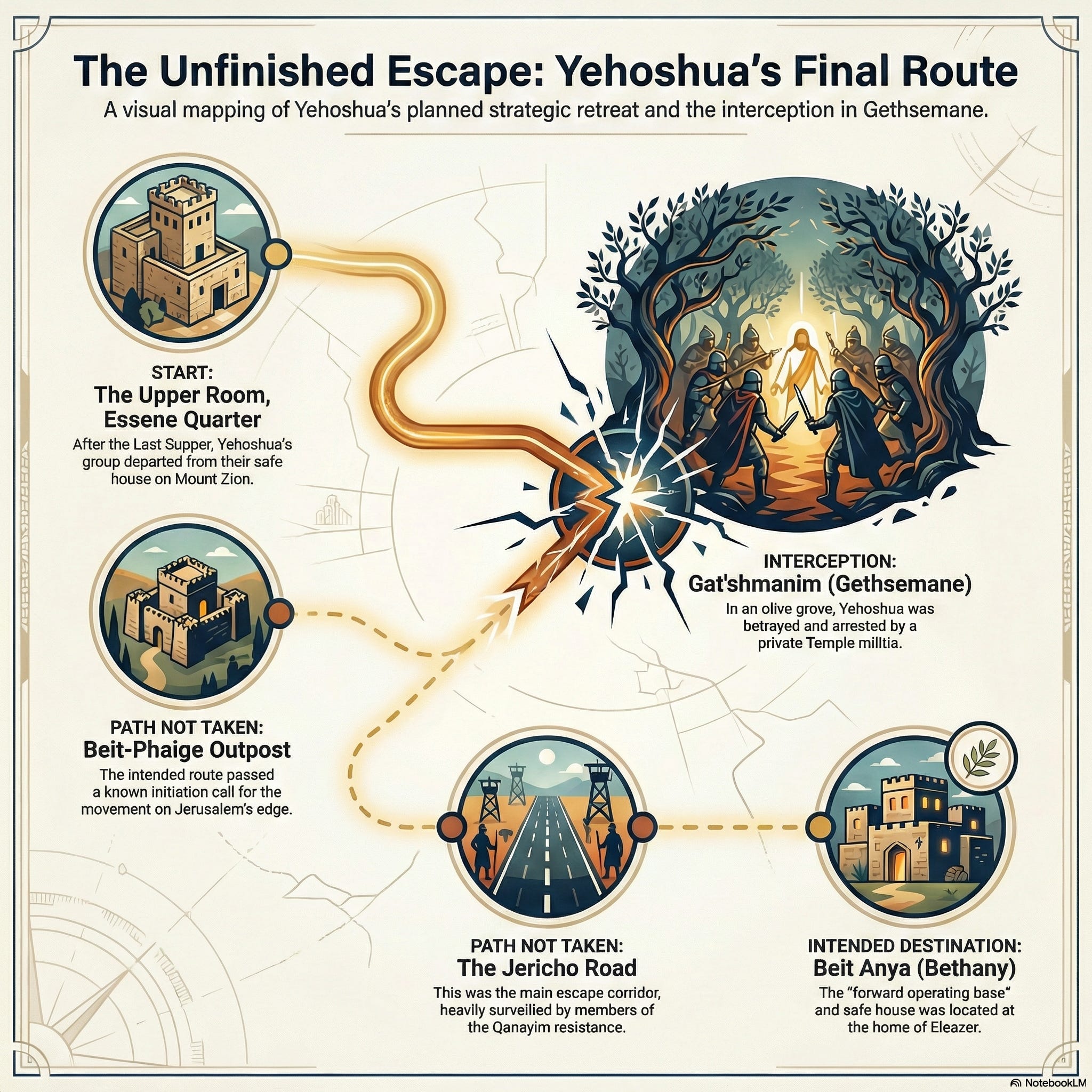
Beit Anya functioned as the movement’s forward operating base throughout the Passover operation. The village sat on the southeastern slope of the Mount of Olives, roughly two miles from Jerusalem’s eastern gates, and offered everything a resistance campaign required: trusted allies, secure shelter, and strategic geography. Eleazer, Miryam, and Marta (the siblings whom later tradition would remember through the raising narrative) were steadfast supporters who sheltered Yehoshua under protection of covenant hospitality. Any approaching band of soldiers or vigilantes would be visible long before reaching the village. The road from Jerusalem passed first through Beit-Phaige (”house of unripe figs”), a small neighborhood perched between the city walls and the Essene healing community at Beit Anya (”house of the afflicted” or “house of figs”). That intermediate position provided an early warning system: watchmen at Beit-Phaige could spot torches or troop movements and send word ahead, giving Yehoshua and his collaborators time to scatter into the Judean wilderness, as the gospel accounts indicate he had done many times before.
On the night of his arrest, Yehoshua was walking back toward this safehouse after the Passover meal when something went wrong. The synoptic accounts describe him in acute distress: sweating, anguished, falling to the ground in prayer, asking his closest followers to keep watch while he withdrew. Whether we read this as spiritual agony, the onset of poison, or the psychological weight of what he knew was coming, the text makes clear that Yehoshua did not reach Beit Anya. He stopped at Gat’Shemanim, a privately owned commercial olive orchard with its stone press, partway up the Mount of Olives. He was too ill or too overcome to continue.
Yehudah had watched Yehoshua evade arrest before. He knew the escape route. He knew the timing. He knew that once Yehoshua reached Beit Anya, extraction became nearly impossible without triggering exactly the kind of confrontation the authorities wanted to avoid. The betrayal, then, was not simply revealing a location. It was cutting off the escape at the only point where interception remained feasible: the oil press on the mountainside, in the dark hours before Yehoshua could reach the safety of his people.
The arrest party that came for Yehoshua was not the Antonia garrison. The gospels describe a mixed force sent by the chief priests and elders: Temple guards and servants, possibly supplemented by some Roman soldiers. They came “with swords and clubs” (Mark 14:43), a phrase suggesting armed civilians and Temple police rather than legionary infantry.
The operation was designed to be deniable, to avoid direct Roman involvement in what could be framed as an internal religious dispute.
Even at the moment of arrest, Yehoshua’s supporters attempted resistance. One of them drew a sword and struck the High Priest’s servant, cutting off his ear. Yehoshua stopped the violence: “Put your sword back in its place, for all who draw the sword will die by the sword” (Matthew 26:52). The moment reveals both the presence of armed followers and Yehoshua’s determination to prevent the encounter from escalating into open battle.
The Strategic Picture
Now step back and see the full picture. A coordinated movement seized the Jerusalem Temple during Passover, shutting down its commercial operations and establishing physical control of the sacred precincts. The occupation lasted approximately four to five days, from Sunday through Wednesday or Thursday night. Roman and Temple authorities were unable or unwilling to dislodge the occupiers by force, fearing the consequences of a violent confrontation. Only through stealth and betrayal, under cover of darkness, could they finally arrest the movement’s leader.
The timing is no coincidence. Four to five days was exactly the window required for reinforcements to arrive from Ptolemais.
Once those legionaries were on the march, the strategic calculus changed. Time was no longer on the occupiers’ side. The authorities needed to end the crisis before regular Roman troops arrived and turned a local embarrassment into a provincial catastrophe.
Yehoshua’s execution followed with brutal efficiency. Arrested at night, tried before the Sanhedrin at dawn, brought to Pilatus for confirmation, scourged, and crucified, all within roughly eighteen hours. The haste makes sense once you understand what was at stake. The occupation had to end, and it had to end before the situation spiraled further out of control.
What Kind of Victory?
If Yehoshua and his followers understood the military situation, and all evidence suggests they did, then what was the occupation meant to achieve? Why seize the Temple if reinforcements would inevitably arrive?
One possibility: the occupation was never intended to be permanent. Instead, it was a demonstration, a proof of concept. Yehoshua showed that an organized covenantal movement could paralyze the commercial apparatus of the Temple, humiliate the priesthood-impersonating aristocracy, and force Rome into an impossible position, all without striking a single blow. The action revealed the fragility of imperial control during festival season. It exposed how few soldiers actually stood between the people and their sacred spaces.
Another possibility: Yehoshua expected divine intervention. If he believed (as apocalyptic movements often did) that YHWH would act decisively to vindicate his cause, then the occupation was not a military gamble but an act of prophetic faith. Seize the Temple, proclaim the Commonwealth, and wait for YHWH to do the rest. Many scholars, from Albert Schweitzer onward, have read Yehoshua’s final week through this eschatological lens.
A third possibility, not mutually exclusive: the arrest and execution were themselves part of the demonstration. By dying rather than fighting, Yehoshua transformed the meaning of the confrontation. Rome and its collaborators had all the swords. They won the only way they could win, through violence and betrayal. The movement lost its leader but preserved its integrity, its message, and its claim to the moral high ground.
Whatever Yehoshua’s intentions, his followers drew a clear lesson from the events of that week. Power was more fragile than it appeared. Courage and coordination could achieve what seemed impossible. And the machinery of empire, for all its intimidating apparatus, depended ultimately on fear. Remove the fear, and the machine ground to a halt.
Conclusion: Reading with Strategic Eyes
The Passover Temple occupation makes sense only when you understand the military context. The thin auxiliary garrison, the distance of the legions, the staging ground at Ptolemais, the four-to-five-day reinforcement window: these are the facts that explain the “time gap” between seizure and arrest. Without them, the gospel accounts remain mysterious. With them, the strategic logic becomes clear.
Yehoshua caught Rome asleep. Not literally, of course. Roman authorities knew perfectly well what was happening. But they lacked the manpower to respond, and they knew it. For four or five days, the Temple belonged to the people. The money-changers were gone. The commercial apparatus was silent. A Galilean Moreh ha-Tzedek stood in the courts of YHWH and proclaimed another system, another economy, another way of becoming within the world.
The cross was Rome’s answer. It was the only answer Rome knew how to give. But the question had already been asked, in public, before witnesses. And the fact that we are discussing this question today seems to suggest that the question has outlasted Rome’s response.
Suggested Readings for Further Detail
Crossan, John Dominic, and Jonathan L. Reed. Excavating Jesus: Beneath the Stones, Behind the Texts. San Francisco: Harper San Francisco, 2001.
Horsley, Richard A. Jesus and Empire: The Kingdom of God and the New World Disorder. Minneapolis: Fortress Press, 2003.
Isaac, Benjamin H. The Limits of Empire: The Roman Army in the East. Rev. ed. Oxford: Oxford University Press, 1992.
Josephus, Flavius. The Jewish War. Translated by G. A. Williamson. Rev. ed. London: Penguin, 1981.
Sanders, E. P. Jesus and Judaism. Philadelphia: Fortress Press, 1985.
Udoh, Fabian E. To Caesar What Is Caesar’s: Tribute, Taxes, and Imperial Administration in Early Roman Palestine (63 B.C.E.–70 C.E.). Brown Judaic Studies 343. Providence, RI: Brown Judaic Studies, 2005.