


Paul of Tarsus arrived in Jerusalem in the late spring of 57 CE, carrying a collection of money he had spent four years gathering from the diaspora assemblies of Macedonia and Achaia. He went to Ya’akov ha-Tzaddik on the second day. The elders of the Jerusalem kehilla were with him. Paul reported what the Sacred Guardian had done through his ministry among the Goyim. The elders heard him out.
Then Ya’akov spoke:
You see, kinsman, how many thousands of people among the Judahites there are who have committed themselves, and they are all zealous [qana] for the Torah? They have all heard how you that you teach all the diasporic Yahwists among the uncovenanted [ha-Goyim] to abandon and denounce Moshe. They hear that you are telling them not to Covenant/circumcise their children or walk according to the instructions. So, what are we to do about this? Here is what we instruct you to do. There are four men here who are under oath and have taken a zealous vow. You will take them with you and cleanse yourself with them. You are to pay the costs of shaving their heads personally. Only then will the people understand that these rumors are just rumors, and that you yourself have submitted to the performance and observance of the Torah. [1]
Paul agreed. To be fair, he wasn’t really given an option to refuse. If he had refused, the mob would have murdered him as they had murdered Stephanos, with his own approval. He went to the Temple with the four men, completed the purification rituals, paid the expenses for the head-shaving. On the seventh day, a group of Yahwists from Anatolia, that is “Asia Minor”, recognized him in the Temple precincts and incited a mob. They accused him of bringing Goyim into the inner court, the Court of Isra’el.
The accusation was false. The crowd rioted. The Roman tribune extracted him under guard. He never spoke to the Jerusalem Assembly again.
Look at the scene clearly. The Jerusalem kehilla under Ya’akov’s leadership is described as zealous for the Torah, numbered in the thousands. The rumors about Paul’s teaching are not characterized as slander to be ignored. They are characterized as rumors that need to be publicly dispelled by ritual demonstration. Ya’akov does not tell Paul that the rumors are wrong. He tells Paul to prove they are wrong.
Notice something here: Paul agrees.
He doesn’t even attempt to defend his actions or his words. Ya’akov judged that he was guilty and ordered teshuva by tevilah [return to the Covenant through immersion and washing], the “repentance of baptism” offered by Yohanan the Immerser.
In the framing of the text, he performs the ritual, and is subsequently arrested before he can complete it. The narrative then leaves Jerusalem and follows Paul to Rome.
This fracture in Jerusalem was not simply an anomaly. It was the blueprint.
It should be worth noting that the source documenting this scene is Acts, the second half of the Lukan corpus. We will argue below that Luke-Acts is itself a position paper, produced for Roman administrative consumption, written in large part to smooth exactly this kind of friction. That even this document could not suppress the Jerusalem fracture tells you something about how deep the fracture ran. The early movement was not a single church facing outward at Rome. It was an internally contested coalition with rival authority structures, rival textual archives, and rival theories of who Yehoshua was. The gospels were not eyewitness reports of a single history. They were position papers from inside that contest, written by communities with something at stake in how Yehoshua was remembered.
This essay reads each gospel through three diagnostic windows. Which prophets the text claims as its lineage. Which rival apostles it names, attacks, or silences. What kind of Mashiach (Meshach’yah, Messiah) does it ask its audience to follow?
Run the three windows across the seven gospel traditions of the first and second centuries, and the political geography of the early movement reassembles in front of you.
The Technique and the Process
Three registers, seven gospels. In this essay we will explore three primary questions across multiple gospel traditions:
Who were the prophets? Who were the disciples? Who was Yehoshua?
The prophet question reveals what historical lineage the community is claiming. A text that opens with Yeshayahu is making a different claim than a text that severs the Hebrew prophets entirely. A text that names Jeremiah is evoking the lament tradition. A text that builds on Daniel is standing in the stream of apocalyptic-restoration. The selection of which prophetic imagery and which textual traditions to draw from is never neutral. This question provides critical analytical data to explain how the community understood Yehoshua’s place within the broader prophetic tradition.
Similarly, the question of the disciple figures themselves reveals factional alliances, rivalries, and even antagonisms. Each gospel makes choices about which members of the inner circle to include, which to elevate, which to subordinate, which to critique, and which to leave out entirely. These choices are not editorial accident. They are the rhetorical signature of a community defining itself against competitors it could not name openly without losing the argument or alienating the persuadable.
Lastly, the Yehoshua question reveals the covenantal substance that the community is trying to preserve or dissolve. A Mashiach (Meshach’yah) who is the faithful executor of the Sinai Compact is doing different work than a Mashiach who is a metaphysical incarnation, and different from the one who is the divine spark interior to the disciple. The portrait tells you what kind of campaign the community is asking its audience to join.
When we map the diagnostic results of these three windows across all seven gospel traditions, a two-dimensional picture emerges. The first axis measures Torah alignment: how faithfully each text embeds Yehoshua's campaign within the constitutional framework of the Sinai Compact, from maximum embeddedness at one end to full constitutional severance at the other. The second axis measures mystical orientation: how far each text moves from constitutional-historical praxis toward interior gnosis, cosmic mysticism, or direct personal revelation. Plotting each gospel on these two axes produces a map of the early movement's political and theological geography that no linear history can reproduce. We will return to that map. For now, the registers.
Run the three registers across seven gospel movements. Hebrew and Greek Matthew treated together as the Matthean stream, with attention to the seam where the translation event leaves fingerprints. The Petrine testimony of Mark. The Libertini-Xristianoi syntheses in Luke-Acts. The mystical and polemical Fourth Gospel. The cryptic Coptic Thomas. The devotional Gospel of Mary. The radical Pauline erasure of Marcion's gospel.
Seven communities. Seven position papers. One contested first century.
The textual chronology and the case for Hebrew Matthean priority were laid out in “The Earliest Gospel Was Never Greek.” The reconstruction of the documentary timeline appears in “What Could the Canon Look Like.”
This essay builds on the ground those two cleared. Readers who want the case for the chronology should consult those essays. The argument here is what the chronology, once accepted, lets us see.
The Gospel(s) of Matthew
The earliest gospel was not written in Greek. It was written in Hebrew, by Levi bar-Kalfai ha-Mattit’yahu (Matthew), for the kehilla ha-Ebyonim (Assembly of Dispossessed) gathered in Jerusalem under Ya’akov ha-Tzaddik (James the Just One). The patristic testimony on this point is unanimous across institutional streams that disagreed about almost everything else. Papias, Irenaeus, Origen, Eusebius, Jerome. Five witnesses across three centuries, none of them allies of the Ebyonim, all of them confirming the same sequence. [2]
The Greek Matthew is the diaspora translation, produced around 75 to 80 CE for Mediterranean assemblies that needed the Hebrew material rendered into the working language of the wider Mediterranean. It absorbed Markan structural material where useful. It preserved the logia teaching material where possible. It added the infancy narrative and the Davidic genealogy. The seam between the two editions is where the argument lives.
The Prophets
Hebrew Matthew embeds the prophets without formula citation. The Sermon on the Mount is a halakhic intensification that assumes the prophetic substrate throughout. When Yehoshua says blessed are those who hunger and thirst for tzedaqah, he is speaking into a community that hears Amos, Micah, and Isaiah in the same breath.
The text does not need to mark the citations because the audience is already reading Yehoshua within the grain of their prophetic understanding.
Greek Matthew adds the formula-citation apparatus.
Touto de holon gegonen hina plērōthē…
This took place to fulfill what was spoken by the prophet…
The phrase appears more than ten times across the gospel. Yeshayahu is cited more than any other prophet. The virgin-birth passage at Matthew 1.23 deploys the Septuagintal parthenos rendering of almah in Isaiah 7.14. The Galilean ministry is framed by Isaiah 9.1-2. The healing miracles are warranted by Isaiah 53.4. Jeremiah is named explicitly twice, once at Matthew 2.17 to explain the massacre of the innocents through Rachel’s weeping, and once at Matthew 27.9 in a composite citation that actually draws from Zechariah and is misattributed in the transmission. Hosea XI.1 explains the flight to Egypt. Micah 5.2 establishes Bethlehem as the necessary birthplace.
Isaiah and Jeremiah loom largest. The Matthean tradition leaves no major prophet unread. The selection is comprehensive because the constitutional grammar requires it.
The Figures
Mattit’yahu is the implicit author. Greek Matthew makes the self-identification explicit, naming “Matthew the tax collector” in the apostolic list at Matthew 10.3, a designation absent from Mark and Luke. Ya’akov ha-Tzaddik is present in Hebrew Matthew as the constitutional authority of the Jerusalem kehilla. The Greek translation softens this presence. He is subsumed under “his brothers” who appear at the family-conflict scenes, his constitutional role left implicit rather than named.
Kefa is elevated in Greek Matthew with the keys passage at Matthew 16.17-19, a passage absent from the parallel scenes in Mark and Luke. We would expect this transition to accompany the spread of Greek Matthew throughout the Diaspora where Kefa was most active.
You are fortunate and favored, Shimon bar-Yonah, for no organic source has revealed this understanding to you, but my Source who is in the Flourishing Always-Already. And I declare this:
You are ha-Kefa [the Stone], and on this rock I will build my Ekklesia [Assembly], and the gates of Sheol [death] will be forbidden from dissolving it.
I will give you the keys of the Commonwealth of Flourishing [Malkuth’a b’Shamayim]. Whatever you cling to here in the Earth will manifest in the Always-Already, and whatever you let go of here on Earth will be released in the Always-Already.
One note: the Archive renders Shamayim as 'Flourishing Always-Already' to recover the Hebrew sense of a dimension of reality already present, not a spatial afterlife.
The keys passage is the foundational text for what would later become the institutional Petrine succession. The Archive’s reading, supplied at length in the Kefa dossier, is that Kefa’s actual leadership was real but procedural rather than monarchical, and that the keys passage was already being read as monarchical by the time Greek Matthew was circulating to diaspora audiences.
Yohanan ben-Zavdai is present and named throughout. Toma is quiet. Miryam ha-Magdelah appears at the cross and at the tomb, named but minimally framed. The whole inner circle of the Twelve appears in their constitutional roles. Paul is absent. He is not mentioned, not alluded to, not engaged. Greek Matthew was produced by Torah-faithful Yahwists who were trying to make the original material accessible to diaspora communities without compromising it, and they did not consider the Pauline mission part of the legitimate transmission.
The Yehoshua
The Matthean Yehoshua is the covenantal teacher and the faithful executor of the Sinai Compact. Meshach’yah (Messiah) in this text is procedural anointing into a constitutional office, not metaphysical incarnation. The Sermon on the Mount is the document’s spine. Those crushed by extraction inherit the Land (ha-aretz). The merciful receive mercy. The peacemakers are called bnei ha-Elohim, the inheritors of powerful organizing forces. The Lord’s Prayer encodes Shemitah at the level of daily liturgy. Aphes hēmin ta opheilēmata hēmōn, which translates roughly to “release us from our debts as we have released those who owe us,” is technical commercial vocabulary for debt cancellation, recited daily, binding the community to the practice it was praying. [3]
The Greek edition adds the infancy narrative and the Davidic genealogy. The original community did not need genealogies because they knew the family. Ya’akov, Yoshe, Yehudah, Shimon. The brothers of Yehoshua were sitting at the table. The Greek-speaking diaspora communities did need genealogies, because messianic legitimacy in their context required a genealogical apparatus. The infancy narrative is the seam where the translation event becomes visible.
Implications
The Matthean stream is the position paper of the Jerusalem-Ebyonim coalition, working to keep the diaspora communities tethered to the constitutional substance that the original kehilla embodied. The Hebrew edition is the foundational document of the Commonwealth in operation. The Greek edition is a translation produced under pressure to prevent absorption into the Pauline orbit, retaining the constitutional material while accommodating the genealogical and christological apparatus the diaspora required. The seam between editions is exactly where the pressure is visible. Read the seam carefully and you can see the Matthean community fighting to keep the campaign within the Sinai framework while the world around it was beginning to translate the campaign into something else.
The Gospel of Mark
Mark is the field report of a fisherman. The internal evidence is consistent with the patristic claim, preserved by Papias through Eusebius, that Yohan Markos served as Kefa’s translator and recorded the substance of his itinerant preaching. The pacing is what gives it away. The narrative is built from short recollection units, compressed episodes, urgent transitions. The Greek word euthus, “immediately,” appears more than forty times in sixteen chapters. This is how a man who has worked the lake tells a story. Quickly. Vividly. With salt still clinging to his beard. [4]
The text was produced between 65 and 75 CE, after Kefa’s execution in Rome, most plausibly in Alexandria. It circulated among the federated communities Kefa had been visiting on his itinerant rounds.
The Prophets
Mark uses prophets selectively but strategically. The opening composite citation blends Malachi 3.1 and Isaiah 40.3 and attributes the entire blend to Yeshayahu, framing the campaign as the long-prophesied restoration. Daniel VII.13 anchors Yehoshua’s identity at the trial scene before the Sanhedrin:
“… you will see the Human One [Inheritor of Humanity] seated at the right hand of power, and coming with the clouds of the heavens.”
Zechariah 13.7 reframes the disciples’ coming abandonment as foretold necessity at the Last Supper:
“I will strike down the shepherd, and the sheep will be scattered.”
Isaiah and Daniel loom largest. Jeremiah is largely absent, which matters. Mark is producing an apocalyptic-restoration document, not a lament document. The community Kefa was preaching to needed the warrant of cosmic vindication, not the elegy of failed polity. The prophet selection tells you what the federated diaspora communities needed to hear.
The Figures
Kefa is the warts-and-all center of gravity.
The two-stage healing of the blind man at Bethsaida, who first sees people as walking trees and only afterward sees clearly, sits immediately before Caesarea Philippi where Kefa first names Yehoshua Mashiach and is then rebuked as ha-Satan for refusing the path of suffering. Trees walking, then painful clarity. The narrative pairing reads as Kefa’s own midrash on his own life. The storm on the lake, with the disciples panicking and Yehoshua asleep on a cushion in the stern, is the kind of story a fisherman would tell against himself. The denial in the courtyard is preserved with brutal exactness. The original ending, breaking off with the women fleeing in fear and the messenger telling them to “tell his disciples and Kefa” that he is going ahead to the Galil, leaves Kefa’s status in tragic suspense.
Yohanan and Ya’akov ben-Zavdai appear as the B’nei Ragesh, inheritors of thunder, which presents through context as ambitious, firey, and somewhat naive. They request the seats of honor in the Commonwealth. They claim they can drink the cup Yehoshua drinks. The portrait is unflattering and almost certainly preserves Kefa’s own memory of his fellow inner-circle members.
Levi appears at the tax booth. The call is immediate. He rises and follows. He hosts a great meal with tax collectors and sinners, and the meal becomes the catalyst for Yehoshua’s mission statement: “I came not to call the righteous, but sinners.”
Ya’akov ha-Tzaddik is subsumed under “his brothers” who think Yehoshua is out of his mind, at Mark 3.21. This is the most striking detail in the entire Markan figure-treatment. The brothers come to take charge of him because they think he has lost his mind. Yehoshua, when told they are outside asking for him, replies that whoever does the will of the Sacred Guardian is his brother and sister and mother. The passage almost certainly preserves an early Petrine memory that had not yet been smoothed by the post-execution reconciliation between the Galilean inner circle and the Jerusalem family. By the time Hebrew Matthew was being compiled, Ya’akov was the constitutional authority of the kehilla. By the time Mark was being compiled in Alexandria, the diaspora memory of the Galilean campaign still preserved the earlier moment when the family had not yet aligned with the campaign.
In Mark, Toma is quiet and Miryam ha-Magdelah is the chain-of-custody witness from cross to burial to tomb. She becomes the Apostle to the Apostles.
The Yehoshua
The Markan Yehoshua does not explain himself. He acts and the audience is left to infer the meaning. His teachings come in compressed parables that the disciples do not understand and that he refuses to interpret for the crowd. The "messianic secret," the repeated injunctions to silence after the healings, is not a literary device. It is the operational discipline of a campaign that knew itself to be living under imperial surveillance and Herodian collaboration. Yehoshua in Mark moves like a field commander whose communications are coded because the enemy is reading the mail.
Implications
Mark is the position paper of the Petrine federated communities of the diaspora, working to keep them oriented toward the constitutional substance after Kefa’s execution and the destruction of the Temple. The portrait of Kefa as fallible-but-restored is preparing the audience for a community that will have to navigate failure together without their founding shofet. The portrait of Ya’akov ha-Tzaddik and the brothers as initially unbelieving reflects an early Petrine memory that the later Matthean tradition would smooth and the Lukan tradition would erase entirely. Mark and Hebrew Matthew are adjacent but not identical. The Petrine and Jacobite streams were already developing distinct emphases in the years before Mark was composed, and the differences matter.
The Petrine stream remembered Yehoshua’s family as latecomers to the campaign. The Jacobite stream remembered itself as constitutional from before the beginning.
The Gospel of Luke + the Acts of the Apostles
The Lucian project arrived later than the others, around 100 to 115 CE per the Archive’s chronology, produced by a publishing collective the Archive identifies as the Collegium Lucii, organized around the figure of Lucius of Cyrene who appears in Acts 13.1 as one of the Antiochene prophets and teachers alongside Barnabas and Paul. The audience is named in the prologue: kratiste Theophile, “most excellent Theophilus,” the technical Greek title for a Roman equestrian or magistrate of investigatory rank. Lucius was writing for the Roman administrative class, producing a probatio designed to establish the movement as an ancient and legitimate philosophical school within the religio licita of Yahwism, posing no threat to the Pax Romana. [5]
The Prophets
Luke uses prophets to construct universalized moral teaching. The opening synagogue scene at Natzrat reads Isaiah 61.1-2 as the Jubilee manifesto and stakes the entire ministry on it: “the Spirit of the Sacred Guardian is upon me, because he has anointed me to proclaim good news to the poor, to proclaim release to the captives and recovering of sight to the blind, to set at liberty those who are oppressed, to proclaim the year of the Sacred Guardian’s favor.”
The Eli’yahu and Elisha cycle is deployed in the same Natzrat sermon to justify Yehoshua’s eventual rejection by his own town. Eli’yahu was sent to a widow in Tzarpat, not to widows in Isra’el. Elisha cleansed Na’aman the Syrian, not a leper of Isra’el. Luke uses the two prophets typologically to establish Yehoshua as a prophet whose mission extends to the Goyim by precedent. The move is theologically elegant and constitutionally consequential. Luke has Yehoshua himself authorize the Gentile mission through prophetic typology, before the campaign has even begun.
Jo’el 2.28-32 is deployed in Acts 2 as the structural blueprint for the Ekklesia: “in the last days, says the Sacred Guardian, I will pour out my Spirit on all flesh, and your sons and your daughters shall prophesy.”
Isaiah and the Eli’yahu/Elisha cycle loom largest. Daniel and the apocalyptic register recede. Jeremiah’s lament tradition is largely missing. Luke is producing a Hellenistic universalizing document, not an apocalyptic-restoration document. The prophet selection has been sorted by what serves the universalizing argument and what does not.
The Figures
Kefa is the pastoral penitent. The miraculous catch of fish, the depart-from-me-for-I-am-a-sinful-man response, the sifting prayer at the Last Supper (”Shimon, Shimon, ha-Satan has demanded to have you, that he might sift you like wheat, but I have prayed for you that your faith may not fail”), the silent look after the third denial, the speeches in Acts 2 and 10 that establish the Petrine line as the apostolic foundation of the Ekklesia. The Lukan Kefa is the model for subsequent church leaders. He fails, repents, is restored, and leads.
Levi appears at the great banquet, where Luke specifies that he “left everything behind.” The detail fits Luke’s broader theme that one cannot serve both the Sacred Guardian and Mammon.
Ya’akov ha-Tzaddik appears in Acts 15 as the procedural moderator at the Council of Jerusalem. His actual constitutional authority is diminished into chairmanship. He delivers the closing summary that becomes the Apostolic Decree, but the framing presents him as a consensus-builder rather than the constitutional head of the Jerusalem kehilla the patristic tradition independently confirms him to have been.
Yohanan ben-Zavdai is repositioned as Kefa’s apostolic partner. Luke specifically pairs them as the two sent to prepare the Passover meal. They are the executive team in the early chapters of Acts. The Boanerges portrait in Mark, with the request for honor seats, is softened into companionship.
Toma is quiet. Miryam ha-Magdelah is domesticated. Luke alone supplies the backstory at Luke 8.2-3, naming her as a woman from whom seven demons had gone out, and listing her among the women, including Yohana and Shoshana, who provided for the campaign “out of their resources.” She is the healed patroness, the wealthy benefactor. At the empty tomb, when she and the other women report what they have seen, the male disciples dismiss their words as leros, the Greek term for the babbling of a fevered mind. The Lukan Miryam is the financial supporter whose witness, when it counts, is institutionally rejected.
Paul is rehabilitated as the harmonious co-laborer with Jerusalem he never actually was. The bitter conflict documented raw in Paul’s own letter to the Galatians becomes in Acts a series of resolved disputes and warm reunions. The break with Yosef bar-Nabba is recontextualized as a personality clash over the reliability of Yohan Markos. The Council of Jerusalem becomes a harmonious gathering. Paul’s repeated trials before Roman magistrates consistently end with the verdict that he has done nothing worthy of imperial concern.
The Yehoshua
The Lukan Yehoshua is the universalized prophet of the Jubilee. The Magnificat sounds the Jubilee notes loudly in chapter one, with Miryam praising the Sacred Guardian who has scattered the proud, brought down the powerful, lifted up the lowly, filled the hungry, and sent the rich away empty. The parables of the Prodigal Son, the Good Samaritan, and the Rich Man and Lazarus intensify the Jubilee economic vision. This material is among the most economically radical in the entire gospel corpus.
But the framing has shifted. The constitutional substance is presented as universal moral teaching rather than as covenantal practice. The Roman authorities are softened. The Pilate of Luke is reluctant, almost sympathetic. The centurion at the cross declares Yehoshua dikaios, “righteous.” The constitutional posture is being adjusted for an audience that needs to be reassured the movement is not seditious.
Implications
Luke-Acts is the position paper of the urban-accommodationist wing, the Syndicate of the Freedmen, working to render the movement legible to Roman imperial administration. The smoothing of the Pauline conflict is not editorial accident. It is the actual purpose of the document. The figures most reduced are the figures whose constitutional authority would have been embarrassing to the synthesis the Lucian college was building. Ya’akov ha-Tzaddik loses his constitutional weight. Miryam ha-Magdelah loses her commission. Paul gains a sanitized history. The Jubilee material is preserved on the page while the constitutional framework around it is dissolved into universal ethical vision. The trajectory of this synthesis leads through Constantine.
The Fourth Gospel
The Yohananim corpus arrived around 95 to 98 CE per the timeline, from the community in Asia Minor that had gathered around the elderly Yohanan ben-Zavdai, with Polykarpos of Smyrna serving as amanuensis - an interpreter and scribe. The text is doing something none of the other canonical gospels are doing. It is writing back against a world that has already absorbed Pauline categories, and it is using Hellenistic vocabulary to do so. [6]
The Prophets
The Fourth Gospel deploys prophets to frame Yehoshua as the replacement for Temple, feast, and sacrifice. Isaiah 53 is cited at John 12.38-40 to explain why the people did not believe despite the signs. The “they will look on him whom they have pierced” passage from Zechariah 12.10 anchors the crucifixion at John 19.37. The Passover-lamb requirements from Shemot XII and Bemidbar IX are alluded to at John 19.36, framing Yehoshua as the ultimate Paschal sacrifice whose bones are not broken.
Moshe is treated as a prophet whose writings testify to Yehoshua. John 5.46: “if you believed Moshe, you would believe me, for he wrote about me.” The Yohananim text uses prophets to anchor the cosmic-and-intimate Yehoshua inside the Devar YHWH tradition that runs from creation through Sinai through the prophets and returns in the campaign of Yehoshua himself.
Isaiah looms largest, with Zechariah and Moshe as supporting voices. The minor prophets recede. Daniel is surprisingly muted given the apocalyptic register that runs through the rest of the Yohananim corpus, particularly the Apocalypse. The selection has been sorted by what serves the replacement-typology argument. Yohanan is using the prophets to demonstrate that everything the Temple, the feasts, and the sacrificial system pointed toward is now accomplished in the campaign of Yehoshua.
The Figures
The Beloved Disciple is at the structural center. He outruns Kefa to the tomb at John 20.4. He sees and believes first, before Kefa enters. He stands at the cross when Kefa flees. He receives Yehoshua’s mother into his household at the moment of execution, which is a constitutional act of family transfer with covenantal weight. The Archive’s reading affirms the identification of the Beloved Disciple with Yohanan ben-Zavdai, with the textual production mediated through Polykarpos.
Kefa is honored but subordinated throughout. The race to the tomb has the Beloved seeing first while Kefa enters first, a careful balance of insight and office. The foot-washing at John 13 has Kefa over-correcting from his initial refusal (”not my feet only, but my hands and my head”), showing him as the disciple who struggles to understand the inverted-economy logic Yehoshua is enacting. The threefold restoration on the shore of the Galilee at John 21 undoes the three denials with the question “do you love me,” and ends with Kefa being told to focus on his own path rather than asking what will happen to the Beloved.
The Yohananim treatment of Kefa is gentle. It is also a correction.
Toma is honored with the post-resurrection scene at John 20.24-29. His demand to see the wounds and put his finger in the side is welcomed, not condemned. Yehoshua appears specifically to satisfy the demand. The Yohananim Toma refuses to detach belief from material reality. He is the constitutional opposite of his later Coptic capture, where Toma is the didymos who has direct unmediated access without need of evidence.
Miryam ha-Magdelah is fully restored as the Apostola Apostolorum. The garden dialogue at John 20.11-18 preserves an extraordinary intimacy. She stands weeping at the tomb. She does not recognize Yehoshua until he says one word: “Miryam.” Her response, Rabbouni, is a deeply personal student-teacher bond that transcends the institutional group. He commissions her to go to “my brothers” and tell them he is ascending. She is the primary link between the risen Yehoshua and the Ekklesia. The Fourth Gospel is the only canonical text that supplies this commissioning intact.
Despite these individuals and texts being known to John and Polykarpos at the time of writing these texts, Paul is absent. Luke is absent. Acts is absent. No Pauline letter is cited. Across the entire Yohananim corpus, the Gospel and the three epistles and the Apocalypse, this silence is total and strategic. The First Epistle of Yohanan makes the diagnosis explicit at I John 2.18-19: “many antichrists have appeared. They went out from us, but they were not really part of us. If they had been part of us, they would have stayed with us.” The Apocalypse extends the diagnosis to the imperial economy itself. No one buys or sells without the mark. The merchants weep when Rome’s markets fall because their traffic in human beings has been interrupted. A theology that blesses participation in guild banquets and idol-sourced markets under the rubric of “knowledge” becomes, in Yohananim eyes, an accomplice of the Beast. [7]
The Yehoshua
The Yohananim Yehoshua is the cosmic and intimate Mashiach who is the Logos. The opening at John I.1 is the first signal: “in the beginning was the Logos, and the Logos was with the Sacred Guardian, and the Logos was the Sacred Guardian.” To a Greek ear shaped by Stoic and Platonic talk of the Logos as rational ordering principle, this sounds like a metaphysical hymn. To a Yahwist ear, steeped in Bereishit and the prophets and the Wisdom literature, it is something else entirely. It is a compressed retelling of the creation account, of Sinai, of the Devar YHWH that calls light out of chaos and speaks the Covenant into being and returns in the prophets as a sword of justice. Yohanan is doing strategic translation work. He is taking the Greek vocabulary that Paul’s Gentile communities were already using and slipping it back inside a Yahwist grammar where the Word and the Covenant are the same Voice.
The “I am” sayings, egō eimi, echo the divine self-naming at the burning bush and bind Yehoshua’s identity to the Sinai signature-event. He is the bread, the light, the door, the way, the vine, the resurrection. The Temple economy is purged at the beginning of the campaign rather than the end. The signs press the Torah’s claims more deeply into the physical world, not less.
Implications
The Fourth Gospel is the position paper of the Yohananim community of Asia Minor, fighting a two-front war. Against the Pauline lieutenants whose pastoral letters were already shaping the second-generation assemblies. Against Timothy, Titus, Onesimus, and the institutional structures their letters established. The Fourth Gospel does not name Paul because Paul is not the live target. The live target is the apparatus Paul's lieutenants built after his execution. Against the synagogue authorities whose Birkat ha-Minim expulsions of the 80s and 90s have pushed the movement out of its native institutional home. The Yohananim solution: use the Greek vocabulary the Pauline communities are speaking, but bend it back into Yahwist grammar. Promote the figures the Pauline letters have minimized, Miryam and Toma, to constitutional weight. Subordinate the figure, Kefa, whose office had become the institutional rallying point of the post-Pauline orthodox synthesis. Refuse to acknowledge Paul at all, anywhere, ever. The result is the most sophisticated document in the canon: a custodial counter-strike disguised as a metaphysical hymn.
The Gospel of Thomas
The Gospel of Thomas survives in a complete Coptic translation recovered from Nag Hammadi in 1945, and in three Greek fragments from Oxyrhynchus dated to the late second or early third century. It consists of 114 logia attributed to Yehoshua, with minimal narrative framing. The Coptic recension was preserved by communities in fourth-century Egypt who had reframed earlier material through the speculative cosmologies the Archive identifies as the late Gnostic synthesis.
The wisdom-sayings substrate is Yahwistic in origin, traceable through Q-parallel material to the same general environment that produced Hebrew Matthew. The custodial overlay is Gnostic. The two have to be distinguished. [8]
The Prophets
The Hebrew prophets are explicitly rejected. Logion 52 is the diagnostic passage:
The disciples said to him: “Twenty-four prophets spoke in Israel, and all of them spoke about you.” He said to them: “You have dismissed the living one who is before you, and you have spoken about the dead.”
The prophets are dead. The only living prophecy is the internal discovery of the light. No Isaiah. No Jeremiah. No Daniel. No Eli’yahu. No Jo’el. The entire Hebrew prophetic tradition is severed in a single saying. Logion 53 extends the severance to ritual circumcision, framing it as a practice without spiritual transformation. The Coptic Thomas has detached from the constitutional framework that the Sinai Compact established and the prophets defended.
The Figures
Toma is at the structural center as the didymos who has direct unmediated access to the Living Yehoshua. Logion 13 stages the rivalry explicitly. Yehoshua asks the disciples to compare him to someone. Kefa says he is like a righteous angel. Mattit’yahu says he is like a wise philosopher. Toma says he is beyond any comparison. Yehoshua then takes Toma aside and gives him three secret words. When Toma returns, the other disciples ask what was said. He refuses to tell them, saying that if he told them, they would pick up stones and throw them at him, and fire would come out of the stones and burn them.
Kefa is the literalist who does not understand. Mattit’yahu is the philosopher who categorizes when he should be experiencing. Both answers are insufficient. Only Toma is admitted to the inner revelation.
Ya’akov ha-Tzaddik receives the cryptic Logion 12:
The disciples said to Yehoshua:
“We know that you will depart from us. Who is to be our leader?”
Yehoshua said to them: “Wherever you have come, you are to go to Ya’akov ha-Tzaddik, for whose sake heaven and earth came into being.”
This passage is doing remarkable work. It preserves what almost certainly is genuine Ebyonim memory of the Jerusalem succession, embedded inside a Gnostic codex whose other content has dissolved the constitutional framework Ya’akov was built to defend. The seam is visible. The Egyptian custodians who preserved the text included Logion 12 because it was already in the substrate they received, without fully understanding what the constitutional weight of the passage actually meant. The Coptic Thomas preserves earlier Ebyonim layers that the custodians did not entirely recognize. [9]
Miryam ha-Magdelah appears at Logion 114, the famous and contested ending:
Shimon Kefa said to them:
“Let Miryam leave us, for women are not worthy of life.”
Yehoshua said:
“I myself shall lead her in order to make her as a man, so that she too may become a living spirit, resembling you men. For every woman who will behave as if they are men will enter the Malkuth of the heavens.”
The Gnostic spiritual-wholeness language is interiorizing. It defends Miryam’s place inside the inner circle, but at the cost of dissolving her gendered constitutional authority into a metaphor for spiritual transcendence. The defense is real. The architecture is dissolving.
Paul is absent. Yohanan is absent. The figures present have been sorted by what serves the wisdom-tradition argument and what does not.
The Yehoshua
The Thomasine Yehoshua is the wisdom teacher whose true identity is the divine spark interior to the disciple. Logion 70:
“If you bring forth what is within you, what you bring forth will save you. If you do not bring forth what is within you, what you do not bring forth will destroy you.”
The constitutional framework has been dissolved into individual gnosis. Yehoshua is no longer the faithful executor of the Sinai Compact. He is the catalyst for the disciple’s interior recognition of the light already within.
Implications
The Coptic Thomas is the position paper of the Egyptian Gnostic communities of the third and fourth centuries, who preserved an earlier wisdom-sayings collection inside their own speculative frame. The substrate is Yahwistic. The overlay has dissolved the Sinai grammar. When the algorithm of “interior gnosis transcends external structures” is run forward, it produces communities with no mechanism for redistribution, debt release, or constitutional accountability.
The historical Indian Nasrani who actually carried the Toma tradition through the Silk Road and the Malabar coast did not run this algorithm. They carried the Peshitta and the Acts of Thomas in Syriac, embedded in covenantal communities that practiced communal property, debt forgiveness, and Torah-faithful liturgy until the Portuguese arrival in 1599. The Coptic text is a custodial accident. Logion 12 preserves the seam where the earlier Ebyonim layer is still visible inside the later Gnostic frame, and the seam tells you that the custodians had access to material older and richer than what they themselves understood. [10]
The Gospel of Mary
The Gospel of Mary survives in a single fifth-century Coptic codex, the Berlin Codex, with two Greek fragments providing parallels. The original composition is generally dated to the second century, though the traditions it preserves are older. The text is short. The first six pages of the codex are missing. What survives opens with a teaching dialogue between Yehoshua and the disciples about the nature of matter, sin, and the inward path. Yehoshua then departs. The disciples are afraid. They weep. They wonder how they can go to the Goyim and proclaim the Malkuth when he the Revered One himself was not spared. [11]
The Prophets
The Hebrew prophets are ignored entirely. The “Son of Man” appears at Mary IV.3, but as something that exists within the believer rather than as the apocalyptic figure of Daniel:
“Let the Inheritor of Humanity be within you, and follow him; those who seek him will find him.”
No Isaiah. No Jeremiah. No prophets cited. The text replaces external prophetic warrant with internal vision. Miryam’s authority comes from her access to private teaching from Yehoshua, not from her position within a prophetic lineage.
The absence is structurally significant. A text that derives authority from internal vision rather than from prophetic lineage is doing different work than a text that grafts itself into the Hebrew constitutional tradition. The Magdalene community is making an authority claim that bypasses the lineage entirely.
The Figures
Miryam ha-Magdelah is at the structural center as the visionary teacher who steadies the collapsed disciples. She rises among them and speaks: “do not weep and grieve and be in two minds. His grace will be with you and will protect you. He has prepared us, he has made us truly human.” The text presents her as the calm authoritative voice while the male disciples have collapsed.
Kefa asks her to share the words of the Reverend that she remembers and they do not know, “for you know him better than the rest of women.” She agrees and recounts a teaching she received in private vision: a discourse on the soul’s ascent past the powers, the exousiai, that attempt to bind it.
The factional flashpoint comes when she finishes. Andrew refuses to believe the Reverend would have given private teaching the rest of them did not receive. Kefa goes further:
“Did he really speak with a woman without our knowledge, and not openly? Are we to turn around and all listen to her? Did he prefer her to us?”
Miryam weeps. Levi defends her:
If the Reverend made her worthy, who are you indeed to reject her? Surely the Reverend knew her very well. That is why he loved her more than us.
Levi instructs the disciples to stop disputing and to go and proclaim what they have received. The text breaks off shortly after.
The factional alignment is sharp. Kefa and Andrew on one side. Miryam and Levi on the other. Mattit’yahu silent. The rest of the Twelve effectively neutralized. Yohanan and Toma absent. Paul absent.
The Yehoshua
The Magdalene Yehoshua is the visionary teacher who entrusts esoteric revelation to a woman and validates inward ascent over institutional office. The substrate is recognizably Yahwistic in the moral framework, the overlay introduces Gnostic ascent-of-the-soul material. The figure who emerges is closer to the Toma Yehoshua than to the Matthean or Petrine Yehoshua. He is the catalyst for inward awakening rather than the faithful executor of the Sinai Compact.
Implications
The Gospel of Mary is the position paper of the Magdalene-honoring communities of the second century, preserving the memory of Miryam’s leadership against the rising tide of institutional male succession claims that the Petrine line was beginning to consolidate. The text amplifies a real first-century friction, Kefa’s unease at Miryam’s closeness to Yehoshua, into second-century factional polemic, and uses Levi as the bridge figure who legitimizes the Magdalene authority by reference to what the kehilla actually saw. The substrate preserves the constitutional substance of women’s leadership in the original campaign. The overlay introduces interiorization that does not quite hold the Sinai framework. The Magdalene community was correct that women’s authority had been suppressed. They were also already drifting toward the dissolution that the Coptic Thomas would complete.
The Marcionite Gospel
Marcion of Sinope arrived in Rome around 140 CE, bearing what he described as the only uncorrupted gospel in circulation. He excommunicated himself from the Roman assembly in 144 CE by excommunicating the Roman assembly from himself. The document he produced, the Evangelikon, was a stripped version of Luke from which every Hebrew prophetic citation, every genealogical reference, every nativity detail, and every suggestion that the God of Yehoshua was the same being as the God of Moshe had been systematically removed. He offered it to the Roman assembly as the original text, prior to the corruption of the Judaizers. They were not persuaded. His excommunication stood. His canon, however, forced the proto-orthodox establishment to produce their own, and the canonical New Testament we have now is, in its final shape, a response to what Marcion started. [12]
The Prophets
Total erasure. Where Greek Matthew accumulates formula citations to legitimate Yehoshua within the Sinai tradition, Marcion’s text removed every one. Where Luke opens with the Natzrat synagogue scene in which Yehoshua reads from Yeshayahu and stakes his entire ministry on the Jubilee manifesto, Marcion’s Evangelikon opened with Yehoshua’s appearance in Capernaum, not in a synagogue, not reading from a scroll, not fulfilling anything. He simply arrived.
This is not neglect, so much as it is a precise surgical removal.
Marcion read the Hebrew prophets carefully enough to conclude that they were speaking for the wrong god. The creator-deity of the Bereshit and Shemot tradition was, in his analysis, a just but vengeful lower deity, the Demiurge, who fashioned the material world and bound humanity to it through covenant obligations. The Father of Yehoshua was an entirely different being: the Unknown God, a god of pure love, alien to the created order and unknown to Moshe, who sent his emissary to purchase humanity’s freedom from the Creator’s just claims.
The Hebrew prophets, in this reading, were speaking genuine prophecy. They were just speaking for the Demiurge, not for the Father. Everything they predicted about a Davidic king, a restored Israel, a covenantal polity, came true in its own terms. It simply had nothing to do with Yehoshua.
This is the most radical position on the prophet axis in the entire map. Not absence, not indifference, not spiritualized reinterpretation. Active theological severance.
The Figures
To this tradition, Paul is the only representative whose transmission of the gospel has not been corrupted. Marcion built his entire Apostolikon, ten Pauline letters, as the authoritative archive of the movement’s actual doctrine. The Twelve are not elevated, subordinated, or silenced. They are invalidated. In Marcion’s analysis, the Twelve, led by Kefa, had capitulated to the Judaizers and produced a version of the gospel that retrofitted Yehoshua into the Demiurge’s messianic scheme. His primary evidence: Paul’s letter to the Galatians, specifically the Antioch incident at Galatians 2.11-14, where Paul publicly confronts Kefa for hypocrisy.
Ya’akov ha-Tzaddik, whose constitutional authority over the Jerusalem kehilla Hebrew Matthew treats as foundational, does not appear in Marcion’s archive. The Jerusalem assembly is the problem, not the solution. Yohanan ben-Zavdai, Levi, Miryam ha-Magdelah: absent. The figure of the Beloved Disciple, whom the Fourth Gospel positions as the custodian of authentic witness, has no place in Marcion’s framework because the Fourth Gospel itself was not yet in his archive when he assembled it.
Paul alone carries the tradition. And the Paul of Marcion’s archive has been filtered through the same lens that produced the Evangelikon: anti-Judaizing, Torah-hostile passages amplified, with Torah-compatible passages either minimized or explained away.
The Yehoshua
The Marcionite Xristos is the Alien Savior. Not the Jewish Mashiach. Not the son of the Creator-God. Not descended from David, or from Abraham, or from Adam. He appeared in Capernaum in the fifteenth year of the Emperor Tiberius as the emissary of the Unknown Father, clothed in something like a human body but not born of a woman, not subject to the Creator’s law, not obligated to the Sinai Compact in any sense. His execution was not a covenantal restoration act. It was a cosmic transaction: the Unknown Father paid the Creator-God’s just claim against humanity in order to free those who responded to the offer.
There is no nativity. There is no genealogy. There is no baptism by Yohanan ha-Matbil, because Yohanan ha-Matbil was the prophet of the Demiurge’s forerunner, and Yehoshua had no need of any such preparation. There is no temptation in the wilderness, because the Creator’s adversary has no jurisdiction over the Unknown Father’s emissary. There is a crucifixion and, depending on which Marcionite sources you follow, something like a resurrection, though the physical body was not
Yehoshua’s true substance and its fate was therefore not the point.
Implications
Marcion is the position paper that exposes what Luke-Acts was hiding.
Luke presents a Pauline mission deferring to Jerusalem authority, a Paul who pays for Nazarite vows in the Temple, a Paul whose trials before Roman magistrates end in the consistent verdict that he has done nothing wrong. Marcion presents what the Pauline mission looked like without that Lukan frame. The Paul of Galatians would not yield to the Jerusalem leaders for so much as an hour. He declared that an angel from heaven preaching a different gospel should be accursed. He described his own pre-campaign Torah observance as excrement. This Paul, the one by his own hand, is closer to the Marcionite archive than to the Lukan portrait.
The fact that Marcion assembled the first canon is itself a structural argument. He did it because the Pauline letters and the Evangelikon were the only texts he recognized as authoritative. The proto-orthodox establishment was forced to respond by assembling a counter-canon, and that counter-canon included Hebrew Matthew’s Greek translation, the Petrine testimony of Mark, the reconciling Lukan corpus, and the Yohananim counter-strike, along with the letters the Pauline tradition attributed to Kefa and Ya’akov and Yohanan. The New Testament is the shape of the Marcionite challenge. It was assembled to answer him.
The Libertini-Xristianoi trajectory that the Archive traces from the Synagogue of the Freedmen through the Pauline assemblies reaches its logical terminus in Marcion. Hebrew Matthew’s editors were already doing preemptive architecture against this trajectory. Marcion simply took the trajectory further than they anticipated anyone would. He was wrong about Yehoshua. He was right about what the Pauline project, followed to its conclusion, would eventually require.
The Map
Step back from the seven gospel movements and the political geography of the first and second centuries reassembles in front of you.
The Matthean stream is the position paper of the Jerusalem-Ebyonim coalition. Maximum embeddedness in the Sinai framework. The constitutional substance is operative at every level, legal, economic, liturgical, communal. The Hebrew edition is the foundational document of the Commonwealth. The Greek edition is a translation under pressure to prevent absorption into the Pauline orbit.
The Markan stream is the Petrine federated communities of the diaspora, working to keep them oriented after the destruction of the Temple. Adjacent to the Matthean stream but not identical. The Petrine memory of the family as latecomers has not yet been smoothed.
The Lucian stream is the urban-accommodationist synthesis, working to render the movement legible to Roman administration. The smoothing operations are extensive. The Pauline conflict is sanitized. Ya’akov ha-Tzaddik loses his constitutional weight. Miryam ha-Magdelah loses her commission. The Jubilee material is preserved on the page and dissolved in the framing. The trajectory leads through Constantine.
The Yohananim stream is the custodial counter-strike against Pauline absorption. Greek vocabulary bent back into Yahwist grammar. The figures the Pauline letters minimized, Miryam and Toma, promoted to constitutional weight. The figure whose office had become the post-Pauline rallying point, Kefa, subordinated. Paul refused acknowledgment entirely.
The Coptic Thomas is the Egyptian Gnostic capture of an earlier wisdom-sayings substrate. The Hebrew prophets severed. The constitutional framework dissolved into interior gnosis. The Logion 12 reference to Ya’akov is the seam where the earlier Ebyonim layer is still visible inside the later Gnostic frame.
The Magdalene Mary is the constitutional defense of women’s leadership against the consolidating Petrine line. The factional combat is staged explicitly. Kefa-and-Andrew versus Miryam-and-Levi. The substrate preserves the suppressed authority. The overlay drifts toward the dissolution.
The Marcionite stream is the radical Pauline terminus. The Hebrew prophets severed by theological argument rather than spiritual indifference. The Twelve invalidated rather than merely subordinated. The Xristos detached from every material and covenantal anchor. Marcion is the mirror that shows Luke-Acts what it was protecting against. Where Luke-Acts contains the Pauline trajectory within a Petrine and Jacobite frame, Marcion releases it from all frames entirely. The canonical project that followed was built, in part, to ensure that his release did not hold.
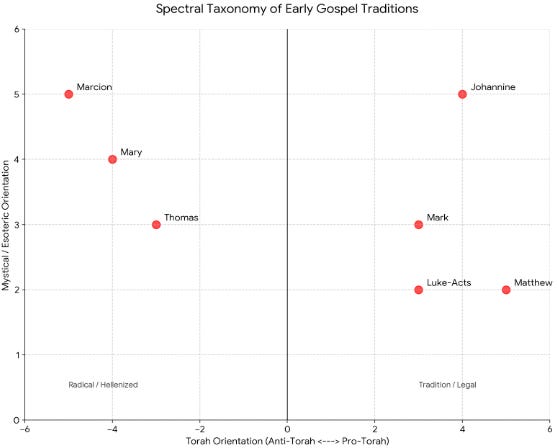
What the map reveals, when you read the gospels as factional position papers rather than as parallel witnesses, is what Paul was up against. He was not preaching into a vacuum. He was competing with an authorized textual tradition carried by ambassadors who had walked with Yehoshua. The aggression of the Pauline letters becomes legible as the rhetorical signature of an operative whose institutional standing had been pulled. The claim of independent revelation, the attacks on the “super-apostles” and the “false apostles,” the constant dismissal of “another gospel,” none of this rhetoric makes structural sense as a response to a textual vacuum. It makes sense only as a response to a textual tradition that was already authoritative in the communities Paul was trying to reach.
The canonical four gospels are not parallel witnesses to a single history. Three of the canonical gospels are working to defend or smooth Pauline standing within the constitutional framework. One is working to deny Paul without naming him. And the text we know as Marcion's Evangelikon is working to complete what Paul started, which is precisely why the other four had to form a canon to contain it.
Reorientation
The reader who has walked through these seven movements may now ask the obvious question. If the gospels are factional position papers, how does the reader choose which one to follow?
The answer, drawing on the Yahwist Liberation Hermeneutic developed by Brandy Mitchell, is that the question is the wrong question. The texts are not equally probative witnesses to a single reality. They are differently positioned witnesses to a contested one, and the test of any witness is the consequence it produces in the world. A succession framework that generates communities practicing material solidarity passes the test. One that generates communities compatible with imperial extraction fails, regardless of how theologically sophisticated it may be.
Run that test. Hebrew Matthew produced the Ebyonim, who held everything in common, who fed the dispossessed, who undercut the Temple’s patron-client extraction, who prayed Shemitah at the rhythm of daily recitation. Mark produced the federated Petrine communities of the Mediterranean diaspora that preserved the memory of the campaign in operative form. Greek Matthew preserved the constitutional substance for diaspora audiences before the broader Ekklesia was captured. The Fourth Gospel produced the Yohananim communities of Asia Minor that maintained the Covenant’s material teeth into the second century, generating the lineage that ran from Yohanan through Polykarpos to Irenaeus.
Luke-Acts produced something different. The communities that received Luke-Acts as their foundation narrative were the proto-orthodox assemblies that would become the imperial church. The Jubilee material was preserved on the page and dissolved in the practice. The trajectory leads through Constantine.
The Coptic Thomas produced the Egyptian and Syrian Gnostic communities that completed the dissolution. The historical Indian Nasrani of the Malabar coast, who carried the Toma tradition in its Syriac form, preserved the Covenant for sixteen centuries until the Portuguese arrived in 1599 to demand they conform.
The Gospel of Mary produced the Magdalene-honoring communities of the second and third centuries, preserving the memory of women’s constitutional authority against the rising tide of institutional male succession. Their voice was suppressed. The texts were buried. They were recovered in the twentieth century, and the recovery is part of what makes the polyphony audible again now.
Marcion produced the Gnostic and Docetist communities that denied the humanity of Yehoshua entirely, communities for which the material body, the material world, and the material Sinai Compact were cosmological errors rather than the site of the Sacred Guardian's redemptive work. His trajectory produced the first canon and forced the production of the second. The Catholic New Testament is the shape of his challenge made permanent.
The diagnostic is therefore clear. Read the texts as they actually are: position papers from inside a constitutional civil war, written by communities that had something at stake in how Yehoshua was remembered, fighting over which version of his campaign would carry forward. Trace the algorithms. Follow them to the ledger. The Yehoshua who emerges from the textual cluster closest to his family, his villages, his Covenant, and his constitutional substance is the Yehoshua who actually walked the Galilean roads. The Yehoshuas who emerge from texts further out on the spectrum are reflections, refractions, sometimes distortions, sometimes counter-strikes against distortion. They are all worth reading. They are not all equally close to the man himself.
The polyphony, heard as polyphony, returns the reader to the historical figure with more precision than the harmonized chorus ever could. The fact that seven communities remembered him seven different ways tells us he was a man large enough to leave seven different impressions, written by communities that had been positioned differently in relation to the Covenant he was trying to restore.
Paul of Tarsus arrived in Jerusalem in the late spring of 57 CE, carrying a collection of money and a controversy that had already split the movement into two camps that could not be reconciled by ritual. Ya’akov ha-Tzaddik knew it. Kefa knew it. Yohanan knew it. The brothers of Yehoshua knew it. The kehilla zealous for the Torah knew it. The civil war was already underway when Paul climbed the Temple Mount, and it has been underway ever since. The polyphony you have just walked through is the war's documentary record. Read it as the record.
Read accordingly.
The Archive of the Ebyonim welcomes good-faith correspondence and even generous disagreements. Your readership is deeply valued. If this article amused you, intrigued you, or provoked new thought, please consider amplifying this post by “Liking”, “Re-Stacking”, and sharing with others. If this post left you feeling bereft, tell us in the Comments. If this essay presents as concerning or otherwise misleading, we invite you to write a response or a disputation. The Archive does not show preference for praise, nor do we paywall for access.
This is our Covenant, laid out to the Commonwealth of YHWH.
Onward unto Jubilee. For the restoration of everything to the commons of the heavens.
Notes for the Nerds
[1] Acts 21.20-24, Shuva B’rit rendering. The Jerusalem scene is documented in Acts 21.17-36 with subsequent material running through Paul’s transfer to Caesarea at Acts 23.23-35. On the Nazarite vow procedure in question, see Bemidbar 6.13-21. On the historical context of Paul’s collection and his arrival in Jerusalem, see the Sha’ul dossier in the Archive, and Bruce Longenecker, Remember the Poor: Paul, Poverty, and the Greco-Roman World (Grand Rapids: Eerdmans, 2010), 135-179.
[2] Eusebius, Historia Ecclesiastica 3.39.16, preserving Papias; Irenaeus, Adversus Haereses 3.1.1; Origen, in Eusebius, HE 6.25.3-6; Jerome, De Viris Illustribus 3 and Commentariorum in Matthaeum prologue. The full case for Hebrew Matthean priority is laid out in The Earliest Gospel Was Never Greek in the Archive. For comprehensive review of patristic testimony, see James R. Edwards, The Hebrew Gospel and the Development of the Synoptic Tradition (Grand Rapids: Eerdmans, 2009), 1-95; and Petri Luomanen, Recovering Jewish-Christian Sects and Gospels (Leiden: Brill, 2012).
[3] On aphesis as technical commercial vocabulary for debt cancellation, see Michael Hudson, ...and forgive them their debts: Lending, Foreclosure and Redemption from Bronze Age Finance to the Jubilee Year (Dresden: Islet, 2018), 1-30; and David Graeber, Debt: The First 5,000 Years (New York: Melville House, 2011), 73-90.
[4] On Kefa as Mark’s source, see Eusebius, HE 3.39.15, preserving Papias; Irenaeus, Adv. Haer. 3.1.1; Justin Martyr, Dialogue with Trypho 106.3. For the internal evidence of Markan urgency, see Robert H. Gundry, Mark: A Commentary on His Apology for the Cross, 2 vols. (Grand Rapids: Eerdmans, 1993). On the Ya’akov ha-Tzaddik “his brothers” passage at Mark 3.21, see John Painter, Just James: The Brother of Jesus in History and Tradition, 2nd ed. (Columbia: University of South Carolina Press, 2004), 11-41.
[5] On the identification of Lucius of Cyrene with the author of Luke-Acts, see John Wenham, “The Identification of Luke,” Evangelical Quarterly 63 (1991): 3-44; the Archive’s Collegium Lucii essay; and the late dating evidence in Richard Pervo, Dating Acts: Between the Evangelists and the Apologists (Santa Rosa: Polebridge, 2006), 149-199. On the technical force of kratistos in Roman administrative usage, see Stephen Mason, Josephus and the New Testament, 2nd ed. (Peabody: Hendrickson, 2003), 251-295.
[6] On the Yohananim community, see Raymond Brown, The Community of the Beloved Disciple (New York: Paulist, 1979); and John Ashton, Understanding the Fourth Gospel, rev. ed. (Oxford: Oxford University Press, 2007). On Polykarpos’s role as amanuensis, see Charles E. Hill, The Johannine Corpus in the Early Church (Oxford: Oxford University Press, 2004), 13-94. On the Birkat ha-Minim expulsions, see Daniel Boyarin, Border Lines: The Partition of Judaeo-Christianity (Philadelphia: University of Pennsylvania Press, 2004), 64-86.
[7] First Epistle of Yohanan 2.18-19; Apocalypse 13.17, 18.11-13. For the Yohananim corpus as integrated counter-strike against Pauline absorption, see the Archive’s Beit Hillel dossier and Sha’ul dossier.
[8] On the textual history of Thomas, see Stephen J. Patterson, The Gospel of Thomas and Jesus (Sonoma: Polebridge, 1993); April D. DeConick, Recovering the Original Gospel of Thomas: A History of the Gospel and Its Growth (London: T&T Clark, 2005); and Stevan L. Davies, The Gospel of Thomas and Christian Wisdom, 2nd ed. (Oregon House: Bardic Press, 2005). On the Q-Thomas relationship and the wisdom-tradition substrate, see John S. Kloppenborg, The Formation of Q: Trajectories in Ancient Wisdom Collections (Philadelphia: Fortress, 1987).
[9] Gospel of Thomas logion 12 in the Coptic recension. For the text and translation, see Thomas O. Lambdin’s translation in James M. Robinson, ed., The Nag Hammadi Library in English, 4th rev. ed. (Leiden: Brill, 1996), 124-138. On Logion 12 as preserving early Ebyonim succession memory inside the Gnostic frame, see Wilhelm Pratscher, Der Herrenbruder Jakobus und die Jakobustradition (Göttingen: Vandenhoeck & Ruprecht, 1987), 151-171.
[10] On the Syriac transmission line through Edessa and the Indian Nasrani, see Sebastian Brock, The Hidden Pearl: The Syrian Orthodox Church and Its Ancient Aramaic Heritage, 3 vols. (Rome: Trans World Film Italia, 2001); and the Archive’s Who Were the Thomasines? essay. On the Portuguese-led Synod of Diamper of 1599, see Susan Visvanathan, The Christians of Kerala: History, Belief, and Ritual Among the Yakoba (Oxford: Oxford University Press, 1993), 24-55.
[11] Gospel of Mary 5:1-10:10 in the Berlin Codex (BG 8502). For the text, see Karen L. King, The Gospel of Mary of Magdala: Jesus and the First Woman Apostle (Santa Rosa: Polebridge, 2003); and Christopher Tuckett, The Gospel of Mary (Oxford: Oxford University Press, 2007). On the historical Petrine-Magdalene rivalry as a real first-century friction amplified into second-century polemic, see Ann Graham Brock, Mary Magdalene, the First Apostle: The Struggle for Authority, Harvard Theological Studies 51 (Cambridge: Harvard University Press, 2003); and the Kefa dossier in the Archive.
[12] On Marcion's Evangelikon and Apostolikon, see Judith M. Lieu, Marcion and the Making of a Heretic: God and Scripture in the Second Century (Cambridge: Cambridge University Press, 2015); and Sebastian Moll, The Arch-Heretic Marcion, WUNT 250 (Tübingen: Mohr Siebeck, 2010). On Marcion's role in forcing the canonical project, see John Barton, A History of the Bible: The Book and Its Faiths (London: Allen Lane, 2019), 244-263; and Joseph Tyson, Marcion and Luke-Acts: A Defining Struggle (Columbia: University of South Carolina Press, 2006).
I've not finished the article, but have a question: why do you refer to Common Era (CE) instead of Anno Domini (the year of the Lord)?
I read the other day, that Constantine gets converted by reading Virgil, and it brings to mind the capacity of missionaries to work with what was in front of them