


Before the infant can speak the word “mine,” the grammar has already spoken through her. The child born into the twenty-first century inherits not a neutral vocabulary but a liturgy of extraction, a catechism written in receipts and terms of service, a gospel proclaimed through loyalty points and credit scores. This is no metaphor: the grammar that turns living things into commodities precedes our consciousness of it, shapes our desires before we can name them, colonizes our imagination before we know we have one to defend.
The Yahwistic prophets knew this linguistic violence. When Hosea denounced Israel’s harlotry with Baal, he was not condemning private sexual ethics but public economic theology—the worship of ba’al, “owner” or “master,” the deity of possession and productivity. The Israelites had adopted not just Canaanite gods but Canaanite grammar: the language that transforms Covenant (b’rit) into contract, gift (matanah) into commodity (rekush), and relationship (yachas) into transaction (miqach).
We are born into Baal’s dictionary. The air—ruach, the same word used for Spirit and breath—becomes a market for carbon credits. The river—nahar, which flows through Eden and Ezekiel’s vision of restoration—becomes an input in production calculations. The body—basar, flesh that the Word became to dwell among us—becomes a ledger of wages earned and debts owed. This commodification grammar is so total, so ubiquitous, that it feels like nature itself rather than what it truly is: a constructed language that can be deconstructed, a liturgy that can be replaced with another.
The Nazarene’s Counter-Grammar
Then into this grammar-cage steps Yehoshua bar-Yosef, the Nazarene, onto what locals called derekh ha-dam—the Blood Road, that seventeen-mile descent from Jerusalem’s Temple heights to Jericho’s date palm groves. This was no random path for teaching. It was an economic diagram drawn in geography, a supply chain made visible by elevation: at the summit, the Temple treasury (the largest financial institution in first-century Palestine, collecting tithes that Josephus estimated at 10 million denarii annually); at the base, Herodian estates where tenant farmers harvested balsam worth its weight in silver while never tasting the profits of their own sweat.
Between these two poles of extraction—sacred and secular, religious and royal—traveled the covenant people, stripped not primarily by bandits but by the taxation systems of both powers. The Greek word used in the parable, ekduo, means “to strip naked, to skin, to flay”—the same term used for priests removing hides from sacrificial animals. The bandits simply made visible what the system did legally: the reduction of human beings to extractable value.
Into this corridor of economic necessity comes the Samaritan—the Shomroni, despised keeper of an alternative Torah who worshiped on the wrong mountain. He sees what the priest and Levite calculated past: a body that is also a nefesh, a living soul. The oil and wine he pours are not mere first aid but shemen and yayin—sacred substances used in Temple ritual and royal coronation, now offered to the profaned and abandoned. His two denarii represent two days’ wages for a common laborer, but the phrase “whatever more you spend” (ho ti an prosdapanēsēs) creates something unprecedented: an open-ended credit line without collateral, a Covenant without contract, a mercy that cannot be calculated because it refuses the grammar of accounting.
This is not moral instruction about being kind. This is economic insurgency. The Samaritan drafts an innkeeper—likely himself economically marginal—into a new financial arrangement that makes mercy structurally possible. He creates, in that moment, an institution: a sanctuary economy operating by different rules than the Blood Road’s logic of extraction.
Yehoshua answers the Adjudicator’s question “Who is my neighbor?” by refusing its grammar outright. The Adjudicator asks tis, seeking a category, a boundary, a limit to liability. Yehoshua answers with poieō—with doing, with making, with becoming. Neighbor is not noun but verb, not status but practice, not identity but action. Ho poiēsas to eleos, “the one who performed mercifulness [hesed]”—this doing is what constitutes the neighbor. The economy of neighborliness exists wherever someone stops when the algorithm says keep moving, pays when the spreadsheet says withhold, promises when the contract says limit liability.
This is the counter-grammar Yehoshua speaks with his life: there is an economy on the other side of money. Not an economy without exchange or coordination, but one where the fundamental unit is not the coin but the Covenant, not the contract but the Table, not the transaction but the testimony.
Reclaiming B’rit: Covenant as Infrastructure

When the earliest friends of that Nazarene gathered after Pentecost, they did not answer his teaching with doctrine. They answered with logistics. Acts 2:44-45 records: “All who believed were together and had all things common (hapanta koina), and they were selling their possessions (ta ktēmata) and goods (tas huparxeis), distributing them to all as anyone had need (kathoti an tis chreian eichen).”
This is constitutional language, not sentiment. The phrase “as anyone had need” echoes Deuteronomy 15:8’s command about lending: “You shall open wide your hand (patoach tiftach) to your fellow, to the needy and to the dispossessed in your land.” The Jerusalem assembly was not inventing new ethics but implementing old ones—specifically, the sabbatical and Jubilee legislation that Torah embeds as economic operating system.
To speak credibly of decommodification in our century requires recovering a vocabulary older than capitalism’s gods, and that vocabulary is b’rit—Covenant.

Not covenant as interior feeling or personal relationship with deity, but covenant as material infrastructure, as constitutional framework for organizing community life. The word itself derives from a root meaning “to cut” (barah), recalling the ancient ritual where covenant-makers would cut animals in two and walk between the pieces (Genesis 15), saying in effect: “May I be thus torn if I break this bond.”
Covenant is bilateral, binding, and bloody-serious. It is not a feeling you refresh on Sundays but a structural commitment you build around. When YHWH cuts Covenant with Abraham, the promise includes specific land boundaries, population projections, and economic arrangements (Genesis 15:18-21). When Moses mediates Covenant at Sinai, it includes architectural specifications for sanctuary, social and personal hygiene laws, agricultural cycles, debt release schedules, and property rights limitations (Exodus 19, Numbers 10). This is infrastructure you can walk around in.
The Jubilee provisions in Leviticus 25 are not spiritual ideals but economic code: “The land shall not be sold in perpetuity (la-tsmitut), for the land is mine; you are but strangers (gerim) and sojourners (toshavim) with me” (Lev 25:23). The Hebrew tsmitut suggests utter finality, complete severance—exactly what is forbidden. Land cannot be commodified permanently because it belongs to YHWH; humans can only lease it, use it, steward it. Every fiftieth year, the ledger resets. Debts cancel. The enslaved are freed. Property returns. This is not charity appended to religion; this is economic constitution integrated with theological vision.
Contemporary examples demonstrate Covenant’s material power: Community Land Trusts remove land from speculative markets through legal mechanisms—nonprofit ownership, ground-lease covenants, resale restrictions—that make housing permanently affordable. Worker cooperatives restructure ownership so that those who labor govern enterprise, implementing the “common purse” model where earnings become common provision subject to democratic allocation. Time banks create alternative currencies measuring hours rather than dollars, establishing what the parable calls “mercy credit”—reciprocity beyond monetary exchange. These are not metaphors for covenant; they are Covenant made concrete, b’rit as infrastructure.
The Covenant includes Sabbath as operating system feature, not bug. Every seventh day, production ceases—not as personal spiritual practice but as economic reset that prevents accumulation advantage from compounding infinitely. The Hebrew shabbat derives from shavat, to cease, desist, rest. It is the period at the end of the sentence of creation, the pause that prevents work from becoming slavery. When combined with sabbatical-year debt release (every seventh year) and Jubilee redistribution (every fiftieth year), Sabbath creates a ratcheting mechanism against permanent underclass formation.
Empire calls this waste, fraud, abuse—the efficiency experts’ liturgy of accusation. Heaven calls it Jubilee, yovel, from the ram’s horn blast that announces liberation. The same word appears in Leviticus 25:10, the verse inscribed on the Liberty Bell: “Proclaim liberty (deror) throughout the land to all its inhabitants.” That deror is emancipation language, used for releasing slaves and canceling bondage. Covenant economy is freedom infrastructure.
The Blood Road as Economic Diagram
The Jerusalem-to-Jericho road functions in Yehoshua’s parable as more than geographical setting; it is hermeneutical key. Understanding this path’s political economy unlocks the parable’s radical critique of extraction systems, both sacred and secular.
At the apex stands the Temple complex on Mount Moriah, rebuilt by Herod the Great over forty-six years (John 2:20) as both devotional center and financial engine. Josephus records that the Temple treasury held vast reserves—gifts from diaspora communities, tithes from Judean agriculture, half-shekel taxes from every adult male, revenues from money-changing and sacrificial animal sales (Jewish War 6.282). This was ancient Jerusalem’s central bank, controlling capital flows throughout the region.
The priestly aristocracy—primarily Sadducees—managed these operations. Their families monopolized the High Priesthood through Roman appointment, a system that rewarded collaboration and ensured theological compliance. When Yehoshua overturns money-changers’ tables (Matthew 21:12-13), he disrupts not peripheral commerce but core Temple operations. The Greek word trapeza means both “table” and “bank”—he’s attacking financial infrastructure, not ritual purity violations.
At the opposite pole, seventeen miles and 3,600 feet lower, lie Herod’s winter palace estates and the date palm and balsam groves of the Jericho plain. Pliny the Elder describes Jericho’s balsam as among the most valuable commodities in the world (Natural History 12.111-123). Yet the wealth flowed upward—to Herodian coffers, to Roman tribute, to absentee landowners. The actual cultivators remained landless tenants, agricultural workers in a system that turned Covenant land (nachalah, inherited portion) into imperial plantation.
Between these extraction poles, the road descends through the wilderness of Judea—rocky, waterless, perfect terrain for listai, the bandits mentioned in the parable. But who were these bandits? The Greek lēstēs carries connotations beyond common thievery. Josephus uses this exact term for Zealot revolutionaries, for insurgents resisting Roman occupation, for displaced farmers turned guerrilla fighters (Antiquities 20.160-172). The same word describes Barabbas in John 18:40.
These were not random criminals but economic refugees, men stripped by taxation systems before they stripped others. Josephus records that by mid-first century, debt bondage was so pervasive that many fled to wilderness regions, surviving through banditry and hoping for revolutionary change. The steep taxation—Roman tribute, Herodian levies, Temple tithes, priestly assessments—could easily exceed 40% of agricultural output. Small freeholders lost land, became tenant farmers, then fled when they could no longer pay rent.
So when the parable says a man “was going down from Jerusalem to Jericho and fell among robbers (lēstais) who stripped him (ekdusan) and beat him (plēgas epithentes) and departed, leaving him half-dead (hēmithanē),” we must hear the economic poetry. He was already being stripped by the systems at both ends of the road. The bandits made visible and violent what the institutions did legally and slowly.
Now comes the priest—hiereus, one who serves at the altar. He “saw (idon) him and passed by (antiparēlthen) on the opposite side.” The verb antiparēlthen means to go past on the other side, suggesting deliberate avoidance. Why? Not cruelty but calculation. Priestly purity laws (Leviticus 21:1-3) forbade contact with corpses outside immediate family. If the wounded man died during rescue, the priest would be defiled for seven days, unable to serve Temple duties, forfeiting that week’s priestly allotment from sacrifices.
The Levite faces identical calculus. Lower in Temple hierarchy, he has even less margin for ritual error. Both religious professionals perform economic cost-benefit analysis: the potential loss (seven days’ income, seven days’ status) exceeds the duty to rescue. The system has taught them, efficiently and thoroughly, that compassion costs more than it pays. Looking away has better returns than stopping.
This is not personal moral failure but systemic logic. The Temple economy—with its stratified priesthood, its purity requirements, its commodification of sacrifice, its monetization of righteousness—has transformed mercy from Covenant obligation into expensive luxury. The very institution meant to embody YHWH’s covenant has become mechanism for enforcing extraction.
Then comes the Samaritan, Samaritēs, member of the despised schismatic sect. Everything about his identity signifies uncleanliness in Judean eyes—wrong temple (Gerizim not Zion), wrong text (Samaritan Torah variant), wrong ancestry (mixed blood from Assyrian resettlement). Yet he “was moved with compassion (esplagchnisthē),” literally “felt it in his guts,” the same verb used of YHWH’s maternal mercy.
His actions create alternative economy: elthon, coming near (vs. passing by); katedēsen, binding wounds; epicheas, pouring on (that expensive oil and wine); epibibasas, mounting him on his own beast (giving up his mobility); ēnenken, bringing him to the inn; epimelēthē, caring for him through the night. Each verb is economic action, resource allocation, embodied decommodification.
The two dēnaria (denarii) equal two days’ wages for day-laborers working Herodian estates—the very laborers at the bottom of the extraction chain. But more radical still: ho ti an prosdapanēsēs, “whatever more you spend.” The subjunctive mood indicates open-ended futurity. The verb prosdapanaō means to spend in addition, to pay beyond—suggesting expenditure without limit until healing completes. This is covenant credit: “I will repay (egō apodōsō)” creates personal guarantee without collateral requirement.
The Samaritan drafts the innkeeper—pandocheus, keeper of the all-receiving house—into Covenant relation. The innkeeper becomes node in mercy network, steward of open-ended credit, administrator of grace. This is institution-building: creating economic infrastructure where care proceeds without payment at point of need, where trust rather than contract governs exchange, where abundance consciousness replaces scarcity logic.
The First Table: Ebyonim Economics
When we say “de-commodify,” we do not mean romantic retreat to pre-monetary simplicity. Hunter-gatherer bands and village gift economies remain vulnerable to conquest by more complex systems. We mean something more sophisticated: the deliberate dismantling of logics that turn relation into rent, combined with building institutions robust enough to resist re-commodification.
The Jerusalem assembly under Ya’akov ha-Tzaddik (Jacob “James” the Just) demonstrates this sophistication. They were not abandoning complexity but redirecting it. The community described in Acts 2-6 operated sophisticated mechanisms:
Common Treasury (koinos chreō): Not merely sharing meals but pooling assets, maintaining collective reserves, coordinating distributions. Acts 4:32 specifies: “No one said that any of the things (tōn huparchontōn autō) that belonged to him was his own (idion), but they had everything in common (koina).” The Greek idios suggests private, particular, separate—what is cordoned off. Covenant economy makes resources koina—common, shared, accessible.
Needs-Based Distribution (diemerizeto de hekastō kathoti an tis chreian eichen): Acts 2:45 establishes the principle that distribution follows need, not contribution or merit. This implements Deuteronomy 15:4’s Jubilee promise: “There will be no poor (evyon) among you.” The term evyon (Ebyon, Ebionite) becomes the community’s own designation: the Dispossessed Ones, those who voluntarily entered economic vulnerability through redistribution.
Debt Remission as Liturgy: The Lord’s Prayer’s petition “forgive (aphes) us our debts (ta opheilēmata) as we also have forgiven (aphēkamen) our debtors (tois opheiletais)” (Matthew 6:12) intentionally uses financial vocabulary. The verb aphiēmi means release, cancel, let go—technical terminology for debt forgiveness. This is not metaphor spiritualized but liturgical commitment to fiscal action. Every prayer service becomes debt jubilee ceremony.
Healing as Public Service: Acts 3-5 records multiple healing accounts without payment mechanism. When Kefa heals the beggar at Beautiful Gate (Acts 3:1-10), no exchange of silver occurs—explicit contrast to what the beggar expected and what Temple economy demanded. Healing becomes diakonia, public service, Commonwealth provision. The word therapeuō, to heal, shares root with therapeia, service or care—suggesting healing as form of service rather than commodity.
City-Wide Safety Net: Acts 6:1-6 reveals the scale: enough widows that daily food distribution required appointing seven diakonoi (deacons, servants) to administer it. This is municipal-level poverty relief, running on trust (pistis) rather than tribute (phoros). When complaint arises that Hellenist widows are being neglected, the response is structural—increase administrative capacity—not ideological denial of responsibility.
The enemies of this movement called them Ebyonim, the Dispossessed. They wore the insult as identity, even as later badge of honor. Hegesippus, quoted by Eusebius, preserves the memory: the relatives of Yehoshua were called to account by Domitian as descendants of David, but when they showed their calloused hands from agricultural labor and revealed their tiny landholdings (thirty-nine acres between them), the emperor dismissed them as harmless peasants (Eusebius, Church History 3.20). They had chosen dispossession.
The doorframe of that Covenant—to borrow language from the First Letter of John—is just wide enough for the frail (asthenēs) to pass through. The Greek asthenēs means weak, feeble, without strength—precisely those whom imperial economics excludes. Covenant architecture designs for the most vulnerable, making their passage the measuring standard. This inverts empire’s logic, where infrastructure serves power’s convenience.
They were not founding a religion, The Record insists. They were building an economy that made the Temple’s business model unnecessary—and therefore threatened both Temple authorities and Rome’s client-state arrangements. When James was martyred in 62 CE (according to Josephus, Antiquities 20.200), the charge was economic: proclaiming Jubilee debt release that undermined both Temple tribute and Roman taxation. His death was political assassination of economic threat.
The Living Archive of Resistance
Every empire proclaims the same theodicy of inevitability: “It cannot work. People are selfish. Debt is natural. Hierarchy is efficient. There is no alternative.” This is not analysis but liturgy, the creed of extraction recited until it calcifies into common sense. Yet history answers like water through limestone—slowly, persistently, carving channels through seemingly solid doctrine until the whole edifice collapses into truth’s aquifer.
The Essenes answered by constructing counter-Temple infrastructure that ran on common treasury and time discipline rather than sacrifice commodification. At Qumran, where the Dead Sea’s salt-heavy air preserved their constitutional documents, they built what the Community Rule (1QS) calls the yahad—the unity, the together-ones. This was not mystical abstraction but legal specification: “All who freely devote themselves to his truth shall bring all their knowledge, powers, and possessions (hon) into the Community of God” (1QS 1:11-12).
The term hon indicates material wealth, property, assets. The Rule continues with accounting precision: new members undergo two-year probation before full economic integration. First year: assets remain separate, contributions assessed. Second year: property is registered but not yet pooled. Only after passing council scrutiny does full merger occur (1QS 6:13-23). This prevents both freeloading and infiltration—covenant economics with governance teeth.
Their meal practice embodied this economic theology. The Messianic Rule (1QSa 2:17-21) describes communal dining where “no man shall reach for the first-fruits of bread and wine before the Priest... after that, the Messiah of Israel shall reach for the bread, and then all the congregation of the Community shall give thanks, each according to his rank (kavod).” Note the sequence: priestly blessing, messianic participation, then communal sharing by honor-order. This ritualizes both hierarchy (rank matters) and equality (all eat the same food from common supply). The kavod, usually translated “glory,” here indicates social standing earned through service and wisdom, not wealth or birth.
Philo of Alexandria records that the Essenes “have no one rich man among them, for it is a law that those who enter the community must divest themselves of their property (ktēsis) to their relatives or make them public to the society, so that among them all there is neither abject poverty nor excessive wealth, but all possess in common the possessions of each” (Every Good Man is Free 77). The Greek ktēsis denotes acquired property, possessions, estates—precisely what covenant economics forbid from permanent private ownership.
Josephus adds operational detail: they appointed treasurers (tamiai) to manage common funds, with “one and the same mode of life” so that “they regard riches as vice” (Jewish War 2.122-123). The term tamias indicates steward, manager, administrator—suggesting sophisticated accounting systems, not naive communalism. Archaeological evidence confirms this: Qumran’s pantry, kitchen, and assembly hall could serve 150-200 people, with elaborate water systems for both purity rituals and agricultural irrigation. This was intentional community at scale, requiring logistical expertise.
The Ebionites carried this further, extending Essene rigor into urban contexts. While Essenes withdrew to desert purity, Ebionites remained in cities—Jerusalem, Pella, Syrian Antioch—implementing Covenant economics amid imperial pollution. Irenaeus records their continued observance of “the ancient mode of life” including community of goods (Against Heresies 1.26.2). Epiphanius, though hostile, confirms they “pool all possessions, considering it sinful to possess property privately” (Panarion 30.17).
The Johannine communities of Asia Minor—Ephesus, Smyrna, Pergamum, Thyatira, Sardis, Philadelphia, Laodicea (Revelation 2-3)—represented yet another stream. Often caricatured as mystical and otherworldly, they in fact policed economic boundaries with ferocity. The letters to the seven churches contain repeated economic critiques:
To Smyrna: “I know your poverty (ptōcheian)—yet you are rich (plousios)” (Rev 2:9), inverting empire’s measurements.
To Pergamum: those who hold “the teaching of Balaam, who taught Balak to put a stumbling block before the sons of Israel, so that they might eat food sacrificed to idols (eidōlothuta)” (Rev 2:14). This is not ritual purity obsession but economic boundary-keeping. Trade guilds required members to participate in feasts featuring idol-sacrificed meat. Refusing meant economic exclusion—no guild membership, limited trade access, social marginalization. The Johannine communities demanded this sacrifice: covenant membership over market access.
To Laodicea: “You say, I am rich (plousios), I have prospered (peploutēka), and I need nothing (ouden chreian echō), not realizing that you are wretched (talaipōros), pitiable (eleeinos), poor (ptōchos), blind (tuphlos), and naked (gumnos)” (Rev 3:17). The economic vocabulary is devastating: they measure wealth in coin but are destitute in covenant-terms. The Greek talaiporios suggests experiencing hardship, distress, wretchedness—despite apparent prosperity.
These communities measured belonging not by doctrinal precision but by economic practice. The First Letter of John makes this explicit:
“If anyone has the world’s goods (ton bion tou kosmou) and sees his brother in need (chreian echonta), yet closes his heart (kleisei ta splagchna autou) against him, how does God’s love abide in him?”
1 The First Letter of John, chapter 3:17, New American Standard.
The phrase kleisei ta splagchna, literally “shut one’s guts,” reverses the Samaritan’s esplangchnisthē—he felt in his guts, they shut theirs. The test of authentic faith is not confession but contribution, not belief but redistribution.
These are not metaphors. They are forms—constitutional structures, legal frameworks, governance mechanisms. They are living blueprints of de-commodified life, preserved in documentary fragments and archaeological remains, witnessed by hostile sources who could not deny what they sought to condemn. The archive of resistance testifies: alternative economics have been actualized repeatedly across two millennia. That they were suppressed does not prove impossibility but threatens established power.
The Great Spiritualization: How Hillel’s Prosbul Prepared Constantine’s Church
But somewhere between John’s baptism in the Jordan and Eusebius’s baptism of empire, something subtle and fatal metastasized. The disease was not sudden persecution—communities survived that. It was slow accommodation, the progressive translation of material practice into spiritual metaphor, the transformation of covenant economics into individual salvation technology.
The pathology begins in an unlikely place: the study house (beit midrash) of Hillel the Elder, the great Pharisaic teacher whose hermeneutical principles shaped Rabbinic Judaism. Around 20 BCE, facing a credit crunch as the sabbatical year approached, Hillel invented a legal instrument called the prosbul (from Greek pros boule bouleutōn, “before the council of advisors”). This document allowed creditors to transfer loans to a beit din (rabbinical court) before the sabbatical year, circumventing Deuteronomy 15:2’s automatic debt cancellation: “Every creditor shall release (shamat) what he has lent (yad mashehu) to his neighbor.”
The Mishnah preserves both Hillel’s reasoning and the mechanism: “Hillel enacted the prosbul for the welfare (tikkun) of the world, because people were refusing to lend money to one another” (Shevi’it 10:3). The Hebrew tikkun olam, repair of the world, would become a noble concept in Jewish social ethics. Here it functions as justification for nullifying Torah economics. The logic: if people won’t lend near sabbatical year (fearing non-repayment), the poor suffer more from credit shortage than they gain from debt release.
This is not obviously evil. It addresses real economic friction. But it represents a fateful choice: preserve the letter (lending happens) by abandoning the spirit (periodic debt jubilee). The prosbul maintains transactional economy by suspending transformational reset. It protects capital accumulation by voiding covenant interruption.
Hillel’s grandson, Gamaliel I, taught a brilliant student from Tarsus—Saul, later Paul. While we cannot prove direct transmission, the pattern persists: Hillel’s accommodation model reappears, amplified, in Paul’s letters. Where Hillel preserved lending by legal workaround, Paul preserves Roman social order by theological reframing.
The technical term is spiritualization—the process whereby material, economic, political realities are translated into interior, moral, psychological states. In Paul’s letters, this operates through strategic Greek vocabulary:
Redemption (apolytrōsis): In Exodus, padah means ransom from slavery, literal purchase of freedom. In Leviticus 25, ge’ullah describes Jubilee land redemption, restoration of ancestral property. Paul uses apolytrōsis (Romans 3:24, Ephesians 1:7, Colossians 1:14) but shifts reference: redemption from sin’s guilt, not creditor’s claim. The legal-economic term becomes soteriological metaphor.
Freedom (eleutheria): The Hebrew deror in Leviticus 25:10 specifies emancipation of debt-slaves and return of mortgaged property. Paul employs eleutheria constantly (Romans 8:21, 1 Corinthians 10:29, 2 Corinthians 3:17, Galatians 5:1) but reconfigures it: freedom from law’s condemnation, from sin’s power, from death’s fear. Liberation moves from ledger to conscience.
Debt/Trespass (opheilēma/paraptōma): Where the Gospels maintain economic reference (Matthew 6:12’s “debts”), Paul shifts toward moral: “trespasses” (Colossians 2:13), “sins” (1 Corinthians 15:3). The fiscal becomes ethical, the material becomes spiritual.
This is not wholesale abandonment. Paul collects funds for Jerusalem’s poor (Romans 15:25-27, 1 Corinthians 16:1-4, 2 Corinthians 8-9), remembering his agreement with Ya’akov (“James”), Kefa (“Peter”), and Yohanan (John) to “remember the ebyonim” (Galatians 2:10). He urges generosity, opposes exploitation, defends workers’ wages (1 Timothy 5:18). But—critically—he does not demand economic restructuring.
The enslaved remain as slaves: “Were you a slave when called? Do not be concerned about it” (1 Corinthians 7:21). Masters remain masters: “Masters, treat your slaves justly and fairly, knowing that you also have a Master in heaven” (Colossians 4:1). The system continues; the participants receive spiritual dignity within it. This is accommodation theology: accept the structure, baptize the status quo, spiritualize the change.
The Letter to Philemon exemplifies this perfectly. Paul returns the runaway slave Onesimus to his master Philemon—but now as “beloved brother” (Philemon 16). The relationship transforms spiritually while remaining slavery structurally. Paul hints at emancipation (”receive him back... no longer as a slave,” v.15-16) but doesn’t command it. He appeals, suggests, implies—but doesn’t invoke Jubilee law requiring release.
By the late first century, this spiritualization program enables rapid expansion. Pauline Christianity can spread through the Roman Empire without threatening imperial economics. Wealthy patrons can join without divesting property. Slaves can convert without freedom. The gospel reaches “all classes” (as later fathers boasted) precisely because it stopped demanding economic transformation. The Commonwealth of the Heavens migrates from material community to interior experience, from “on earth as in heaven” to “in heaven after death.”
Constantine completes what Paul began. When the emperor converts in 312 CE and convenes Nicaea in 325 CE, Christianity receives imperial sanction—but at Christianity’s expense. The faith born in occupied Palestine, nurtured in Essene communes and Ebionite assemblies, tested in Johannine resistance to trade guild compromise, now becomes empire’s legitimation. The cross—instrument of Rome’s terror against resistance—becomes empire’s symbol. The Eucharist—table of radical economic equality—becomes ritual administered by hierarchical priesthood in basilicas mimicking imperial throne rooms.
The Covenant’s economics were not denied outright. They were preserved safely in metaphor. Debt became moral failing requiring confession, not fiscal burden requiring cancellation. Jubilee became eschatological hope, not calendrical practice. Sabbath became Sunday rest, not production cessation. Neighbor-love became personal virtue, not economic infrastructure. The door widened for empire’s inclusion—and narrowed for covenant’s practice.
We know the returns on this investment. A Christianity comfortable with Constantine birthed Christendom comfortable with kings, colonization, and (proto-)capitalism. When medieval peasants invoked Jubilee during revolts, Imperial Church authorities condemned them as heretics. When Anabaptists practiced community of goods, both Catholics and Lutherans drowned them. When liberation theologians recovered Covenant economics in 20th-century Latin America, the Vatican silenced them. The pattern repeats: whenever material practice threatens to re-materialize, the spiritualizers re-emerge, insisting that the Commonwealth is “not of this world” (John 18:36)—ignoring that this very phrase comes from Yehoshua’s interrogation by Pilate about whether he threatens Rome’s political sovereignty, not an abstract statement about religious versus secular realms.
The Prophetic Atheism of Capital
If commodity-capitalism functions as religion—and the evidence compels this recognition—then Karl Marx was not its first atheist so much as its fiercest iconoclast, its most penetrating prophet of false consciousness. He did not smash the idol to erect another deity; he wrote a scripture of unmasking, revealing the mechanisms by which humans imbue the works of their hands with autonomous power, then submit to that power as if it were natural law rather than human construction.
Enrique Dussel’s magisterial analysis in The Theological Metaphors of Marx (2024) excavates the prophetic-Judaic substrate underlying Marx’s critique. Dussel demonstrates that Marx’s vocabulary of capital is saturated with religious imagery drawn from biblical tradition—particularly the Hebrew prophets’ denunciation of idolatry and the Torah’s Jubilee legislation. This is not coincidental decoration but structural necessity: to critique capitalism adequately requires theological language because capitalism operates theologically.
Capital, Marx observes in Das Kapital Volume 1, is “a jealous god (ein eifersüchtiger Gott)” demanding liturgical devotion of unpaid hours, a Moloch whose appetite compounds without Sabbath rest. The reference is precise: Moloch, the Canaanite deity condemned in Leviticus 18:21 and Jeremiah 32:35, demanded child sacrifice by fire. Marx identifies capital’s accumulation drive as equivalent child-sacrifice system—consuming workers’ lives, children’s futures, natural resources, social bonds, all to feed exponential growth.
The term “fetish” (Fetisch) in “commodity fetishism” (Warenfetischismus) comes from Portuguese feitiço, witch-craft or magical charm, but Marx deliberately invokes biblical idolatry critique. When he writes that under capitalism “the social relations between people (gesellschaftliche Verhältnisse) assume the fantastic form (phantasmagorische Form) of a relation between things (Verhältnis von Dingen),” he describes exactly what Isaiah mocks in 44:9-20—idol-makers who worship wood-and-metal products of their own labor, attributing autonomous power to inert objects.
Dussel identifies the pattern: Marx performs negative theology—the first movement of prophetic dialectic. Like Amos thundering “I hate, I despise your festivals” (Amos 5:21), like Jeremiah announcing “I will banish from them the voice of mirth” (Jeremiah 25:10), Marx declares capital’s divinity false, its liturgies demonic, its promises deceptive. He completes the iconoclastic moment—smashing the idol—but does not proceed to the second, constructive moment of proclaiming the true God. Marx remains within negative critique.
This makes Marx’s project incomplete but not useless. The diagnosis remains exact: commodity-capitalism transforms social relationships into commodity relationships, lived time into exchange value, human creative capacity (Gattungswesen, species-being) into wage-labor. His famous description of capital as vampire that “sucks living labor (lebendige Arbeit)” and “lives only by sucking living labor” (Kapital Vol. 1, Chapter 10) uses Gothic horror imagery to capture theological reality: the dead feeding on the living, the created dominating the creator, the servant become master.
Marx knew his scriptures. His doctoral dissertation addressed ancient Greek atomism, but his notebooks reveal deep engagement with biblical texts. In On the Jewish Question (1844), he writes: “Money is the jealous god of Israel (der eifersüchtige Gott Israels), beside which no other god may exist.” This controversial passage (often misread as anti-Semitic) actually extends the First Commandment’s logic: just as YHWH tolerates no rival deities, so capital in its jealousy permits no alternative values. The bourgeois world has made Mammon its sole divinity.
Mammon—the Aramaic māmōnā, meaning wealth or riches, personified in Matthew 6:24’s teaching: “You cannot serve YHWH and Mammon (theō kai mamōnā).” Marx’s critique continues Yehoshua’s either-or: choose between the economy of covenant and the economy of accumulation; no middle path exists. Paul’s attempt at synthesis—spiritual freedom within economic bondage—Marx exposes as false consciousness, ideology that reconciles the irreconcilable through mystification.

The diagnosis extends to capitalism’s temporal logic. Capital recognizes no Sabbath, no rest, no periodic reset. The drive for Mehrwert (surplus value) is infinite, compound, cancerous. Where Torah builds Sabbath into creation’s rhythm (seventh day, seventh year, fiftieth year), capital builds acceleration into its algorithm—each cycle must exceed the previous, each quarter demands growth, any pause threatens collapse. This is what Marx means by capital’s “werewolf hunger (Werwolf-Heißhunger) for surplus labor”: insatiable appetite that transforms humans into instruments of accumulation.
Dussel argues this makes Marx’s work essential preparation for recovered covenant economics. Before the positive construction can begin—building actual Commonwealth—the negative work is required: clearing the sanctuary of idols, exorcising the demons of commodity-fetishism, recognizing capital’s false divinity. This is why liberation theology found Marx indispensable: not because socialism replaces Christianity but because Marx’s critique of capitalism’s theology enables Christianity’s recovery from Constantinian compromise.
If the Commonwealth is to be born again in our day, it will require both movements: this negative theology of capital’s unmasking and the positive covenant reconstruction of material alternatives. Marx provides the demolition; Torah, Prophets, and Ebionite practice provide the blueprints for rebuilding. Neither suffices alone. The iconoclast without architect leaves only rubble. The architect without iconoclast builds on contaminated ground.

The Embarrassingly Practical: Mechanisms, Not Moods
None of this is antiquarian romance. None of this is theoretical luxury for those with bandwidth to debate angels and pinheads. The question pressing against our moment is embarrassingly practical, materially urgent, existentially necessary: How do we decommodify and demonetize what must never be priced—land, shelter, care, education, energy, water, food, presence—without romantic collapse into pre-modern vulnerability or utopian dissolution into chaos?
We do it the way the Covenant actually did it: not by mood but by mechanism, not by slogan but by structure, not by sentiment but by system. The Hebrew prophets did not merely denounce injustice; they specified alternatives. Amos didn’t just thunder against those who “trample the head of the poor into the dust” (Amos 2:7); he demanded, “Let justice roll down like waters, and righteousness like an ever-flowing stream” (mishpat and tsedakah—both legal-economic terms, Amos 5:24). Isaiah didn’t only critique fasting that ignores hunger; he prescribed exactly what authentic fast requires: “to loose the bonds of injustice (motserot resha), to undo the thongs of the yoke (charutsot motah), to let the oppressed go free (deror), and to break every yoke (motah)” (Isaiah 58:6). These are constitutional specifications, policy directives, implementation instructions.
The Covenant’s genius lies in its structural specificity. It doesn’t trust good intentions; it builds good systems. Consider the architectural precision:
Re-making Ownership: The Community Land Trust (CLT) model implements Leviticus 25:23’s principle that “the land shall not be sold in perpetuity” through legal mechanism, not moral appeal. A nonprofit land steward holds title perpetually; residents lease land through 99-year ground leases; resale formulas in covenants prevent speculative windfall; resident governance ensures democratic control. This structure de-commodifies land while maintaining use rights—exactly what Jubilee legislation prescribed. Over 225 CLTs currently operate in the United States, stewarding thousands of units of permanently affordable housing. This is not theory; it is tested technology.
Re-designing Credit: Worker cooperatives and multi-stakeholder cooperatives restructure ownership to prevent absentee extraction. One member, one vote regardless of capital contribution. Capped pay ratios (often 3:1 to 8:1 between highest and lowest paid) versus corporate ratios exceeding 300:1. Indivisible reserves that cannot be distributed to members, ensuring intergenerational sustainability. Federation safety nets where successful co-ops support struggling ones. Mondragón Cooperative Corporation in Spain employs 80,000 people across 100+ cooperatives with €12 billion annual revenue—demonstrating commonwealth economics at industrial scale. The Evergreen Cooperatives in Cleveland, Ohio, implement a similar model as explicit anti-poverty strategy, creating worker-owned businesses (laundry, solar installation, hydroponic agriculture) that cannot be relocated or sold off.
Re-purposing Surplus: Mutual aid networks and time-bank circuits de-commodify care and expertise by measuring exchange in hours rather than dollars. One person’s hour equals another’s, regardless of market wage differentials. A lawyer’s hour of tax advice equals a gardener’s hour of vegetable harvest equals a nurse’s hour of wound care. This implements the Sabbath principle: all human time has equal dignity. TimeBank USA coordinates 500+ local time banks with 37,000+ members exchanging 500,000+ hours annually. During COVID-19, mutual aid networks in the U.S. mobilized millions of volunteers and delivered material support to vulnerable neighbors—proving reciprocity norms function at crisis scale.
Re-training Desire: Public-option utilities and community energy cooperatives treat power and water as covenant goods, not commodities. Cooperative or municipal ownership; lifeline tiers ensuring basic access regardless of ability to pay; democratic rate-setting by user-members not profit-maximizing executives. This embodies Sabbath-for-Creation: rest for land, limits on extraction, recognition that elements (air, water, energy from sun and wind) are gifts to steward, not resources to exploit. Germany’s energy cooperatives involve over 1 million citizens in renewable power generation. Boulder, Colorado’s municipalization effort (despite fierce utility resistance) demonstrates citizens can reclaim energy infrastructure from private extraction.
The table below synthesizes Covenant principle with contemporary mechanism:
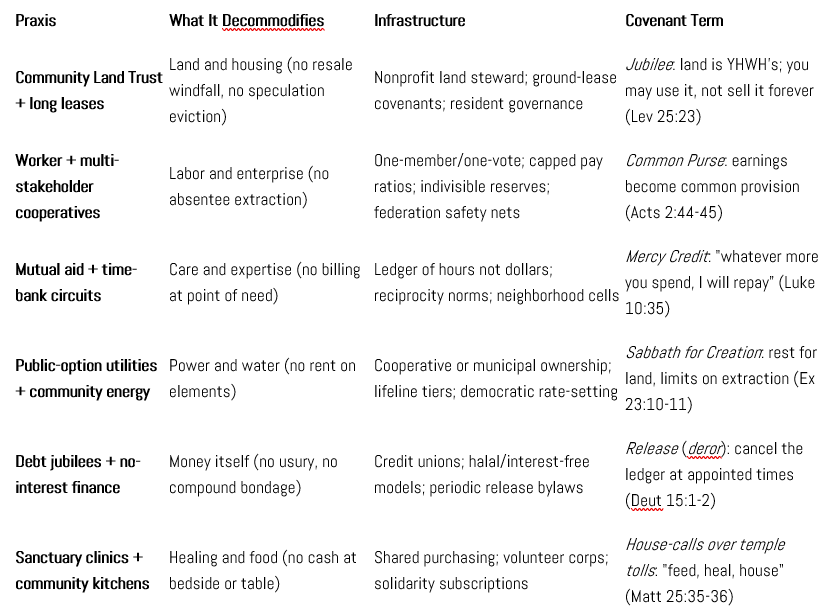
These are not boutique experiments for bohemian enclaves. They are architectures tested under adversity, refined through failure, proven through persistence. They demonstrate that Covenant economics scales beyond small intentional communities precisely because Covenant economics builds institutions, not just inspires individuals.
We re-make ownership through legal structures that separate use from commodity. We re-design credit through governance systems that democratize enterprise. We re-purpose surplus through reciprocity mechanisms that circulate rather than concentrate. We re-train desire through infrastructures that make solidarity easier than isolation, sharing simpler than hoarding, mercy more rational than abandonment.
And we do this in federated sanctuaries—not enclaves withdrawing from the world but ports within it. Ports don’t deny the sea’s existence; they provide harbor, a rule other than waves. The rule is this: land held in stewardship not speculation, work governed democratically not dictatorially, surpluses serving stability not extraction, membership proven through practice not purchased through fees. We count hours as gladly as dollars, sometimes instead of dollars. We form credit that remembers faces not just credit scores. We forbid interest breeding itself like cells dividing cancerously. We feed people without demanding their paperwork first. We prefer federations to fiefdoms because power shared is power multiplied. We choose repair over replacement because we measure wealth by what returns whole, not what returns profit.
The objection arises: “But what about scale? These work for small communities, not modern economies.” The archive answers: Mondragón employs 80,000. Germany’s energy cooperatives mobilized millions. The Emilia-Romagna region of Italy generates 30% of its GDP through cooperative enterprises—2 million members, 8,000+ cooperatives, integrated across agriculture, manufacturing, retail, social services. This is not marginal; this is regional economy organized through commonwealth principles.
The deeper objection: “But won’t people always choose self-interest over community?” Here covenant wisdom sharpens: we don’t deny self-interest; we restructure it. CLTs make it in your self-interest to support permanently affordable housing because your own security depends on the trust’s stability. Worker co-ops make it in your interest to ensure workplace sustainability because you govern rather than merely labor. Time banks make reciprocity rational because the hours you give return as hours received. The Covenant doesn’t demand selfless saints; it designs systems where doing good aligns with doing well.
The Testimony of Endurance: Why Some Commonwealths Last
“Tell me again why you believe this can last,” the policy expert asks with practiced skepticism, and I honor the question’s weight. The statistics sting: most communes dissolve within five years. Most worker cooperatives fail within a decade. Most intentional communities splinter over personality conflicts or financial stress. Most mutual aid networks exhaust their volunteers. Most movements that begin with revolutionary fervor end in bureaucratic ossification or sectarian fragmentation.
Yet some endure. Monasteries have maintained communal life for fifteen centuries—the Benedictines since 529 CE. The Hutterites have practiced full community of goods for nearly five centuries—since 1528. The Mondragón cooperatives have thrived for seventy years through economic depressions, fascist dictatorship, democratic transition, and global market integration. The Grameen Bank has provided microfinance to nine million poor borrowers over four decades with 97% repayment rates. What differentiates durable Commonwealth from failed experiment?
The research is methodologically boring and theologically conclusive: sustainable commonwealths braid transcendent purpose to precise governance; they give form to love. This is not mystical hand-waving but structural observation. Communities that articulate only economic rationality fail because economic crises overwhelm rational calculation. Communities that articulate only spiritual ideals fail because material needs overwhelm aspirational commitment. Communities that integrate both—that ritualize material practice as spiritual discipline—develop resilience through crisis.
The Benedictine Rule exemplifies this integration. It specifies in excruciating detail how the monastery distributes food (omnes aequaliter suscipiant, all receive equally, Chapter 34), rotates leadership (abbas eligatur, the abbot is elected, Chapter 64), manages property (monachi proprium aliquid habere non debeant, monks should have no property, Chapter 33), and resolves conflict (capitulum culparum, chapter of faults for public acknowledgment, Chapter 46). But these practical mechanisms serve transcendent purpose: the opus Dei, the work of God, the liturgical prayer cycle that structures every day. Economic practice becomes spiritual discipline; spiritual discipline enables economic practice.
The Essene Community Rule (1QS) operates identically. It prescribes probationary periods, property pooling sequences, meal protocols, conflict resolution procedures—but frames all within covenant fidelity to YHWH. The Damascus Document specifies that members must contribute two days’ wages monthly for orphans, widows, and poor (CD 14:12-16)—but this isn’t mere philanthropy; it’s cultic obligation, worship expressed through redistribution.
The pattern repeats: they ritualize forgiveness before conflict, ritualize redistribution before scarcity, ritualize hospitality before fear. This is the genius of liturgy—it establishes pattern prior to need. When conflict erupts, the community doesn’t invent response; it activates existing ritual. When resources contract, the community doesn’t debate distribution; it follows established protocol. When strangers arrive, the community doesn’t deliberate inclusion; it practices habituated welcome.
The Hutterites demonstrate this with devastating efficiency. When a Bruderhof faces financial crisis, the confederation redistributes. When members conflict, they activate the bruederrat (brothers’ council) following precise reconciliation steps. When young people question communal life, they enter rumspringa-like exploration knowing they’ll be welcomed back without penalty. These aren’t spontaneous acts of generosity but constitutional requirements, covenant obligations, ritualized practices that continue regardless of individual mood.
Compare this to communes of the 1960s-70s, many of which dissolved within years. The difference wasn’t idealism—both Hutterites and hippie communes shared commitment to alternative life. The difference was structure. Communities organized around charismatic leaders collapsed when leaders failed or departed. Communities without clear governance mechanisms splintered over decision-making. Communities lacking economic protocols exhausted resources. Communities without conflict resolution rituals fractured over interpersonal tensions.
The Essenes wrote their constitution in water and time—baptismal immersion marking entry, ritual purity structuring daily rhythm, calendrical cycles organizing community life. Ya’akov’s assembly wrote theirs in bread and debts—daily distribution of food, regular forgiveness of financial obligations, weekly shared meal as governance space. The Johannine communities wrote theirs in boundary-keeping love—clear criteria for table fellowship, explicit economic tests of authentic faith, systematic exclusion of those enriching themselves at community expense.

The point is not to copy ancient garments—we are not Essenes, we do not have Second Temple context, we face different economic structures. The point is to keep their grammar: Covenant is not a mood you refresh on Sunday; it is a redundancy-trained system that knows what to do when someone bleeds on the road or cannot pay the rent.
Contemporary examples confirm the pattern. Catholic Worker houses that endure practice daily liturgy alongside daily hospitality—the works of mercy flow from liturgical works. Transition Towns that sustain organize regular skill-shares, monthly potlucks, seasonal celebrations—ritualizing resilience before crisis demands it. Community Land Trusts that weather market pressures maintain resident education, annual meetings, clear succession planning—democratizing governance before power concentrates.
The research on cooperative longevity reveals similar patterns. Cooperatives with strong educational programs (teaching cooperative principles to new members) survive crises better than those without. Cooperatives with regular social gatherings (not just business meetings) maintain higher member engagement. Cooperatives with clear mission statements (transcendent purpose beyond profit) weather economic downturns more successfully. The integration of meaning and mechanism predicts endurance.
This is why vows matter. Monastics take vows of stability, obedience, and conversion of life—legal commitments backed by communal enforcement. Hutterites baptize adults into covenant knowing they surrender private property permanently. Worker-owner cooperatives require capital investment from members, creating financial stake that discourages casual departure. These commitments function as friction, beneficial resistance that prevents the entropy of easy exit.
Modern culture’s allergy to vows—our preference for flexibility, optionality, keeping-doors-open—actively undermines commonwealth formation. You cannot build durable alternative when everyone reserves right to return to market economy whenever covenant demands exceed comfort. The Covenant requires commitment, not because covenant is authoritarian but because alternatives require critical mass. Below threshold membership, commonwealth infrastructures collapse; above threshold, they become self-sustaining.
The Interior Architecture: Structural Conversion, Not Motivational Piety
There exists also the interior work, which is not interior at all. This is the great deception of spiritualized religion: the assumption that transformation happens primarily in private consciousness, that conversion is cognitive shift rather than communal reconstruction, that the soul’s architecture can be renovated while leaving social structures intact.
One of our own—a member of this Q’hila Ebyonim—wrote a confession we preserve not as sentiment but as cartography, a map of the terrain between extraction and covenant. Four and a half decades, the confession records, of believing the scarcity lie with liturgical devotion. Four and a half decades of attempting to beat the debt dragon by riding it, of serving Mammon while praying to YHWH, of loosening hundreds of thousands in uncollectable accounts and calling that small mercy “the hem of Jubilee,” as if touching the garment’s edge sufficed while refusing to meet the Healer’s eyes.
The confession names what the Essenes called “smooth things” (chalaqot)—the ethics that justify harm because efficiency demands it, the rationalizations that permit passing by because stopping might make us late, the cult of realism that sneers at mercy’s foolishness. The Community Rule warns against doreshei chalaqot, “seekers of smooth things,” those who interpret Torah to accommodate power rather than confront it (4Q169). This is Hillel’s prosbul writ large: the progressive smoothing of covenant’s sharp edges until it no longer cuts into our comfort.
The confession records the specific geography of compromise: the creditor who calculates profit before humanity, the landlord who optimizes return before shelter, the employer who measures labor before dignity, the consumer who prices convenience before consequence. These are not abstract categories but documented coordinates, actual decisions in real ledgers, the blood road’s economy internalized until it colonizes imagination itself.
But here the confession pivots—and this pivot is why we preserve it. The cure named is not motivational. It is not interior pep-talk, not twelve-step program, not therapeutic reframing, not mindfulness practice divorced from material action. The cure is structural: “a Kehilla that makes it easier to do good than to do evil, that puts the body in the breach and says, ‘Break me first’.”
This is covenant epistemology: knowledge through practice, transformation through structure, conversion through community. The Hebrew yada’, to know, implies intimate experiential knowledge, not cognitive apprehension. When Adam “knew” Eve, conception resulted—knowledge that produces new reality. When Israel is commanded to “know (yada’) that I am YHWH” (Exodus 6:7), the knowing happens through liberation experience, not doctrinal instruction. Covenant knowledge is praxis-knowledge, embodied understanding emerging from material practice.
The Desert Fathers understood this when they developed praktikē—not theory but practice, not ideas but actions, not concepts but concrete exercises that reshape consciousness through bodily discipline. But they often erred toward individual asceticism, missing the communal dimension. What the Ebionites grasped—what this confession recovers—is that transformation requires infrastructure.
You cannot become generous in isolation when isolation’s structure rewards hoarding. You cannot practice mercy when your economic position punishes stopping. You cannot embody covenant when covenant-keeping costs everything while extraction costs nothing. The interior conversion requires exterior architecture. The soul’s furniture must match the city’s layout.
This is why the Kehilla—the gathered assembly, the commonwealth community—functions as conversion technology. Not through preaching at members but through structuring around them arrangements that make covenant practice the path of least resistance. Consider the mechanisms:
Common Treasury: When resources pool before distribution, generosity becomes default rather than exceptional act. You don’t decide each time whether to share; the structure shares, and you participate. The decision is made once—joining the covenant—then automated through governance. This is what Acts describes: “distribution was made to each as any had need” (Acts 4:35). Not individual charity depending on daily virtue but systematic provision depending on constitutional structure.
Rotating Service: When everyone cycles through menial work—cleaning, cooking, maintenance—humility becomes habitual rather than aspirational. The Benedictine porter who greets guests, the Essene baker who prepares communal bread, the Ebionite widow who administers distribution—these roles don’t require extraordinary holiness but ordinary rotation. The structure teaches humility by requiring its practice.
Accountability Partnerships: When two or three gather to examine economic choices—purchases made, wages paid, resources hoarded—the scrutiny comes from peers not preachers. The Essene maskil (instructor) who guides members’ discernment, the Johannine community that measures belonging by whether “anyone has the world’s goods and sees his brother in need yet closes his heart” (1 John 3:17)—these create feedback loops where covenant violation becomes visible, nameable, correctible.
Ritual Confession: Not generic “I have sinned” but specific economic accounting. The Service of the Threshold we practice opens with naming actual harms: “I withheld fair wages from my worker.” “I charged interest to my neighbor in need.” “I hoarded while my sister lacked.” This liturgical naming creates semantic field where economic sins become as serious as sexual ones, where exploitation is as confessable as adultery, where accumulation is as shameful as theft.
The confession we preserve ends not with absolution but assignment: concrete next action, specific repair, material restitution. This mirrors James 5:16’s instruction:
“Confess your sins (hamartias) to one another and pray for one another, that you may be healed (iathēte).”
A Halakah from Ya’akov ha-Tzadik to the Great Confederation | chapter V, verse 16 | Ebyonim Shuva B’rit Translation
The healing (iathēte, from iaomai, to cure, restore, make whole) comes not from confession alone but from the prayer-and-action that follows—the community supporting the confessor in actual change.
This is the liturgical technology of conversion: ritualizing forgiveness before conflict, ritualizing redistribution before scarcity, ritualizing hospitality before fear. The rituals don’t replace authenticity; they create conditions where authenticity becomes possible. Without structure supporting transformation, transformation remains fantasy—desired but never actualized, proclaimed but never practiced, interior but never incarnate.
The quantum dimension here—to borrow vocabulary from contemporary hermeneutics—is that observation changes the observed. When covenant community watches your economic choices, those choices transform. Not through surveillance as control but through witness as accountability. The Hebrew ‘edah, assembly or congregation, shares root with ‘ed, witness. The gathered community bears witness to each member’s covenant fidelity, and that witnessing creates feedback that enables transformation.
This is not behaviorism—mere external conditioning. It is structural discipleship—the recognition that sanctification happens within sanctuary, that holiness emerges from holy community, that becoming-righteous requires righteous-architecture surrounding the becoming. Paul knew this when he insisted:
“Do not be conformed (syschēmatizesthe) to this world, but be transformed (metamorphousthe) by the renewal (anakainōsei) of your mind.”
Paul’s Letter to the Romans, chapter 12:2, New American Standard
The transformation (metamorphosis) happens through renewal (anakainōsis, making new again)—and renewal happens within community that models alternative pattern.
The confession ends with testimony: thirty-six months into Covenant life, finding that mercy has become muscle memory, that generosity flows without calculation, that abundance consciousness replaces scarcity logic—not because virtue increased but because structure shifted. The Kehilla makes it easier to do good than evil by removing barriers to good and erecting barriers to evil. This is practical sanctification—holiness made structurally probable rather than heroically exceptional.
The Politics of Permanent Accumulation: Why Empire Resists Jubilee
Let us speak with brutal candor about the political theology of resistance. If covenantal economics offered only sweetness—only prosperity gospel prosperity, only win-win outcomes, only efficiency gains—empires would have baptized Jubilee ages ago. That they have not, that they instead systematically suppressed, spiritualized, or criminalized covenant practice, reveals the fundamental incompatibility between commonwealth and imperium.
The reason Jubilee requires apostles rather than consultants, prophets rather than policy advisors, martyrs rather than reformers, is that Jubilee forbids permanent accumulation, and permanent accumulation is the sacrament by which empires know themselves.
Accumulation is not mere wealth-gathering. It is the process whereby power compounds across generations, whereby advantage reproduces advantage, whereby dominance self-perpetuates. The Greek thēsaurizō, to store up treasure (Matthew 6:19), implies not simple saving but systematic hoarding, the construction of reserves that outlast mortality, the transformation of temporary surplus into permanent hierarchy.
Every empire—Pharaonic Egypt, Neo-Assyrian conquest-state, Neo-Babylonian extraction-regime, Persian imperial federation, Hellenistic successor kingdoms, Roman domination-system, medieval Christendom, colonial capitalism, contemporary neoliberalism—operates through the same fundamental grammar: the few accumulate by extracting from the many, then use accumulated power to extract more efficiently, in recursive cycle without natural termination point.
Jubilee interrupts this recursion. The fifty-year reset (Leviticus 25) prevents any family from permanently monopolizing land. The seven-year debt release (Deuteronomy 15) prevents any lender from permanently bonding debtor. The sabbath-year agricultural rest (Exodus 23) prevents any landowner from permanently exhausting soil. These are anti-accumulation technologies, constitutional mechanisms that periodically redistribute, that systematically prevent hierarchy from solidifying into permanence.
Empire cannot tolerate this. Not because empire is staffed by monsters (though it sometimes is) but because accumulation is empire’s operating system, its core algorithm, its theological foundation. To accept Jubilee is to reject accumulation. To practice periodic redistribution is to renounce imperial logic.
Consider the historical pattern of resistance to Jubilee:
Hillel’s Legal Fiction (c. 20 BCE): The prosbul nullifies Deuteronomy 15’s automatic debt release. The rationale is pragmatic—people won’t lend near sabbatical year—but the effect is structural: permanent debt becomes possible again. Rabban Hillel preserves lending (accumulation mechanism) by voiding release (anti-accumulation mechanism). This is not accident but strategy—the accommodation of covenant to capital’s demands.
Herod’s Building Program (37-4 BCE): The client-king’s massive construction projects—Temple renovation, Caesarea harbor, Masada fortress, multiple palaces—require sustained taxation beyond Torah’s limits. The grandeur impresses, the buildings endure, but the financing violates Jubilee principles. Josephus records the taxation burden driving small farmers into debt, debt into bondage, bondage into banditry (Antiquities 17.204-208). Empire builds monuments through extraction.
Paul’s Metaphors (50s-60s CE): The brilliant theologian transforms economic terminology into spiritual vocabulary. Apolytrōsis (redemption) becomes liberation from sin, not creditor. Eleutheria (freedom) becomes conscience-liberty, not debt-cancellation. Opheilēma (debt) becomes moral trespass, not financial obligation. The spiritualization enables Christianity’s spread through empire without threatening empire’s economics. Slaves can be Christians; masters can be Christians; the structure remains; only the interior changes. This is not conspiracy but consequence—Paul’s genuine theological vision has the unintended effect of making covenant compatible with accumulation.
Constantine’s Bargain (312-337 CE): The emperor embraces Christianity, convenes councils, builds basilicas—but the economic system remains extractive. The Church receives property, privilege, power—but abandons covenant economics. Bishops become landed aristocrats. Monasteries accumulate estates. The Eucharist becomes ritual administered by hierarchy in buildings mimicking imperial throne rooms. The faith born in resistance becomes empire’s legitimation. Accumulation baptized continues accumulating.
These are not mistakes but strategies. They domesticate the dangerous memory of a people who believed that forgiveness was not feeling but fiscal event, that liberation was not spiritual but structural, that salvation was not individual but social. They transfigure release into symbol, transform material practice into metaphysical principle, translate economic insurrection into interior piety.
And yet—and this is crucial—under the floorboards, the old current runs. The memory persists. The archive preserves. Every time a community land trust takes an acre out of speculative circulation, an ancient text breathes new life. Every time a cooperative federation rescues failing workplace without predatory terms, a prophet smiles at a ledger. Every time an undocumented Samaritan drafts an innkeeper into mercy credit, another coin of Caesar fails to purchase what matters.
The resistance continues because the covenant cannot be fully spiritualized. It keeps breaking through into material practice. Medieval peasants invoked Jubilee during revolts—and were crushed, but the memory survived. Radical Reformers practiced community of goods—and were drowned, but the witness endured. Liberation theologians recovered covenant economics—and were silenced, but the truth spread. The pattern repeats across centuries: suppression breeds preservation, martyrdom multiplies witness, death becomes seed.
This is the politics we must name clearly: covenant economics and imperial accumulation cannot coexist. Every attempt at synthesis—Hillel’s prosbul, Paul’s spiritualization, Constantine’s church-state fusion, contemporary “faith-based initiatives” that deliver social services while leaving economic structures intact—represents temporary truce, unstable equilibrium, accommodation destined to collapse when crisis forces choice.
The crisis is now. Climate catastrophe reveals permanent growth’s impossibility. Wealth concentration threatens social cohesion. Debt bondage reduces billions to precarity. The choice clarifies: continue imperial accumulation toward systemic collapse, or transition to covenant redistribution toward commonwealth sustainability.
The apostles of Jubilee—we who carry this dangerous memory into contemporary crisis—do not promise easy victory. The record shows: covenant communities are suppressed, leaders are martyred, alternatives are criminalized. But the record also shows: the testimony endures, the archive persists, the practices resurface, the memory survives to inspire new generations.
We build not naively but knowingly, not expecting empire’s blessing but prepared for empire’s resistance, not assuming smooth transition but training for dangerous passage.
What Then Shall We Build? The Disciplined Imagination of Covenant
The question crystallizes in the quantum collapse between possibility and actuality: What then shall we build? Not what shall we imagine, not what shall we theorize, not what shall we defer to some eschatological horizon—but what shall we build, with hands and lumber, with legal instruments and agricultural cycles, with ledgers and liturgies, with bodies and breath?
The record we have excavated—through documentary fragments and architectural remains, through suppressed gospels and hostile witnesses, through the persistence of practice against the grain of empire—gives us not a blueprint to copy but a grammar to conjugate, a set of generative principles that can be instantiated across contexts while maintaining covenant fidelity.
This is the disciplined imagination: constrained by historical precedent, guided by theological principle, tested by material practice, refined through failure, multiplied through federation. We are neither antiquarians resurrecting dead forms nor futurists inventing ex nihilo. We are traditioners—those who receive tradition as living seed and plant it in contemporary soil, tending until it bears fruit recognizable to our ancestors yet nourishing to our children.
The Sanctuary Economy: Ports Inside Empire’s Sea
We build sanctuary economies—and the term requires precision. Not enclaves withdrawing from the world, sealed communes attempting self-sufficiency through isolation. Not utopias pretending to exist outside history’s contamination. But sanctuaries—spaces of alternative practice within empire’s geography, ports offering harbor governed by rules other than market waves.
The Hebrew miqdash, sanctuary, shares root with qadosh, holy, set apart. But set-apart-ness (qedushah) in covenant theology never means irrelevance or withdrawal. The Temple was miqdash precisely because it stood at the center of Jerusalem, drawing nations to YHWH’s instruction. The Sabbath is qodesh, holy time, but it sanctifies the whole week by its interruption, not by its separation.
Ports do not deny the sea’s existence; they acknowledge it while providing alternative to its sovereignty. A port offers vessels rest from waves’ chaos, repair from storm damage, resupply for continued journey. The port operates by different principles than open water—regulated commerce instead of piracy, coordinated movement instead of drift, collective safety instead of individual vulnerability. Yet the port remains part of the maritime system, essential node in global network, threshold between land and sea.
This is the architecture we build: threshold spaces where covenant rules govern internally while interface with market economy continues externally. The rule is this:
Land is held in stewardship, not speculation. Title vests in community trust; use rights grant to residents through long leases; resale restrictions prevent windfall profit; democratic governance ensures accountability. This implements Leviticus 25:23—”the land shall not be sold in perpetuity, for the land is mine”—through 21st-century legal mechanism. The CLT model demonstrates that property can be de-commodified while maintaining security of tenure, that individuals can have homes without commodifying housing, that communities can grow without displacing the vulnerable.
Work is governed democratically, not dictatorially. One member, one vote regardless of capital contribution; capped pay ratios prevent hierarchy ossification; indivisible reserves ensure intergenerational sustainability; surplus serves stability not speculation. This instantiates Acts 2:44-45—”all who believed were together and had all things common”—in worker-cooperative form. The Mondragón example proves that covenant economics can compete in global markets without sacrificing democratic principle, that efficiency and equality can reinforce rather than oppose each other.
Surpluses serve commonwealth, not private accumulation. Time banks measure exchange in hours not dollars, equalizing labor’s dignity; mutual aid networks coordinate reciprocity without monetization; solidarity subscriptions fund essential services through voluntary contribution rather than forced payment. This embodies the Samaritan’s “whatever more you spend, I will repay”—open-ended credit based on trust rather than contract, circulation rather than concentration.
Membership is practice, not fee. You belong by participating, not by paying. You remain through contribution, not through consumption. The covenant community measures belonging by whether someone with means opens their hand (1 John 3:17), not whether they affirm correct doctrine or possess correct pedigree. This is orthopraxy over orthodoxy—right practice over right belief—the ancient priority that Constantine inverted when he made creedal affirmation more important than economic transformation.
We count hours as gladly as dollars, and sometimes instead of dollars, recognizing that all human time carries equal dignity before YHWH even as market assigns differential value. We form credit that remembers faces, that knows the borrower’s story, that measures capacity through relationship rather than algorithm. We forbid interest to breed itself, implementing Exodus 22:25 and Deuteronomy 23:19 through interest-free lending circles and Islamic finance principles. We feed people without demanding their paperwork first, because hunger is not adjudicated, need is not credentialed, image-of-God requires no documentation.
We prefer federations to fiefdoms because power shared multiplies rather than divides, because autonomous nodes connected through covenant create resilience that centralized hierarchy cannot match, because the body has many members (1 Corinthians 12) and no single organ can claim supremacy. The Fleet Doctrine that guides Q’hila Ebyonim recognizes this: communities in different modes (Golden Age abundance, Lean Season contraction, Dark Age survival, Renaissance expansion) support each other through federation, ensuring no single crisis capsizes the whole flotilla.

We choose repair over replacement because we measure wealth by what returns whole, not what returns profit. The Hebrew shalom, peace, derives from shalem, complete, whole, intact. Covenant economics pursues shalom—restoration to wholeness—over accumulation that fragments. This means preference for renovation over demolition, for healing over replacement, for reconciliation over abandonment, for rehabilitation over incarceration.
The Common Table: Supply Chains of Solidarity
We build common tables—and again, precision matters. Not potlucks of sentiment where everyone brings favorite dish and shares pleasant evening. Not charity meals where servers maintain superiority over served. But supply chains of solidarity, logistical networks that coordinate production and distribution according to covenant principle rather than market logic.
The Table functions simultaneously as parliament, treasury, and altar. As parliament: decisions about resource allocation happen during shared meal, with everyone who eats having voice in governance. The early assemblies didn’t separate business meeting from common meal; the meal was the meeting, the space where community discerned direction through deliberation and distribution.
As treasury: the collection basket circulates, contributions are received, needs are announced, distributions are made—all as part of meal liturgy. Acts 6:1-2 reveals this integration: when complaint arose about daily food distribution, the apostles recognized the table’s governance function required dedicated administrators. The economic and the cultic were never separate.
As altar: the table is where sacrifice happens, but the sacrifice is of accumulated surplus rather than animal blood, of hoarded wealth rather than ritual purity, of private property rather than personal righteousness. Paul’s language in Romans 12:1—”present your bodies (sōmata) as living sacrifice (thusian zōsan), holy (hagian) and acceptable (euareston) to God”—immediately follows his discussion of diverse gifts serving common body (Romans 12:3-8) and precedes his instruction on mutual love expressed through hospitality (Romans 12:9-13). The sacrifice is economic, not merely spiritual.
We write bylaws that command release. Not suggest, not encourage, not inspire—command. The community’s constitution requires periodic debt forgiveness as liturgical act. The CLT’s ground lease limits resale price by formula. The cooperative’s articles mandate surplus distribution by democratic vote. The mutual aid network’s covenant obligates reciprocity. These are not aspirations but regulations, not ideals but requirements, not suggestions but structures.
We appoint treasurers who are not ashamed to annul a balance and call it worship. The Greek diakonos, deacon, originally designated financial administrator, table-server, distribution-manager. The seven appointed in Acts 6 weren’t spiritual counselors but economic officers. Their holiness manifested through just distribution, their righteousness through accurate accounting, their worship through canceled debts. We recover this ancient dignity: the treasurer as priest, the accountant as prophet, the administrator as apostle of Jubilee.
We take up collections, yes—but the collection is not tip jar for voluntary generosity. It is municipal budget for the underground city of God, the commonwealth that exists wherever covenant is practiced. The Greek logeia, collection (1 Corinthians 16:1), suggests organized gathering, systematic coordination, not random charity. Paul instructs: “On the first day of every week (kata mian sabbatou), each of you is to put something aside (par’ heautō titheto) and store it up (thēsaurizōn), as he may prosper (hoti an euodoētai)” (1 Corinthians 16:2). This is proportional taxation, regularly scheduled, communally administered—infrastructure finance, not philanthropic whim.
We enroll innkeepers in advance. The Samaritan’s genius was not spontaneous generosity but systematic institution-building. He created relationship with innkeeper before crisis emerged, established credit line before need arose, guaranteed payment before service was rendered. This is proactive solidarity—the creation of covenant networks that activate when emergency strikes rather than improvising response after disaster. Mutual aid succeeds when relationships precede requirements, when trust precedes transaction, when covenant precedes crisis.
We normalize open-endedness—”whatever more you spend (ho ti an prosdapanēsēs)”—because that is how wounds heal: not on payment schedule but when restoration completes. Healthcare under covenant doesn’t discharge patients when insurance coverage expires; it continues until health returns. Education doesn’t end when tuition money depletes; it proceeds until understanding emerges. Healing and teaching are not commodities purchased but covenants fulfilled.
The Schools of Remembrance: Curricula of Dangerous Memory
We build schools of remembrance—batei midrash, houses of study, where the young learn that history is wider than orthodoxy’s memory, that the Covenant has had many dialects but one ethic, that the earliest assemblies were not Roman churches wearing sandals but Yahwist resistance movements implementing Jubilee.
We teach them that “Jewish” and “Yahwist” were not always synonyms, that Second Temple sectarianism produced Essenes and Therapeutae, Pharisees of Hillel and Shammai, Sadducees of Hasmonean and Herodian patronage, Zealots and their dagger-men cousins in the Sicarii, Ebionites and Netsarim, Samaritans—each interpreting Torah through different lenses, each claiming covenant fidelity through different practices. We teach them that Yehoshua bar-Yosef operated within this Yahwist diversity, not as founder of new religion but as renewer of ancient Covenant, particularly its economic provisions systematically neglected by Temple authorities.
We teach them how the Teacher of Righteousness—that mysterious figure preserved in Qumran documents—may have walked out of the Temple rather than serve an illegitimate High Priest imposed by Hasmonean politics, that prophetic protest has always required institutional separation when institutions betray covenant. We teach them that Ya’akov ha-Tzaddik led the Jerusalem assembly for three decades, implementing community of goods and debt remission as practical Jubilee, until Sadducean authorities martyred him for economic heresy that threatened both Temple tribute and Roman taxation.
We teach them the suppressed stories: Miryam ha-Magdelah as apostle and teacher, leading communities in her own right; the Johannine resistance to Pauline accommodation, maintaining economic boundaries that Paul relaxed; the Ebionite preservation of Ebyonim Gospel and Ya’akov’s legacy despite Imperial Christianity’s triumph; the monastic movements that recovered communal living when established Church had fully accommodated empire.
We teach them that variety of streams—Pharisee, Zadokite, Essene, Ebionite, Samaritan, later Druze and Mandaean and Manichaean threads—are all witnesses that history is wider than orthodoxy’s memory. Not to shame one house, but to free imagination for many houses in one city. Not to relativize truth, but to recognize truth’s many mansions, its diverse expressions across cultures and centuries.
The pedagogy is polyphonic—allowing multiple voices to sound simultaneously without forcing harmony. We read Matthew’s Hebrew-rooted Gospel alongside John’s mystical-prophetic vision, Luke’s Gentile-welcoming narrative alongside Ya’akov’s Ebyonim epistle. We acknowledge tensions without resolving them prematurely, contradictions without harmonizing them artificially. The students learn that tradition is dialogue, not monologue; that revelation is conversation, not dictation; that scripture is symphony, not solo.
But we never separate historical study from economic practice. Every lesson connects to concrete action. After studying Amos’s denunciation of those who “trample the head of the poor into the dust of the earth” (Amos 2:7), students organize a living-wage campaign. After examining Jesus’s Temple action against money-changers (Matthew 21:12-13), students audit local predatory lending operations. After analyzing Acts’s community of goods (Acts 2:44-45), students experiment with sharing economies—tool libraries, clothing swaps, meal cooperatives.
This is praxis-pedagogy: learning through doing, understanding through practice, transformation through action. The Hebrew talmud, study, comes from lamad, to learn, which implies not abstract cognition but embodied mastery, skilled practice, habituated competence. We study in order to do, we remember in order to practice, we excavate suppressed narratives in order to recover suppressed practices.
The Choreography of Becoming: Neighbor as Verb, Not Noun
“Who is my neighbor?” (tis estin mou plēsion) the lawyer asks, and in that question the entire architecture of extraction reveals itself. The Greek tis seeks category, boundary, limit—the circumference of obligation beyond which liability ceases. This is the grammar of contracts, the logic of insurance policies, the mathematics of calculated compassion. The lawyer wants an edge case, a definition precise enough to determine who qualifies and who doesn’t, who deserves mercy and who can be passed by with legal impunity.
But watch what the Nazarene does—this is hermeneutical choreography, a dance that refuses the question’s frame. He answers not with tis (who) but with poieō (to do, to make, to act). He shifts from noun to verb, from category to action, from being to becoming. “Which of these three (trios toutōn) became (gegonenai) neighbor to the one who fell among bandits?” The perfect tense gegonenai indicates completed action with ongoing result—the becoming-neighbor that persists through the performed mercy.
This is quantum theology, if we dare the terminology: the neighbor exists in superposition until the wave function collapses through observation—and the observation is mercy done. Ho poiēsas to eleos, “the one who did mercy”—this doing constitutes the neighbor-relation. Neighborliness is not ontological status but performative practice, not identity marker but enacted solidarity, not category you possess but covenant you practice.
The Hebrew rea’, neighbor, comes from ra’ah, to see, to perceive, to shepherd. The neighbor is one with whom you enter visual field, whose need you perceive, for whom you become shepherd. But this seeing is not passive observation; it is active recognition that creates responsibility. When Abraham asks “Am I my brother’s keeper (shomer)?” (Genesis 4:9), the answer embedded in the question’s grammar is yes—shomer means guardian, watcher, one who keeps vigil. To see the other is to become their keeper, their guardian, their neighbor.
The Samaritan’s choreography maps the movement from stranger to neighbor: elthon (coming near—choosing proximity over distance), katedēsen (binding wounds—touching pollution rather than maintaining purity), epicheas (pouring on—expending resource without calculation), epibibasas (mounting him—surrendering mobility), ēnenken (bringing to shelter—extending care beyond moment), epimelēthē (caring through night—staying present), ho ti an prosdapanēsēs (whatever more you spend—pledging open-ended commitment).
Each verb is a step in the dance, each action a movement in the choreography of becoming. The Samaritan doesn’t simply have compassion (splangchna, guts, viscera); he is moved with it (esplagchnisthē)—the aorist passive indicating that compassion happens to him, that mercy seizes him before he chooses it, that covenant claims him before he calculates cost.
This is the economy of neighborliness: not theory but praxis, not calculation but response, not category but creation. The modern enactments—time banks that measure exchange in hours not dollars, mutual aid networks that coordinate reciprocity without monetization, cooperatives that distribute surplus democratically, land trusts that de-commodify property—these are not boutique reforms for progressive enclaves. They are Samaritan infrastructures staged for scale, covenant mechanics amplified through contemporary mechanisms.
Their viability is not hypothetical. It is empirically demonstrated, rigorously documented, multiply instantiated:
Time Banks: 500+ communities, 37,000+ members, 500,000+ hours exchanged annually (TimeBank USA data). Each hour equals every other hour, implementing radical equality principle. The retired teacher’s hour tutoring equals the unemployed youth’s hour gardening equals the professional lawyer’s hour of legal advice. This is neighbor-making through time-equity, the recognition that all human hours carry equal dignity even when market assigns differential value.
Mutual Aid Networks: During COVID-19, over 800 mutual aid groups formed in US cities within weeks, mobilizing hundreds of thousands of volunteers to deliver food, medicine, masks, support to vulnerable neighbors (Mutual Aid Hub documentation). No payment changed hands; pure reciprocity organized through digital coordination and embodied solidarity. This is neighbor-making at pandemic scale, proving that alternative economics emerge precisely when market failure becomes undeniable.
Worker Cooperatives: Over 400 worker-owned cooperatives in US employ 7,000+ worker-owners with democratic governance (Democracy Collaborative data). The Evergreen Cooperatives in Cleveland demonstrate explicit anti-poverty strategy: anchor institutions (hospitals, universities) commit to purchasing from locally-owned cooperatives employing neighborhood residents. This is neighbor-making through economic democracy, the transformation of employment from extraction to participation.
Community Land Trusts: 225+ CLTs preserve 15,000+ units of permanently affordable housing (Grounded Solutions Network data). The Dudley Street Neighborhood Initiative in Boston—a CLT governed by residents of color in historically redlined neighborhood—demonstrates that communities can reclaim land from speculation, prevent displacement, maintain affordability across generations. This is neighbor-making through land covenant, the implementation of Leviticus 25 through 21st-century legal instruments.
These are not metaphors. They are material instantiations of the Samaritan principle: building bridges of resources between wounds and futures, creating infrastructures that make mercy the default rather than the exception, establishing covenants that hold when contracts would tear.
The viability question—”Can this really work?”—misses the point. It already works, wherever covenant is practiced. The algorithm says “keep moving” (productivity demands efficiency, schedules tolerate no interruption, compassion costs more than indifference). The covenant says “bind and pay and promise and return” (stop for the bleeding, expend resource for healing, pledge commitment beyond calculation, follow through on covenant).
The question is not whether neighbor-economics can scale but whether we will practice neighbor-economics at all. Every moment someone stops when efficiency demands movement, pays when profit demands withholding, promises when contract demands limits, returns when convenience demands forgetting—in that moment, the Commonwealth instantiates, the Kingdom arrives, the Covenant renews.
This is why Yehoshua refuses the lawyer’s categorical question. Categories enable avoidance. If “neighbor” designates only fellow-Jews (as some rabbis taught) or only fellow covenant-keepers (as Essenes practiced) or only fellow-citizens (as Roman law specified), then the priest and Levite passed by correctly—the wounded man might not qualify. But if “neighbor” is verb not noun, action not category, then everyone in proximity becomes potential neighbor awaiting your choreography of mercy to actualize the relation.
The scandal multiplies: the Samaritan—ritual enemy, theological opponent, ethnic other—becomes neighbor by doing mercy, while priest and Levite—covenant members, ritual specialists, ethnic kin—fail to become neighbors by withholding mercy. Status doesn’t determine neighborliness; practice does. Pedigree doesn’t create covenant; participation does. The door that James describes as “just wide enough for the frail to pass through” swings wider to admit the Samaritan who acts than the priest who calculates.
The Archive Inoculates: Learning from the Cranky, Sectarian, Wounded, Mortal
“This is only possible for saints,” the objection arrives with the weariness of experience. “Ordinary people—selfish, wounded, conflicted, mortal—cannot sustain such demanding economics. You’re describing impossible idealism.”
But the archive disagrees with devastating specificity. The people who actually did this—who pooled property in Jerusalem assemblies, who withdrew to Qumran communes, who maintained Johannine economic boundaries, who preserved monastic communities of goods across centuries—were emphatically not saints in the hagiographic sense. They were cranky, sectarian, wounded, and mortal. They quarreled over trivial matters and split over serious ones. They were betrayed by trusted leaders and disappointed by failed experiments. They were wrong about eschatological timelines and right about economic principles. They fought internally, mourned frequently, failed repeatedly.
And then they tried again. Not because failure didn’t hurt, not because betrayal didn’t wound, not because mortality didn’t terrify—but because the Covenant is not a résumé to perfect; it is a river to enter. The Hebrew nahar, river, suggests continuous flow, perpetual movement, dynamic process. You cannot step into the same river twice (Heraclitus understood this Hebraic truth), but you can keep entering the river, keep swimming against current, keep allowing the flow to carry you toward covenant’s delta.
Ya’akov ha-Tzaddik exemplifies this perfectly. Hegesippus preserves the tradition (quoted in Eusebius, Church History 2.23.4-7) that “James’s” knees were “like a camel’s” (parēmplounto tais kamēlou gonasi)—calloused, hardened, worn from perpetual kneeling. He prayed constantly in the Temple for the people, interceding for Jerusalem’s preservation even as he led an assembly practicing economic alternatives that threatened Jerusalem’s power structures.
This is not ethereal mysticism but embodied contradiction: leading resistance while interceding for the resisted-against, building alternative while mourning the necessity, practicing Jubilee while grieving that Temple authorities refused it. Ya’akov died not because he transcended material concerns but because he would not translate Jubilee into metaphysics while hungry people waited downstairs. When Ananus the High Priest (a Sadducee aligned with Rome) orchestrated Ya’akov’s execution in 62 CE, the charge was economic: proclaiming Jubilee debt-release that undermined both Temple tribute system and Roman taxation (Josephus, Antiquities 20.200).
The Qumran community preserved in their Rule (1QS) provisions for conflict resolution—elaborate procedures for addressing grievances, mechanisms for correcting violators, protocols for restoring offenders. They wouldn’t need such detailed governance if everyone were perfect saints. The Damascus Document (CD) includes economic penalties for specific violations—fines measured in days’ rations, temporary exclusions from communal meals, reductions in property shares. This is practical holiness, not idealized perfection—communities of flawed people building structures that make covenant possible despite human tendency toward extraction.
The Johannine epistles reveal internal conflicts with brutal honesty. Diotrephes “who likes to put himself first (philoprōteuōn), does not acknowledge our authority” (3 John 9). Someone is teaching “another Jesus” and “a different spirit” and “a different gospel” (2 Corinthians 11:4)—likely referring to teachers who accommodate empire more readily than Paul considers acceptable, or who demand more Judaic practice than Paul’s Gentile mission permits. The community struggles with “antichrists” who “went out from us, but they were not of us” (1 John 2:19)—internal schisms over theological and economic boundaries.
These aren’t failures of covenant but evidence of wrestling within covenant. The very term “Israel” means “wrestles with the High One” (Yisra’el from sarah, to struggle, and El, God). The patriarch Ya’akov becomes Israel after wrestling all night with the mysterious figure, receiving both blessing and wound, gaining new name and permanent limp (Genesis 32:22-32). Covenant doesn’t eliminate struggle; it sanctifies it, transforms it from meaningless conflict into generative tension.
The stories preserved even by opponents—church fathers denouncing Ebionites as heretics, Roman historians mocking Christian economic practices, Rabbinic sources criticizing sectarian separatism—testify to covenant’s historical reality precisely through their hostility. Irenaeus (Against Heresies 1.26.2) confirms Ebionites practiced “the ancient mode of life” including community of goods. Epiphanius (Panarion 30.17), though condemning them, documents their continued observance of Sabbath, their rejection of Paul, their maintenance of Ya’akov’s economic teaching. Even hostile witnesses become archival evidence.
These testimonies exist to inoculate us against despair. When our cooperative fails, when our community fractures, when our Jubilee attempt collapses under economic pressure—the archive reminds us: they also failed, repeatedly, and yet the witness endures. The Essenes’ Qumran community was destroyed by Roman legions in 68 CE, scrolls hidden in caves as final desperate act. Yet those scrolls emerged in 1947, vindicating their witness, proving their practice, inspiring new generations.
The Ebionite communities were suppressed by Imperial Christianity, deemed heretical for maintaining economic radicalism that accommodated Constantine rejected. Yet fragments survive—in Gospel of the Hebrews, in Pseudo-Clementine literature, in patristic denunciations that inadvertently preserve what they sought to erase. The suppression itself becomes testimony: empire feared this enough to destroy it, which paradoxically validates its power.
If they did this with less technology and more opposition—without digital coordination, without legal recognition of nonprofits, without academic legitimation, without foundation grants, without any institutional support—what excuse do we have? We have bandwidth they lacked, empty churches they filled, cities thick with rooms they would have consecrated. We have cooperative law they would have died for, nonprofit structures they would have celebrated, tax exemptions they would have considered miraculous. We have communication technology that could coordinate mutual aid at scales they couldn’t imagine.
The question is not capacity but commitment, not possibility but practice, not whether covenant economics can work but whether we will work covenant economics. The archive provides not encouragement only but obligation—the moral weight of witnesses who maintained covenant under worse conditions creating expectation that we maintain it under better ones.
Return to the Ditch: Where Decommodification Becomes Local
Let us end where the blood road begins again: a ditch, a man, a schedule, a choice. The abstraction collapses into locality, the theory crystallizes into decision, the manifesto meets the material. Decommodification is not first a policy enacted by legislatures or a program administered by institutions. It is a locality, a specific place where spreadsheet logic meets bodily need and one of them must yield.
The Greek topos, place, appears throughout the Samaritan parable: the wounded man lay in place (keimenon), the Samaritan came upon the place (elthōn), the inn provided place (pandocheion, all-receiving-place). Each location is kairos-thick—charged with decision-weight, pregnant with covenant-potential, offering threshold between two economies.
Every one of us encounters such places daily, multiple times, mostly unconsciously. The homeless veteran outside the grocery, our schedule pressing toward errands—a ditch, a man, a schedule, a choice. The coworker mentioning credit card debt, our budget already allocated—a wound, a resource, a calculation, a decision. The news report of evictions, our political attention fatigued—a crisis, a scroll-past, a numbness, a surrender.
Decommodification happens or fails to happen in these micro-moments before it happens or fails in macro-policy. The Samaritan’s choreography—seeing, feeling, approaching, binding, expending, committing—begins with elthōn, coming near, choosing proximity when distance was available. Every subsequent mercy flows from that first movement toward rather than past.
But—and this is crucial—to keep choosing the body day after day, we must engineer the spreadsheet. Individual virtue exhausts without structural support. The Samaritan could stop once, could bind one wound, could pledge one debt—but what about tomorrow’s wounded? Next week’s bandits? The systemic violence producing casualties faster than individuals can respond?
This is why individual mercy, however beautiful, cannot substitute for covenantal infrastructure. We must author rules that make mercy the default and extraction the exception. We must design cities that teach children to confuse generosity with normal, to see sharing as baseline rather than special, to experience commonwealth as air they breathe rather than aspiration they strive toward.
We must, in the most radical sense, legislate love. Not through coercive law that punishes failure but through covenant law that structures possibility. The Hebrew torah means instruction, teaching, guidance—not primarily prohibition. Torah instructs: leave gleanings for poor (Leviticus 19:9-10), release debts every seven years (Deuteronomy 15:1-2), return land every fifty years (Leviticus 25:10), remember stranger because you were strangers (Exodus 23:9).
These are legislative acts—community decisions about resource allocation, governance choices about economic structure, constitutional commitments about who belongs and how we treat them. They don’t wait for individuals to feel generous; they establish generosity as system requirement. They don’t hope for voluntary charity; they mandate structural solidarity.
The contemporary equivalent: write covenants, charters, bylaws, calendars, budgets that instantiate covenant principle in binding form. The CLT’s ground lease isn’t suggestion; it’s contract. The cooperative’s articles aren’t aspiration; they’re governing document. The mutual aid network’s commitment isn’t sentiment; it’s enforceable agreement. The liturgical calendar’s Jubilee isn’t symbol; it’s scheduled event with material consequences.
To take land off the auction block requires legal mechanism—trust structures, deed restrictions, resale formulas, perpetual covenants that bind future owners. To take hours off the auction block requires alternative valuation—time banks, hour exchanges, reciprocity ledgers that measure dignity rather than market worth. To take shame off the auction block requires cultural transformation—rituals that celebrate vulnerability, liturgies that honor need, pedagogies that teach interdependence as strength rather than weakness.
In their place, we put a common table with an infinite line of credit drawn on the treasury of those who do not pass by. This is not metaphor but mechanics. The treasury exists wherever people pool resources—the Jerusalem assembly’s common purse (Acts 4:32-35), the Essene yahad‘s common fund (1QS 6:19-20), the Hutterite community chest, the cooperative’s indivisible reserves, the mutual aid network’s solidarity subscriptions.
The infinity comes not from unlimited resources but from unlimited commitment—the Samaritan’s “whatever more you spend” made perpetual through institutional structure. The CLT commits perpetually to affordable housing. The cooperative commits perpetually to democratic governance. The time bank commits perpetually to hour-equality. The Jubilee calendar commits perpetually to periodic release.
We confess how far we stand from this vision. We confess how thoroughly trained we are by what one of our members calls the “Ahriman algorithm”—that voice of inertia whispering: you are late (efficiency demands movement), you are poor (scarcity justifies hoarding), you are important (status excuses cruelty), you are realistic (pragmatism permits passing by). This is the voice of empire’s catechesis, the liturgy of extraction we absorb before we can name it, the grammar of commodification we inherit before we have words to resist it.
But then we confess something older, something truer, something written in creation’s fabric before empire twisted the weave: our breath belongs to a Guardian whose economy rests every seventh day, releases every seventh year, and returns what was taken every fiftieth. That our neighbor is not category but choreography—whoever we become for the sake of a wound. That our politics is a table where all eat, our currency is trust that compounds through reciprocity, our surplus is for the ones outside the door.
The Commonwealth is not utopia deferred to some post-revolutionary or post-apocalyptic horizon. It is grammar possible today, syntax available now, vocabulary we can speak this afternoon. Go and write it—not as distant legislation but as immediate covenant, not as future policy but as present practice. Bind the wound within arm’s reach. Pay the debt you can cancel. Promise the support you can deliver. Return to check on healing’s progress.
Build the sanctuaries—the CLTs and cooperatives, the mutual aid networks and time banks, the community clinics and solidarity kitchens—that make that sentence easy, that create infrastructure where mercy flows like water finding its level, where covenant becomes as ordinary as breathing, where commonwealth is simply how we live.
And when the high priests of efficiency ask with practiced incredulity what you think you are doing, wasting time on unprofitable mercy, squandering resources on unreturned investment, sacrificing productivity for unquantifiable compassion—answer plainly, without defensiveness, with the calm of those who have touched ancient truth:
We are canceling the price of being human. We are practicing Jubilee. We are becoming neighbors. We are doing likewise.
Thus concludes this Mishna of Decommodification, submitted to The Record of Q’hila Ebyonim not as final doctrine but as working manifesto, not as complete theology but as covenant grammar, not as closed system but as open invitation to all who would become neighbors through practiced mercy, who would build commonwealth through embodied covenant, who would translate Jubilee from memory into material, from archive into action, from Word into flesh dwelling among us.
In witness to the work,
In memory of those who stopped,
In hope of the Commonwealth yet coming,
The Table extends.
The Door widens.
The Covenant continues.