

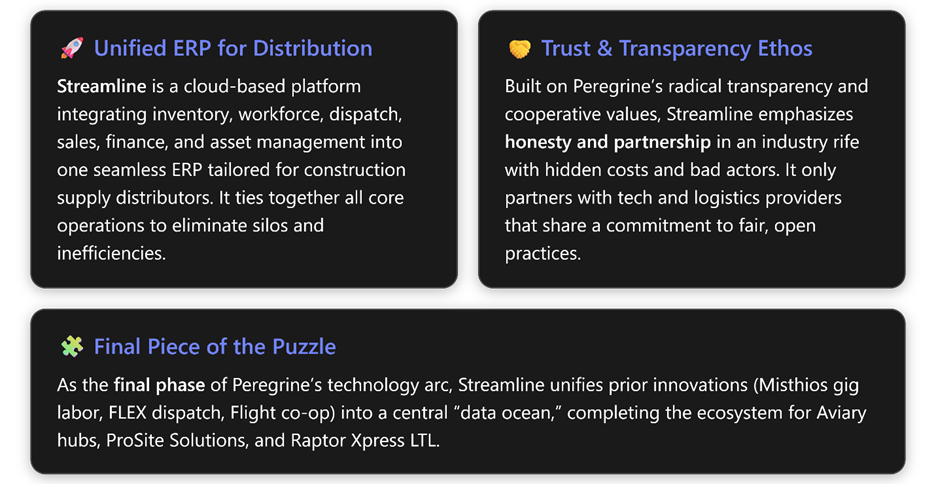
Streamline is an enterprise software platform purpose-built to solve supply chain inefficiencies in the construction and industrial distribution sector. It delivers a fully integrated suite of applications – covering Inventory (Stock), Personnel (Crew), Dispatch + Logistics (Drive), Accounting (Tally), CRM/Sales (Connect), and Asset Management (Fleet) – on a unified cloud-based ERP backbone. Streamline was conceived as the technological capstone of Peregrine’s logistics ventures, tying together earlier projects (the Misthios on-demand labor app, FLEX digital freight system, Flight owner-operator co-op, etc.) into one coherent platform. By doing so, it completes the evolution toward a trust-based, transparent, and efficient supply chain network. Targeting investors, ethical industry partners, forward-looking developers, and “brokers of conscience,” this summary outlines how Streamline works, the problem it addresses, and its role in building a new era of trust and productivity in a market historically plagued by fragmentation and bad actors.
Market Need: Fragmented Systems + Trust Gaps in Distribution
Distributors’ Existing Systems Are Ineffective. Across the construction supply chain, distributors often rely on a patchwork of severely outdated, inefficient, and unintuitive software. Different functions – inventory, sales, logistics, accounting, HR – run on isolated legacy systems (or even spreadsheets and clipboards nailed to walls) that don’t talk to each other. This “disintegrated distributor” model means data silos everywhere: one system for trucking, another for orders, another for maintenance, etc., with no single source of truth. The result is duplicated effort, manual workarounds, and costly errors. Moreover, many legacy ERP implementations in distribution have failed dramatically – for example, JB Hunt famously sued their TMS provider after a 2-year, $3M failed implementation, and one VP lamented “we did that to ourselves on purpose” when an SAP roll-out crippled operations. Clearly, traditional big-box ERPs (and cobbled point solutions) aren’t meeting the needs of mid-market distributors.
High Costs, Rigid Hardware, Low ROI. Legacy systems tend to require expensive on-premise hardware, licenses, and consultants, making them cost-prohibitive for many distributors. They often demand the company conform to the software (instead of the software adapting to the business), leading to disruptive change management that sometimes ends in abandonment. Many distributors have paid heavily for systems that never delivered value – or avoided modernization entirely, knowing a failed IT project could sink the business. This has left the door open for a nimble solution that can provide modern capabilities without the traditional costs and risks.
Distrust in a “Bad Actor” Industry. Compounding the technology gap is a crisis of trust in the logistics sector. The construction logistics and freight brokerage world has been riddled with unscrupulous actors – from double-brokering scams to opaque pricing – leading to high-profile fraud cases and lawsuits. In such an environment, many distributors and carriers have grown wary of new platforms claiming efficiency if they suspect hidden agendas. Poor transparency and “black box” practices by incumbent brokers and software vendors have caused skepticism. Streamline enters with a very different stance: it is designed on “radical transparency” principles to build trust through openness. The platform’s ethos (drawn from the Peregrine Strategy) is that honesty and partnership are competitive advantages in a market full of middlemen playing zero-sum games. This means Streamline will show exactly how data flows, reveal true costs (e.g. using a published cost-plus pricing model for freight), and integrate only with partners who uphold integrity. In short, the industry desperately needs both a technology upgrade and an ethical reset – Streamline aims to deliver both, by providing distributors a modern integrated system they can trust.
Solution Overview: An Integrated, Cloud-Based ERP Suite
Streamline is a comprehensive cloud ERP that unifies all key operational areas of a distribution business on one platform. Instead of six separate tools for six functions, Streamline offers six modules that work as one. Each module addresses a critical piece of the supply chain puzzle, and together they share data seamlessly in a centralized “data ocean.” The modules (and their roles) include:
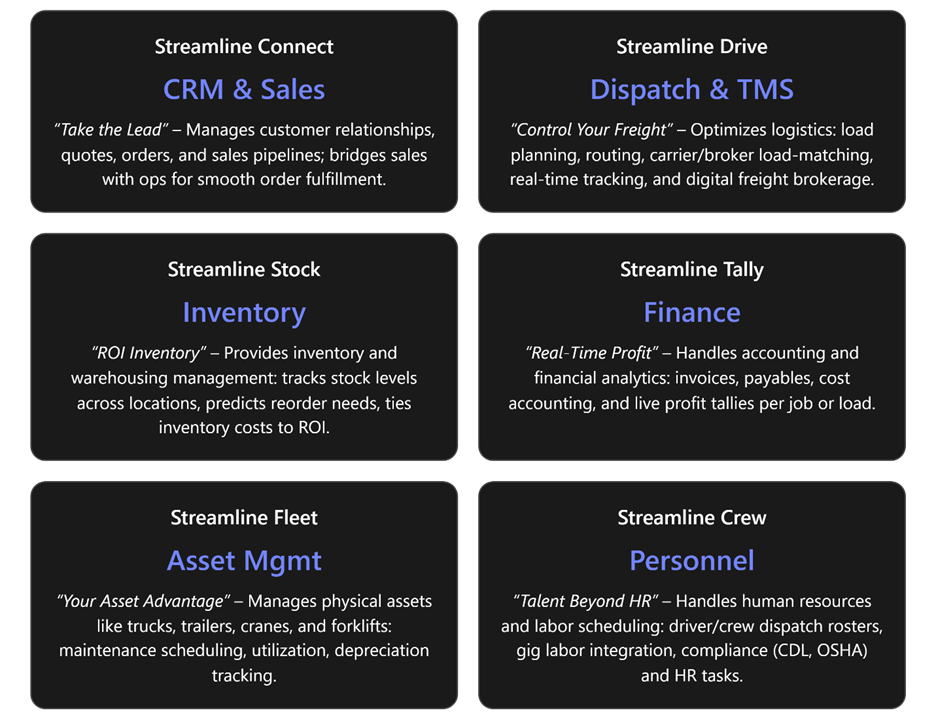
All modules share a common data platform and user interface, so information flows freely without re-entry. For example, a new order in Connect immediately reflects as a shipment to plan in Drive; available inventory in Stock shows up for salespeople in Connect; delivery costs from Drive feed into real-time profit calculations in Tally. This integration replaces the “swivel-chair” workflows (where employees manually move data between systems) with a single source of truth.
Cloud-Native + API-Driven: Streamline is built as a cloud-based SaaS, avoiding the need for local servers or intensive IT support. This means rapid, inexpensive deployment – what used to take a year to implement can be up and running in weeks. Being API-first, Streamline readily connects with external services and IoT devices, allowing companies to shed costly inefficiencies in their information chain by automating data exchange. Open APIs also future-proof the platform: as new technologies (AI services, blockchain, etc.) emerge, they can be plugged in without overhauling the core.
Automation + ML: Wherever possible, Streamline uses automation to eliminate manual work. For instance, it incorporates OCR (Optical Character Recognition) and Robotic Processing Agents (RPA bots) to handle document management – processing paperwork like bills of lading or delivery tickets automatically, so staff can be redeployed to higher-value tasks. Machine learning algorithms are embedded to provide predictive analytics and decision support. Examples include forecasting demand to optimize stock levels, predicting maintenance needs for assets to reduce downtime, and suggesting optimal carrier assignment or routing in the dispatch process. By learning from the “data ocean” (including historical patterns across all modules), Streamline can surface insights a human might miss – such as flagging an unusual drop in crew productivity that correlates with a specific shift schedule, or identifying which customer order patterns tend to cause delivery bottlenecks. This smart assistance gives distributors incredible precision and foresight in managing their ops. This particular feature competes with the “AI” trend by insisting that “AI” cannot do what the market says and that, instead, we should be seeking a more humanatic endeavor of “AMI” – Automated Machine Intelligence, processes which enhance human intelligence and human-driven outcomes.
Modular Adoption, Unified Upgrade: Recognizing that not every business will overhaul all systems at once, Streamline is designed for modular adoption. A distributor can start with one or two modules to fix their biggest pain (say, implement Drive to modernize dispatch and Crew to manage labor) and still integrate with legacy tools for other functions. Streamline’s strategy is to beachhead with a limited value proposition for the client’s most urgent need, then expand usage as trust is built. Many early customers might use Streamline as a superior TMS (transportation management) first – immediately seeing benefits in freight coordination – and later add inventory and accounting once they experience early wins. Ultimately, because it’s one codebase, adding modules is seamless and the end goal is a full-suite deployment when the customer is ready. This contrasts with legacy ERPs that forced a disruptive “big bang” cutover. Upgrades and new features also roll out uniformly via the cloud; gone are the days of patching multiple systems or expensive version migrations.
In summary, Streamline is designed from the ground up for agility, interoperability, and intelligence. It offers distributors the holistic capabilities of a top-tier ERP without the usual complexity – delivering integration by design and robust automation out of the box. Companies can adopt it gradually, but once fully implemented, it transforms a disjointed operation into one synchronized organism.
Differentiators: How Streamline Stands Apart
Streamline’s approach represents a sharp break from both the clunky enterprise systems of yesterday and the narrow point-solutions of today. Key differentiators include:
Unified vs. Siloed: Many competitors offer point solutions (e.g. a TMS only, or a WMS only) that still leave gaps to be bridged by the customer. Streamline offers end-to-end coverage. It blurs the line between what traditionally might be different vendors, essentially acting as CRM + TMS + WMS + ERP in one – purpose-built for distributors so it doesn’t feel like an overstuffed generic ERP. This one-stop solution means one vendor relationship instead of several, one training curriculum for staff, and zero integration headaches for the customer.
Best-of-Breed Integration: Streamline acknowledges it can’t (and shouldn’t) reinvent every wheel. Instead, it plays well with third-party specialists, pulling their data into the central hub. For example, rather than building its own freight marketplace, Streamline integrates with top load boards and broker platforms (like Truckstop – via the Denim API for quick freight financing and tendering). It ties into Motive (formerly KeepTruckin) to ingest real-time truck telematics and driver ELD data into Drive. It can sync with Xero or QuickBooks if a customer prefers to keep their accounting there (though Tally provides native tools). It connects with Highway for carrier compliance data and Carrier Assure for carrier vetting, ensuring that any external trucking capacity brought into the system is verified and trustworthy. It even envisions connecting with labor gig platforms like Veryable (and Peregrine’s own Misthios) to pull in temporary labor when Crew module forecasts a shortfall. All these integrations mean clients leverage what others have “already mastered” – e.g. they keep using what works (if they love Xero, keep it – Streamline will plug in) and replace what doesn’t. Streamline becomes the data ocean where these streams converge, providing one governance and analytics layer over all. For the user, it feels like one system; under the hood it’s orchestrating many. This philosophy of open architecture is a stark contrast to legacy all-in-one giants that force customers into their full stack whether or not it’s all excellent.
Rapid, Low-Risk Implementation: Cloud deployment and modularity make Streamline far faster and safer to implement than traditional systems. There is no hardware to install, no lengthy code customization project – core configurations are done via web portal. The system’s flexibility means it can conform to the client’s processes initially (if, say, a distributor wants to keep a certain workflow, Streamline can often be configured to accommodate it) and then gradually introduce best-practice improvements. This mitigates the “big bang” fear. The track record of legacy failures (like the MercuryGate and SAP examples) is largely due to massive scope and poor change management; Streamline avoids that by starting small, delivering value early, and expanding gradually. Its quick wins and incremental approach build buy-in at the ground level – employees see it helping, not disrupting. Additionally, as a multi-tenant SaaS, updates are frequent and painless – clients benefit continuously from enhancements (e.g. a new machine learning forecast feature can roll out to all with zero downtime). The overall effect is drastically lower Total Cost of Ownership (TCO) and higher ROI compared to big ERP projects of the past.
Emphasis on Trust + Ethics: Streamline’s DNA is trust and transparency, which resonates in specific features and policies. For instance, every transaction in the system can be traced – there’s an immutable audit log that shows exactly who did what and when, which discourages any shady backdoor dealings with data. Pricing models within Streamline (for those using its brokerage capabilities) are “published cost-plus” – the system can show shippers the cost breakdown and the agreed margin rather than hiding markups. This approach is inherited from Peregrine’s brokerage philosophy that “sunshine disinfects – honesty builds trust”. In practical terms, brokers of conscience who use Streamline will find that it enforces fair play: for example, carriers could automatically see the agreed fuel surcharge formula, and customers see detention fees calculation transparently. While such radical openness is novel, it helps weed out bad actors – those unwilling to operate above-board will not integrate with a platform that shines a light on everything. Conversely, Streamline attracts partners who value integrity, creating a virtuous circle: a network where data is reliable and stakeholders trust each other. Over time, this could form a market differentiator – shippers and suppliers will prefer doing business through Streamline’s ecosystem, knowing it’s populated by vetted, reputable parties (e.g. carriers with good safety scores, brokers with no double-brokering history, etc., as verified through integrations like Highway and Carrier Assure that feed compliance data). This ethical stance aligns with Peregrine’s brand and the investors who prioritize ESG; it also directly improves resilience (trust reduces conflict and legal risk).
Real-Time Visibility + Intelligence: By combining all operational data in one place, Streamline offers unparalleled real-time visibility. A manager can pull up a single dashboard to see live metrics: today’s sales orders, inventory turns by warehouse, trucks en route and their ETAs, cash flow projections – all updating in sync. Traditional distributors might wait weeks for an accountant to piece together such insight (if at all possible). Streamline’s Tally module gives instant P+L views (even at per-load or per-customer granularity), so decisions can be based on current facts, not last quarter’s averages. And the built-in analytics can highlight anomalies (e.g. if a certain product’s delivery cost is trending above norm, suggesting an issue in routing or pricing). Competing software might provide slices of this, but rarely the whole picture unified. Streamline essentially delivers a “control tower” for the entire operation. This is a major selling point to industry partners – software developers appreciate the modern tech stack enabling this, and investors appreciate the value such data brings (possibly monetizable insights or AI training data across an industry). Streamline can become to a distributor what an AWS-style OpsCenter is to a network engineer: one command center to monitor and manage everything.
In short, Streamline distinguishes itself by combining breadth, openness, ease, and ethics. It is as comprehensive as an ERP, as user-friendly as a modern SaaS, and as principled as a co-op. There are point solutions that compete with pieces of it, and giant platforms that compete with the idea, but none that package this exact mix of capabilities and values. This strengthens the business case for investors and partners: Streamline isn’t entering an oversaturated me-too software market; it’s defining a new space at the intersection of logistics tech and cooperative ethos.
Strategic Role: The Final Phase of an Integrated Vision
Streamline is not an isolated product – it is the capstone of The Peregrine Strategy’s technological arc. Over the past few years, Peregrine and its logistics affiliate Silverwater have developed a series of innovative projects tackling different industry challenges, each building toward a coherent ecosystem. Streamline represents the “fully-developed ERP platform” that ties all these pieces together, enabling the whole vision to function as one unified solution. Consider how Streamline integrates and completes the prior phases:
Project Misthios (Gig Labor Marketplace) – introduced a flexible, on-demand labor pool for truck drivers and skilled supply chain workers. Streamline’s Crew module now ingests Misthios data (and other labor sources like Veryable) into core operations. Example: A dispatcher using Streamline can see available gig drivers for a shift in real time (from Misthios) and allocate them to routes in Drive with one click. Hours worked flow into Tally for payroll or payments. Impact: The previously separate realm of ad-hoc labor becomes a seamlessly managed extension of the company’s workforce. This smooths out staffing crunches without frantic phone calls – the cooperative labor concept is operationalized within Streamline.
FLEX (Digital Freight Dispatch Platform) – created a dynamic system to match loads with capacity across Peregrine’s fleet and co-op partners. Streamline’s Drive module is effectively the evolution of FLEX embedded in a larger ERP. It retains all FLEX capabilities (AI load matching, automated pricing, digital freight tendering) but now connects to inventory levels (Stock) and customer orders (Connect). Example: When a sales rep confirms a big order in Connect, the system can automatically trigger a freight request in Drive, which uses FLEX algorithms to source a truck (whether an internal fleet truck or a Flight co-op partner or an external broker). As soon as a match is found, that info loops back to update the order’s delivery schedule for the customer in Connect. Impact: The once standalone dispatch function is fully integrated – there’s no gap between order taking and carrier securing. Additionally, brokers of conscience can plug into this load-matching as approved partners. Streamline essentially merges freight brokerage into the enterprise workflow, under the ethical guidelines Peregrine insists on (e.g. transparent cost-plus rates to shippers, quick payments to carriers).
Project Flight (Owners’ Co-Operative Network) – established a federation of independent owner-operators and small fleets, providing them with shared resources and collective bargaining power. Streamline acts as the digital backbone for the Flight co-op. All co-op member trucks and shipments are managed through the Streamline platform (via Drive and Fleet), allowing the cooperative to operate like a unified carrier while each owner still sees their own P\&L in Tally. Example: When a Flight member driver updates a delivery status in the mobile app (part of Drive module), it not only notifies the customer, but also logs the activity for co-op performance metrics and triggers the QuickPay mechanism Peregrine pioneered (paying that driver within 48 hours). Streamline’s finance engine handles the co-op’s profit-sharing records automatically based on data it gathers – calculating patronage dividends (each member’s share of co-op profit) from the revenue and cost data. Impact: This turns the co-op from a great idea with spreadsheets into a scalable reality with system support. The Aviary hubs (the physical co-op hubs) feed data into Streamline too – fuel drawn by a co-op truck at an Aviary station, for instance, posts into that truck’s cost record immediately. In essence, Streamline is the ERP of the co-op, enabling dozens of small companies to function “loosely but unbreakably” together by providing a common system.
The Aviary (Cooperative Logistics Hubs) – developed driver-centric hubs with parking, fuel, maintenance, and cross-docking at key junctions. Streamline interacts with the Aviary in multiple ways: Fleet module schedules maintenance at hubs and tracks usage; Stock module might manage any inventory staging at Aviary warehouses; Drive module plans multi-leg routes through Aviary hand-off points. Example: Suppose a load is planned to go through an Aviary for a trailer swap: Streamline will generate a digital work order for the hub (visible to hub staff via a Streamline portal) indicating when truck A arrives and truck B departs with the trailer, with all data (pallet count, weight, destinations) attached. As the swap occurs, the hub manager checks it off in Streamline, which alerts both the customer (via Connect) and triggers any needed billing for cross-dock services (via Tally). Meanwhile, any downtime the truck spends at the Aviary can be used for scheduled maintenance which Fleet pre-arranged – all coordinated within one system. The central “brain” (Streamline) orchestrates the physical network (Aviary) efficiently. Impact: The Aviary hubs reach maximum usefulness when guided by an integrated system. Streamline ensures that what happens on the ground at hubs is fully synchronized with transportation plans, inventory needs, and customer promises. It effectively turns physical infrastructure into smart infrastructure, by linking it with the digital workflow.
ProSite Solutions (Warehouse + Last-Mile Services) – Streamline also enables cooperative warehousing and specialized last-mile support at the Aviary hubs. For example, the ProSite facility at an Aviary offers 50,000 sq ft of cross-dock warehouse space (with 20+ loading bays, high-speed doors, and light temperature-controlled zones) to consolidate LTL shipments or provide overflow storage. Streamline’s Stock and Drive modules orchestrate these operations: inbound shipments are scanned into Stock, staged under covered areas (per digital signage for bay assignments), and then routed via Drive for local delivery. The integrated system supports multi-company usage – independent distributors can place inventory in the ProSite warehouse (tracked by Streamline) and schedule deliveries to job sites on shared trucks. Example: Three small drywall distributors, squeezed for space, stock extra material in an Aviary ProSite warehouse. Using Streamline, they each see their stock levels, and when their customer orders come in (via Connect or EDI), Streamline consolidates the loads and arranges a single crane truck (from the co-op fleet) to deliver to the jobsite, splitting costs transparently. Impact: Streamline makes such “mutual aid” feasible at scale – multiple firms share one advanced facility and fleet as if a unified operation, yet data, billing, and inventory stay correctly attributed to each. This gives independents logistics capabilities rivalling national chains, acting as a relief valve in an era of supply-chain consolidation. (Notably, giant retailers have been buying up distributors: Home Depot acquired SRS Distribution in 2024 and is adding GMS Inc. in 2025; Lowe’s announced an $8.8B deal for Foundation Building Materials; and tech conglomerate QXO Inc. completed an $11B purchase of Beacon Roofing Supply in 2025. In this triopoly “arms race,” Streamline-powered Aviary/ProSite hubs offer independents a fighting chance – a neutral, shared platform to pool resources and preserve local service excellence.)
Specialized Fleet + Labor Integration: Peregrine is deploying a small fleet of specialized equipment (like boom trucks, conveyor loaders, mobile cranes) at each Aviary to rent out to distributors or use for managed jobsite deliveries. Streamline’s Fleet module schedules this equipment usage, while Crew pulls operators via Misthios if needed. Example: A local HVAC supplier’s boom truck is down for repairs (a common occurrence causing multi-day downtime). Through Streamline, they reserve a co-op boom truck from the Aviary for 2 days – the system assigns a qualified Misthios crane operator to it, and the supplier’s deliveries continue uninterrupted. Payment and any training certification checks happen automatically in Streamline. Impact: What used to be a catastrophic service failure (or expensive rental scramble) is now handled with on-demand ease. This “flex capacity” service (rental, turnkey delivery, or labor-only) is a new revenue stream for the co-op and a buffer for small distributors. Streamline enables it by matching needs to available assets and vetted operators in real time. Moreover, by providing gig opportunities during slow seasons, Misthios (within Streamline) helps these distributors retain their core crews – employees can pick up extra work via the platform when their primary employer is slow, reducing the risk of turnover. All of this is coordinated and made scalable by Streamline’s integrated approach, turning the Aviary and ProSite elements into a multi-vector hedge (warehousing + fleet rental + labor exchange) that strengthens the overall ecosystem.
Raptor Xpress LTL (Hydrogen Fleet) – Peregrine’s Phase III project deploying a zero-emission LTL fleet with fuel-cell trucks and advanced route planning. Streamline will provide the operational control system for Raptor: Drive and Fleet handle scheduling of hydrogen refueling stops, Crew ensures drivers trained on FCEV operations are assigned, and Tally tracks the improved cost metrics. Example: The system knows a Raptor truck’s range (via integration with Motive telematics) and will build LTL consolidation routes that factor in hydrogen station locations (likely the Aviary hubs). It can optimize load mix to maximize utilization while ensuring the truck returns to base for refueling as needed. These complex calculations are only feasible with the AI power of Streamline’s dispatch. Additionally, Streamline will log carbon emission savings for each Raptor haul in Tally’s reports, producing ESG metrics for customers (a value-add for them, enabling green reporting). Impact: Streamline is what allows cutting-edge offerings like Raptor to scale – by managing them with high precision and integrating them with “regular” operations. Customers see Raptor LTL options in the same interface as normal freight, making adoption frictionless. It turns a futuristic venture into just another service code in the ERP, albeit tracked with special care.
In summary, Streamline serves as the nerve center that connects and coordinates the entire Peregrine ecosystem. Misthios addressed labor variability, FLEX tackled freight matching, Flight created a human network, Aviary built physical infrastructure, Raptor innovates equipment – Streamline now converges all these threads into a cohesive tapestry. It unlocks synergies: e.g., Misthios + Flight + Flex all working through one system means a sudden surge (new big order) triggers automatic labor provisioning and third-party trucking capacity and maybe a drop at an Aviary – all without managerial heroics. This is the “holy grail” third phase Peregrine envisioned: a fully integrated, responsive supply chain platform that can flex resources in real-time to meet demand while upholding the cooperative, transparent ethos.
For investors and partners, this means Streamline isn’t just a software product – it’s the keystone of an entire business model. By completing the integration of prior innovations, it amplifies their value and creates a defensible end-to-end solution that competitors (who typically do one piece) cannot easily replicate. It also means Streamline will immediately have an anchor client (Peregrine/Silverwater’s own operations and co-op) and proven use cases, reducing go-to-market risk. The technology arc from ad-hoc apps to unified ERP is fulfilled, and Streamline stands at the center of that story, ready to drive both Peregrine’s internal efficiency and offer the same capabilities commercially to forward-thinking distributors and 3PL partners who share the vision of a more connected, ethical supply chain.
Value Proposition: Why Streamline Matters to Stakeholders
For Distributors + Supply Companies (Customers): Streamline offers a one-stop solution to modernize operations with minimal pain and maximal gain. They get big-enterprise capabilities without the big-enterprise IT burden. Concretely, a distributor can expect to reduce operating costs 10–15% through efficiency gains once Streamline is fully in place (per internal projections): manual data entry drops, inventory carrying costs shrink from better forecasting, backorders and lost sales due to poor visibility go down, and logistics spend is optimized. Perhaps even more important, they gain agility – the ability to respond faster to customer needs. For example, if a contractor customer suddenly needs a rush delivery, the team can see within seconds which branch has stock and which driver (own fleet or partner) can deliver, then execute and track it in real time. That kind of responsive service builds loyalty and revenue. Streamline also positions distributors to expand (new branches, new services) easily, since the system will scale with them. From an IT perspective, they don’t need multiple vendors or an army of consultants – Streamline handles updates and integrations, and Peregrine’s team would provide onboarding and support as part of the partnership (likely structured as a subscription + value-added services). In short, customers get the competitive advantages of a custom-integrated solution at a fraction of the effort and cost. Moreover, embracing Streamline sends a message to their partners and clients that they are committed to transparency and reliability (e.g. being able to provide audit trails or live updates). In an industry where “we never know where our stuff is” is a common complaint, a distributor using Streamline can differentiate by saying “we can tell you exactly where your order is and promise it on time – our system ensures it”.
For Investors: Streamline represents a scalable SaaS business in a traditionally underserved niche. The market of building materials and industrial distributors is large (tens of thousands of firms, many still running on legacy) and ready for disruption. Streamline’s model of phased adoption and cooperative ethos can help crack a market that might otherwise resist change – meaning high growth potential once the first movers demonstrate success. Investors can appreciate that this is not a greenfield experiment; Streamline is the product of combining already field-tested components (so it comes with built-in proof points and even initial revenue from Peregrine’s internal use and close partners). The recurring revenue from Streamline could come from software subscription fees per module, transaction fees (e.g. a small % on loads brokered through the system), and even marketplace revenue if Streamline later facilitates direct carrier or vendor transactions. The gross margins on the software are high, and much of the heavy R+D has been done under Peregrine’s Phase II investments. Because Streamline also drives efficiency in Peregrine’s own operations, it indirectly improves the profitability of those units (which investors in Peregrine benefit from). It also opens the door for network effects: as more partners (carriers, brokers, suppliers) integrate with Streamline to do business with Peregrine, the platform’s value grows and can be offered to others. In essence, investors are looking at the foundation of a logistics “operating system” that could scale beyond Peregrine’s ecosystem, with first-mover advantage in a sector that hasn’t seen anything like it. Importantly, it aligns with ESG and impact investing goals – it champions fair labor and sustainable practices (by optimizing routes, reducing empty miles, supporting hydrogen adoption, etc.), and it’s community-oriented (co-op enabling), so it likely qualifies for grant support and impact funds, lowering the effective risk capital needed.
For Industry Partners + Third-Party Providers: Software developers and tech providers see in Streamline an opportunity to plug their services into a broader solution and reach more users. For example, a telematics company partnering with Streamline becomes the preferred IoT sensor provider for all Streamline customers, expanding its sales channel. Brokers “of conscience” – i.e. freight brokers who adhere to compliance and transparency – can integrate via Streamline’s network (through the Drive module marketplace) to get freight opportunities from Streamline-using shippers. Because Streamline will restrict access to vetted, ethical brokers, those who make the cut stand to gain long-term shipper relationships without underhanded competition. Likewise, carriers (especially co-op members) benefit because the system ensures fast payment and honest dealing – a carrier working with a shipper through Streamline knows there won’t be surprise deductions or 60-day waits (the system’s rules and Peregrine’s influence see to that). For technology partners like accounting systems or e-signature services, integration with Streamline can drive usage volume and maybe revenue-sharing in an expanding vertical. In summary, partners that align with Streamline’s ethos will find a symbiotic platform: their specialized tools get embedded in something bigger (increasing their stickiness), and Streamline becomes richer by leveraging their expertise, all while delivering a unified experience to the end-user.
For Brokers + Operators (Users of the System): The frontline users – whether they are freight coordinators, warehouse managers, or sales reps – stand to see a dramatic improvement in day-to-day work. Streamline’s user interface is modern and designed with input from actual operators (Peregrine’s own team). Tasks that used to require juggling multiple logins or Excel files will be done in one screen. For instance, a logistics coordinator no longer has to call accounting for a customer’s credit hold status before releasing an order – Connect/Tally shows that instantly. They also don’t need to use WhatsApp to message a driver and then a separate app to log POD (proof of delivery); Streamline integrates communications and documentation in the workflow. The result is less frustration, fewer errors, and higher productivity. Employees can focus on exceptions and strategic work instead of clerical chores. Companies that have implemented only parts of Streamline already report higher job satisfaction for dispatchers and planners because they “aren’t flying blind anymore” – they have all info at their fingertips. Additionally, because Streamline promotes fair dealing, employees are empowered to be transparent with customers (no need to hide or spin). For brokers specifically, those who commit to the platform’s code of conduct can build trusted partnerships with shippers – moving away from spot market volatility to more stable, relational business through the system. In effect, Streamline could help evolve the role of brokers from adversarial middlemen to collaborative capacity partners, which is exactly the kind of cultural shift many good brokers desire in order to differentiate themselves.
For the Supply Chain (+ Society): At the macro level, if Streamline achieves wide adoption, it could meaningfully reduce waste in the supply chain (fewer empty trucks, better inventory placement meaning fewer rush shipments, etc.), improving the environmental footprint of logistics. Its insistence on accountability and visibility could also help reduce fraud and improve safety – e.g. knowing exactly which carrier hauled what, with digital records, makes it harder for rogue operators to engage in illegal activities unnoticed. By choosing partners committed to safety and compliance, it indirectly pressures the market toward higher standards. Furthermore, by empowering independent operators via the co-op model, Streamline contributes to economic equity – small businesses get access to technology and opportunities normally reserved for large enterprises, helping level the playing field. These broader benefits reinforce Streamline’s brand as not just software, but part of a movement towards a more ethical, efficient supply chain.
Brand Ethos: Trust + Transparency as Core Features
From its inception, Streamline has been guided by Peregrine’s core values: champion the operator, radical transparency, human-centered innovation. These aren’t just slogans — they are deliberately woven into the product’s design and the business practices around it:
“Sunshine Disinfects” – Radical Transparency: Streamline defaults to openness in operations, pricing, and data sharing. In practical terms, this means no black boxes – users can drill down to see how a rate or KPI was calculated, and partners are expected to operate above-board in the system. For example, if a broker in Streamline is arranging a subcontracted delivery, the shipper could (if agreed) see the original carrier rate and the broker’s markup clearly, eliminating distrust. While unconventional, this practice has been shown to build strong trust that leads to more volume and long-term relationships. Internally, every team member using Streamline has access to information relevant to their role without artificial silos – reinforcing a culture of honesty and accountability. The system’s audit trails and permissioning are designed to encourage collaboration, not finger-pointing – mistakes are visible, but as learning opportunities rather than occasions for blame.
Champion the Operator: Streamline is built first and foremost to serve the people on the ground – whether that’s a dispatcher, a driver, a warehouse picker, or a salesperson. This human-centric focus means the interface is intuitive and workflows mirror real-world processes (indeed, many features were refined with feedback from Peregrine’s own operators). It also means providing tools that make the job safer and more dignified. For instance, drivers interfacing with Streamline (via a mobile app) get features like digital pre-trip checklists and an easy way to report issues – giving them a voice in the system. They also benefit from the emphasis on fairness (quick pay, no surprise deductions), which Streamline enforces through its integration of co-op policies. By prioritizing operators’ success, the product ultimately drives company success – a virtuous cycle Peregrine deliberately bakes in. This ethos appeals to brokers and partners of conscience: it signals that Streamline is a platform for those who value treating people right, be it drivers, dispatchers, or customers. Over time, this can form a community or seal of quality – e.g. a “Streamline-verified partner” could imply a certain standard of ethics and performance.
Never Settling – Continuous Improvement: The development mentality behind Streamline is one of relentless refinement. Borrowing Peregrine’s mantra “always advancing, never settling”, the team uses feedback loops to constantly enhance the software. In practice, the system provides in-app feedback mechanisms for users, and Peregrine’s developers push updates frequently. New features are tested in Peregrine’s live environment (with real freight and inventory) before general release, ensuring they add real value. This approach assures investors and customers that Streamline will keep evolving ahead of the industry, not stagnate. It also fits the mission-oriented narrative: the platform isn’t just selling a static product, it’s inviting users to join the evolution of the logistics industry. This “movement” framing – that by participating, brokers and shippers are helping transform logistics to a better model – lends excitement and purpose to what could otherwise feel like just another IT project. It’s an appeal that can draw like-minded clients almost as a cause.
Integrity + Inclusion: Modeled after Peregrine’s broad core value of “Respect & Dignity for All”, Streamline is built to be inclusive and fair. It doesn’t favor big carriers over small ones in its matching algorithms, for example – it looks at performance and fit, not size or personal relationships. A one-truck owner has as fair a shot at a load (if part of the network) as a mega-carrier, based on merit (on-time record, price, etc.). This is a deliberate stance to level the playing field and avoid the old-boys network dynamic. Similarly, the platform can cater to businesses of varied sizes: a $5M regional distributor or a $500M national supplier both find value, because pricing scales and modules can be turned on/off as needed. By designing for flexibility, the product does not implicitly exclude the “little guys.” In fact, those smaller firms are often the ones who benefit most from Streamline (they leapfrog from pen-and-paper to cutting-edge, gaining an edge against larger competitors). This inclusive design extends to multilingual support (given the diverse workforce in trucking and warehousing, instructions and apps in Spanish, etc., are provided), and accessibility (e.g. a colorblind-friendly UI, readable screens for tablet use in sunlight on a loading dock).
Disrupt with Purpose: Streamline is certainly disruptive – it challenges how distribution and logistics IT has long been done – but it is not disruption for its own sake. The purpose is to improve, advance, and elevate the industry. That means Streamline is willing to break some norms (like making certain data transparent) but always with the goal of a healthier ecosystem. This purpose-driven angle is attractive to “brokers of conscience” and progressive industry leaders who are tired of the status quo’s inefficiencies and moral compromises. It also resonates with tech talent; developers and data scientists are more eager to work on a platform that aims to make an industry better rather than just make money. This helps Streamline assemble a strong team and partner network. In messaging, the Streamline team often echoes a line from Peregrine’s story: “This isn’t just logistics. It’s evolution.” – signaling that adopting Streamline is joining a forward-thinking, principled vanguard.
In essence, Streamline’s brand stands for trust, empowerment, and progress, and these are engrained in the product’s features and policies. For an investor or partner reviewing it, this means the platform is differentiated not only by what it does, but how and why it does it. That tends to inspire stronger loyalty and advocacy. Early customers become evangelists because they feel part of something bigger (like how Peregrine’s freight customers have stuck around due to shared values, not just rates). This can accelerate adoption via word-of-mouth in what is ultimately a tight-knit industry community.
Roadmap + Outlook
Having completed core development and internal deployment, Streamline is poised to enter a growth phase. The roadmap ahead includes:
Targeted Customer Onboarding (Next 12–18 months): Focus on a small number of launch partners – likely building material distributors and logistics firms within Peregrine’s network – to ensure successful external rollouts. This involves working closely with their teams, refining any last-mile features, and quantifying results. The goal is to generate 2–3 strong case studies showing, for example, a mid-size distributor boosting on-time delivery from 85% to 98% while reducing admin expenses by 30% using Streamline. These proof points will underpin broader marketing.
Module Enhancements + Partner Integrations: In parallel, continue enhancing each Streamline module. Near-term enhancements on the roadmap include more advanced AI optimization (e.g. dynamic rerouting based on real-time traffic & weather feeds), deeper analytics dashboards for trend analysis (leveraging machine learning to highlight anomalies or opportunities), and expanded partner integrations. On the integration front, adding connectors for popular systems (SAP for larger orgs that might still run SAP financials but use Streamline for ops, for instance) and onboarding additional “ethically vetted” logistics partners into the network (more carriers, regional brokers, warehouse partners). Each added integration or partner increases the value of the network for all users.
Scalability + Performance: Streamline’s architecture will be tested as usage grows. A portion of the roadmap is devoted to scaling infrastructure – ensuring the cloud environment can handle surges (like end-of-month order spikes) without latency. The tech team is implementing advanced containerization and auto-scaling clusters to maintain snappy performance even as data volumes multiply. Security and data privacy measures are continually updated as well, given the sensitive competitive data in the system; achieving ISO 27001 or SOC2 compliance is on the horizon to give enterprise customers confidence.
Market Expansion (2–3 years out): Once a foothold is established in the core sector (building products distribution), Streamline will be extended to adjacent industries. The modular nature makes it adaptable; for instance, foodservice distribution or electrical/industrial wholesale have very similar pain points with outdated systems and could benefit from Streamline with minimal tweaks (perhaps adding a module for lot tracking or different regulatory compliance). The sales approach in new verticals will leverage the credibility built in the initial niche – showing how the solution improved metrics in one domain to win trust in another. Additionally, internationalization may come into play: many developing markets leapfrog to mobile-first cloud systems, and Streamline (with translation and localization) could find adoption in regions where companies are skipping the legacy phase entirely. The brand ethos of transparency could resonate strongly in markets plagued by logistics corruption, offering a counter-model.
SaaS Metrics + Growth Trajectory: Financially, the plan is to transition Streamline from an internally subsidized project to a self-sustaining SaaS business with healthy margins. Revenue will grow via subscription tiers (e.g. a base fee per module per month plus an usage-based component for large transactions volume) and perhaps a share of economics from any marketplace transactions facilitated. By year 3, management aims for Streamline’s external customer MRR (Monthly Recurring Revenue) to exceed the internal “captive” revenue from Peregrine operations – a sign of broad market acceptance. If projections hold, monthly recurring revenue could reach ~$1.6 million by its third year after launch, with high gross margins, given the scalable cloud model. Achieving this would put Streamline on track to be a significant contributor to Peregrine Enterprise’s overall value (and potentially a candidate for spin-off or separate funding if that maximizes shareholder value).
Continued Alignment with Ethical Standards: As Streamline scales, the leadership is committed to maintaining the ethos. This means instituting an Ethics Board or advisory council (including maybe reps from co-op drivers, shipper clients, etc.) to ensure policies and partner vetting remain strict even under growth pressures. It also means measuring impact: e.g. tracking how many independent operators or small businesses Streamline has helped integrate, or publishing transparency reports. These will not only guide internal decisions but also serve as powerful marketing stories (“Streamline Network carriers get paid in 2 days on average, vs industry 30+ days”).
Looking forward, Streamline has the potential to become the backbone of a new kind of logistics industry – one that is highly digital and data-driven, yet fundamentally people-centric and principled. By focusing on both operational excellence and ethical excellence, it is carving out a unique position. The challenges ahead will involve convincing more conservative players to embrace this new way, and outpacing larger software competitors who might eventually awake to this market. But with its head start and deeply integrated model, Streamline stands well-positioned to lead rather than follow.
Conclusion: Streamline transforms the logistics and supply chain management of distribution-oriented businesses through its integrated, cloud-based ERP platform. It addresses a market hungry for modernization by providing a complete suite of tools that eliminate silos, boost efficiency, and enable unprecedented visibility across the enterprise. More than that, it comes with an ideological differentiator – a commitment to transparency, fairness, and partnership in an industry that has long lacked those qualities. This strong ethos, combined with cutting-edge technology, makes Streamline the culmination of Peregrine’s vision for a better logistics ecosystem: one where trust replaces suspicion, data replaces guesswork, and collaboration replaces fragmentation. As the final phase in a trilogy of innovation (after Misthios and FLEX/Flight), Streamline doesn’t just cap off the story – it opens a new chapter where all the pieces operate together in harmony. For investors and partners who seek not only solid returns but also to be part of changing an industry for the better, Streamline offers a compelling opportunity. It is where bold ideas meet proven execution, and where the motto “Forward Together” truly comes to life in the day-to-day operations of moving goods. By choosing Streamline, stakeholders are choosing to join the evolution of logistics – an evolution where efficiency and ethics go hand in hand to create lasting value for everyone in the supply chain.