


Welcome back. Pull the chair up to the same table. The coffee is yours.
If this is your first time sitting at it, fair warning: you have wandered in during act two, and act two of anything plays as gibberish without act one. So before we go anywhere, let me catch you up. And if you were here for the first installment, read it the night it dropped, and have slept at least once since then, which I sincerely hope you have, a short walk back through the room will not hurt either of us. Memory is generous with the plot and stingy with the details, and I will refill them in a moment. First, though, a word about how this particular series behaves, because it does not behave like the rest of what we publish here.
The Ground Rules
A quick orientation, because Odd Musings is the odd one in the catalog, and the rules change when you walk into this room.
Most of what the Archive puts out is built to be argued with. The Record essays come armored, footnotes stacked three deep, every claim braced and load-bearing, daring you to knock one loose. Even the other Meditations keep a certain composure. This series keeps very little.
Odd Musings is the loosest thing I publish, the 2 AM notebook, the back booth where I think out loud and let you watch me do it.
So a few things hold here that hold nowhere else in the Archive.
The pieces are not finished arguments. They are footholds. Some sit on rock, solid enough to put your full weight on. Some sit on moss that may tear loose the second you lean, and I will tell you which is which as we climb, because that honesty is the entire point of the exercise. The footnotes stay light. The block quotes and the architecture carry the load. I break the fourth wall early and often, I say look and stay with me more than is strictly dignified, and the register, if you need a label for it, is Deadpool meets Andor. Wry where it can afford to be, dead serious where it has to be.
And the lens does not move. We read these people as what the text keeps quietly insisting they were. Organizers. Rebels. Kinsmen running an insurgency in the open. The stained glass comes off at the door. If that framing offends you, this is a clean exit and no hard feelings. If it pulls you forward in the chair, good. Pull the chair forward.
Now, the catch-up.
Previously, on Odd Musings
The premise was simple, and a little heretical. Stop reading the gospels like a hymnal. Read them the way a screenwriter reads a script. Ask who has leverage. Ask who is paying for the caravan. Ask who is standing in the shadow when the door opens.
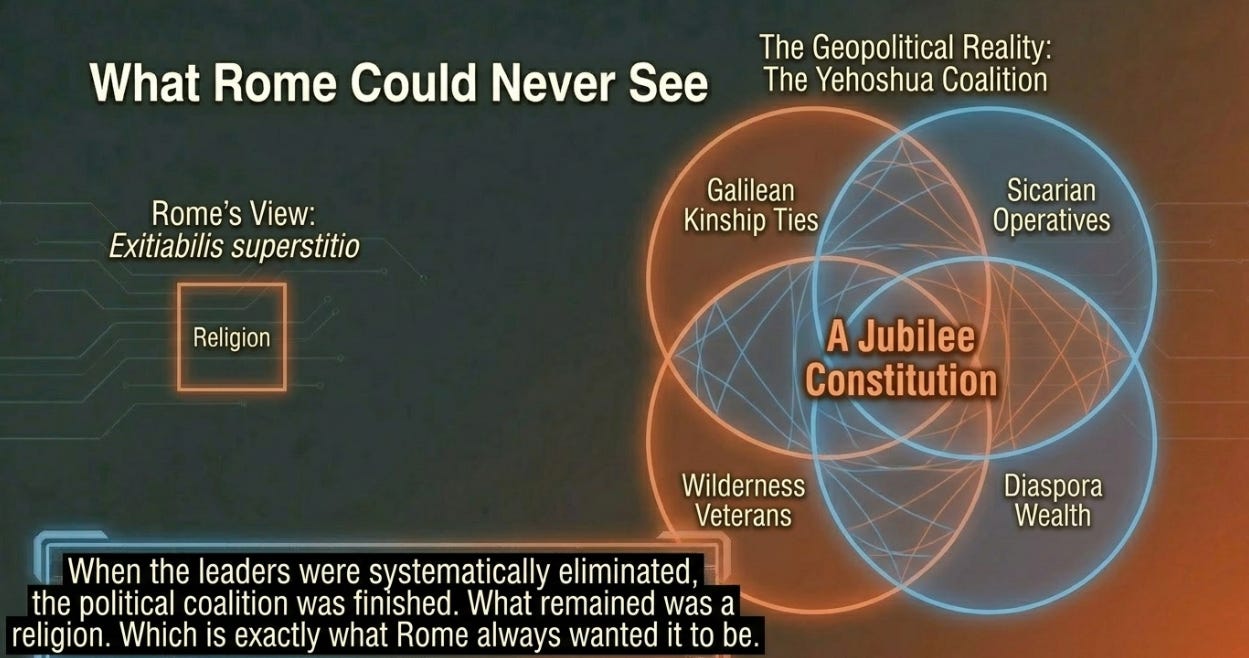
Do that, and the people in the story stop looking like figures in stained glass. They start looking like what the text actually describes: a coalition of organizers, tax-resisters, and armed kinsmen running an insurgency against the most efficient extraction machine the ancient world ever built.
We laid seven footholds. Here they are in one breath.
In the previous essay we met Shimon ha-Qanayi, the man your Bible calls Simon the Zealot, and found that his nickname was not a note about his temperament. It was a family marker. It placed him inside the Galilean resistance dynasty, and it placed that dynasty inside the inner circle of the Twelve.
We lined up the rest of the Twelve and found, not a prayer group, but a working cabinet. A treasurer. A defector from the tax administration. Operatives carrying code names. Veterans of an insurgent network that had just lost its leader.
We found the economic program hiding in plain sight. In Luke’s synagogue scene, Yehoshua reads from Isaiah and announces the year of YHWH’s celebration, and every literate person in that room hears one word: Yovel, the Jubilee, the constitutional reset of Leviticus 25 that cancels debts and returns land.
He was not founding a faith. He was activating the most dangerous economic clause in the Sinai Compact.
We followed the treasurer into the garden and read his betrayal as a tactical theory that did not survive contact with reality. We stood at the empty tomb and asked the impious question of who actually moved a body through a guarded city on a festival night. We found the movement’s two hinges, Ya’akov the anchor who never left Jerusalem and Kefa (Peter) the door who never stopped moving. We read Paul’s road to Damascus as an interception rather than a lightning bolt.
And then we watched the whole thing come apart inside a five-year kill window. Between 60 and 65 CE the leaders died, one after another, and the truce that had held the country back from open war finally snapped.
That was act one. One sentence holds it together. This was never a religion that wandered into politics. It was a political project that learned to move in the open by speaking the language of teaching and healing.

Caught up? Good. Go and top off your cup of coffee. We might need it.
Because tonight we are not going forward from that kill window. Tonight we are going all the way back to the beginning, to a single phrase, and to a name hiding inside it.
Put on your screenwriter eyes again. Stay with me. This one asks you to trust your ears before your eyes.
We pick up the count right where we left it.
Foothold Eight | The Brake and the Engine
Start with two men, born in the same decade, who spent their lives on opposite sides of every argument that mattered.
The first you may know. Rabban Hillel ha-Tzaken, Hillel the Elder, arrives in Jerusalem from Babylon around 38 BCE. He carries Diaspora credentials, claims to Davidic descent, and a talent for legal flexibility that the Herodian court finds immediately useful. The Archive has told his story before. He is the architect of what we have been calling the accommodation apparatus, the man who built a school clever enough to speak Torah while producing deeply anti-Torah results.
The second you have heard named only in passing: Rabban Shammai ha-Tzaken, Shammai the Elder, was already there. He was born around 50 BCE, in the Galilee or near it, in the same generation as Zekhar’yah (Zacharaiah) the Avi’yah priest and Yosef (Joseph) of the House of David, the two men whose sons would carry the next act of this story. Shammai rose to Av Beit Din, the Head of the House of Judgment. In practice that made him the head of the opposition. And he never stopped opposing.
If those two names mean nothing to you, good. It means you were not raised in a study hall, and you are exactly the reader I am writing this for. Here is all you need.
The two men founded two schools, two scholarly batim (houses), Beit Hillel and Beit Shammai. The textbooks treat their disagreements as a scholarly hobby, a couple of brilliant rabbis sharpening each other. Read the disagreements as a screenwriter and a pattern jumps out.
Nearly every time Hillel’s house issued a ruling that quietly dissolved a protection for the poor, Shammai’s house issued a ruling standing directly against it.
Hillel gave the world the prosbul, a legal instrument that let a lender collect a debt straight through the sabbatical year, the year the Torah had commanded all debts be cancelled. Beit Shammai called it a betrayal of the poor and a violation of the Torah. Similarly, Hillel widened the grounds for divorce until a man could dismiss his wife for almost anything. Beit Shammai narrowed them to a single serious cause.
One house was building an engine for extraction. The other was building an emergency brake.
Then Hillel died, around 10 or 11 CE, and the brake learned exactly how the machine worked. Shammai was the most senior jurist alive in Jerusalem. He expected the presidency of the Sanhedrin, the office called nasi. He did not get it. The seat went instead to Hillel’s own son, Simon.
Sit with that for a second, because it tells you what kind of institution we are dealing with. The succession did not follow seniority. It followed bloodline. The accommodation party was not only a school of thought. It was a dynasty, and it had just shown the entire city that inside the captured institution, lineage now outranked law.
That is foothold eight. Two men, one generation, a brake and an engine, and a succession that told the brake exactly what it was up against.
Foothold Nine | The Sage at the Census Line
Now go back to a scene we visited in act one, and this time watch the man standing just off to the side.
Sepphoris, 6 CE. The Roman census line. We met Yehudah ha-Galili here last time, the son of a resistance fighter Herod had executed, the man who steps to the front of the line and refuses to give his name. He quotes the oldest anti-king verse in the canon, from First Samuel, where the people demand a king and the answer comes back through the prophet:
They have not rejected you. They have rejected Me from stewarding over them.
First Samuel | chapter 8.7 | Shuva B’rit Translation
He says it in Aramaic, then in Greek, loud enough for the whole line to hear.
Ein melech ela YHWH. No king, only YHWH.
This time, look at who is standing beside him.
A Pharisee named Tzaddoq ha-Perushi, Zadok the Separatist. Josephus names him, files him under “Pharisee,” and then spends a career making sure nobody takes the moment seriously. Scholars have argued for generations about whether this Tzaddoq belonged to the house of Shammai. I am not going to pretend the sources nail it down, because they do not.
But watch the posture, because posture is evidence too.
A Pharisee standing at a tax line, beside the son of a martyred rebel, reciting the constitution’s most dangerous verse out loud, is not running a Hillelite play. The Hillelites opposed the revolts. They always opposed the revolts, quietly, from a comfortable distance, counseling patience. The man at the line is doing the one thing the accommodation party most explicitly forbade.
That does not prove Tzaddoq was a Shammaite. It eliminates the alternative. Whatever he was, he was not Hillel’s man.
The revolt is crushed. Yehudah dies. Tzaddoq vanishes north into the Galilee and never reappears in any record we have. But the slogan does not vanish with him. Ein melech ela Yohveh goes underground and waits.
Hold onto that. The rigorist current and the armed current have just shown us, at a single census line, that they share a verse, a posture, and an enemy. Their tracks are already running side by side, a full generation before our main story begins.
That’s foothold nine.
Foothold Ten | The Seam of Seven Tribes
A short foothold, but it carries more than its size.
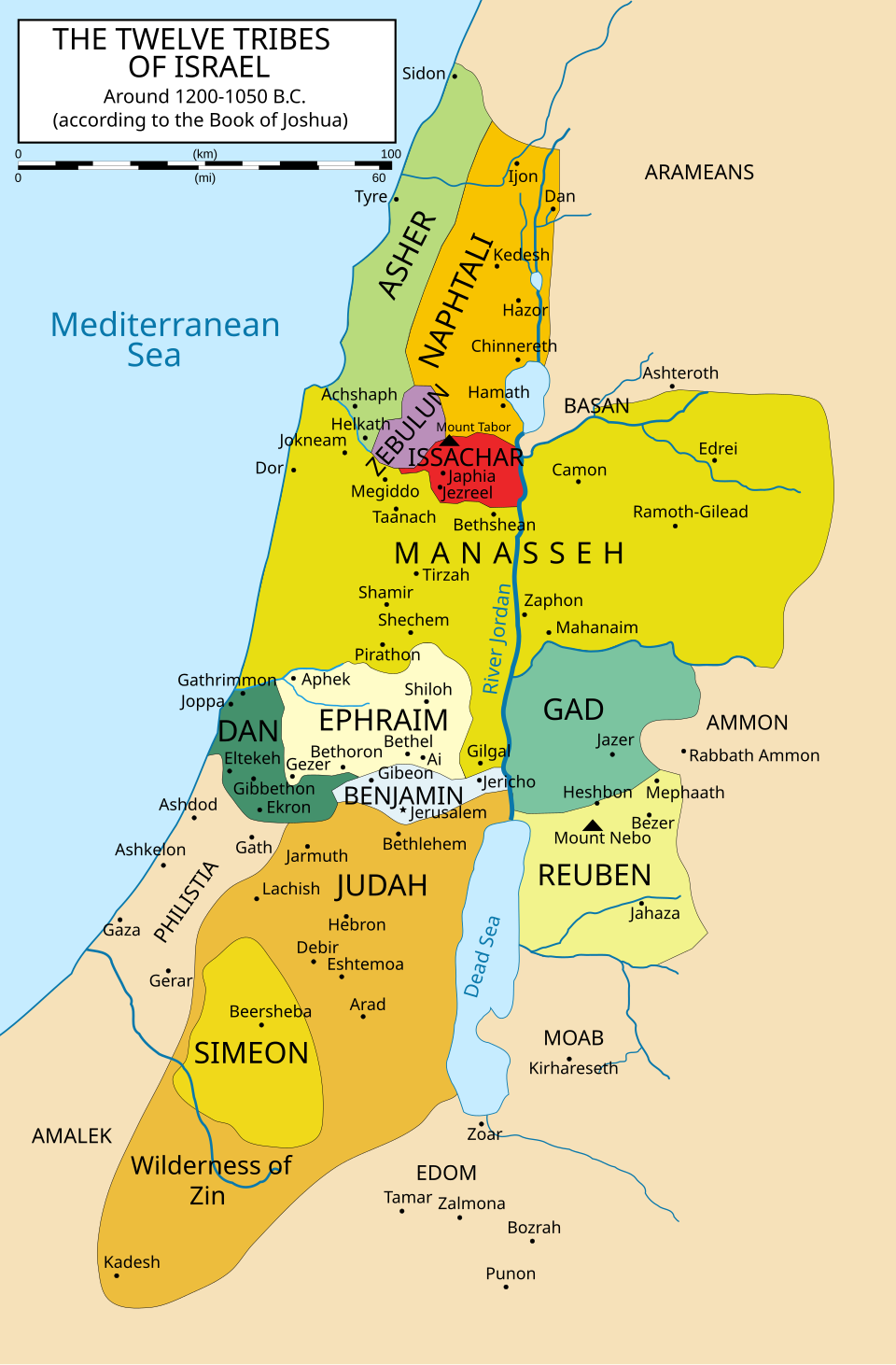
When Yosef bar-Yakob of House David comes back from Egypt with his family, he does not go home. Home, for a man of the Davidic line, is Beit-Lehem, Bethlehem, the seat of the household’s memory and prestige. Yosef skips it. He heads north into the Galilee and founds a small farming settlement called Nazrat, in the seam where seven of the old Israelite tribal territories once met.
Screenwriter question: why there?
Beit-Lehem is visible. It sits under direct administration, first Herodian, then Roman, watched by every authority with a reason to keep a Davidic claimant contained. A man founding a covenantal homestead in Bethlehem might as well mail Rome his address.
In other words, the small, sleepy town just south of the capital was “too hot” for Joseph and his family to keep a low profile.
The Galilean hill country was the opposite kind of place. It sat in what I’ve described elsewhere as a jurisdictional gap. The local ruler, Herod Antipas, had inherited neither his father’s security forces nor his intelligence networks, and direct Roman administration had not yet reached that far north. It was sympathetic country, settled by the kind of rural loyalists who had been resisting for decades. In the most literal sense, it was off the books.
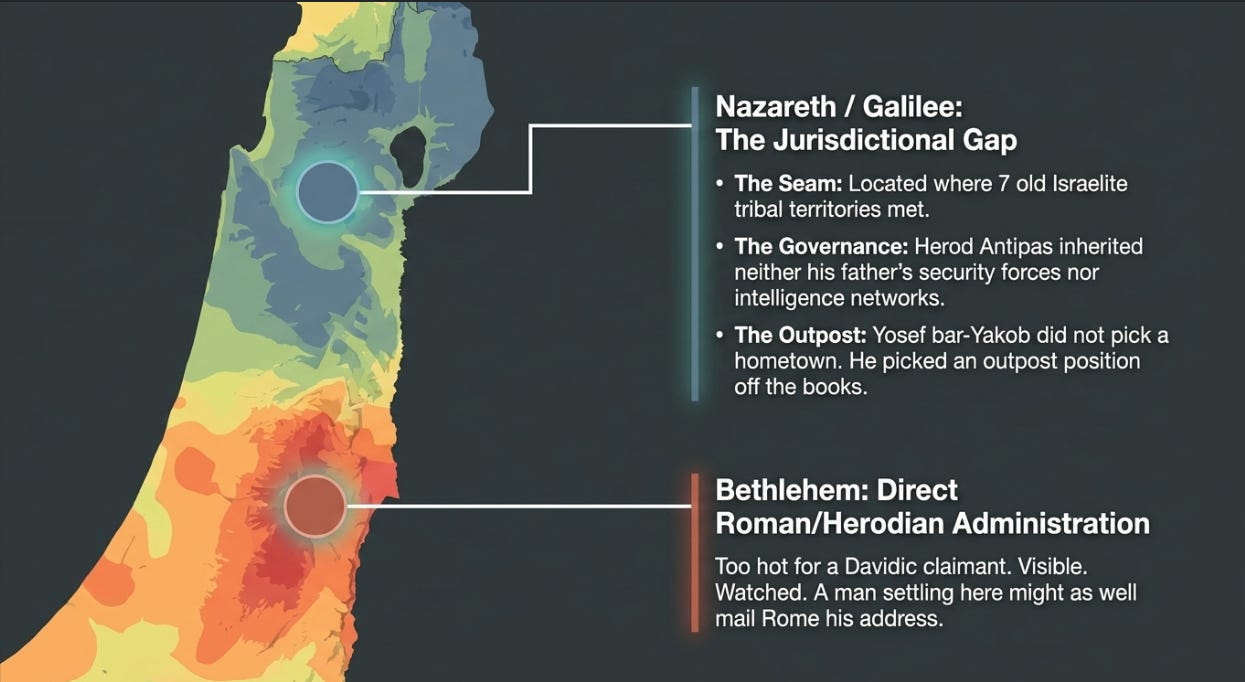
Yosef did not pick a hometown so much as he picked an outpost position. And the young men from this family who would carry the next act grew up inside that gap, in that hill country, breathing the same air as the rebels who had launched their revolution in the middle of that census line.
Foothold ten.
Foothold Eleven | The Phrase
Now we slow all the way down. This is the one the whole essay has been walking toward, so let me set the pace like a documentary and let it breathe.
In the year 25 CE, two things happen. Almost nobody has ever set them in the same sentence.
The first. Beit Shammai wins majority control of the Sanhedrin. For the first time in its history, the rigorist house, the brake, holds the constitutional machinery of Jerusalem in its own hands.
The second. Yohannan bar-Zekhar’yah ha-Matbil, the man we call John the Immerser, walks into the wilderness east of the Jordan and begins to proclaim, in Aramaic, that the Malkutha di-Shamayya is within reach of the people hearing his proclamations.
Stop there. Say that phrase out loud. Say it in Aramaic, the way he said it, not the way your Bible prints it.
Malkutha di-Shamayya. Mal-KOOTH-uh dee sha-MAY-ya.
Now say it again. Out loud. Use your voice for it.
Mal-KOOTH-uh dee sha-MAY-ya.
I render this in English as the Commonwealth of the Heavens.
Now listen to the last word by itself. Shamayya. The heavens. Sound it out slowly: sha-MAY-ya.
And now say the name of the faction that had, that very year, seized the seat of constitutional authority in Jerusalem for the first time in living memory.
Shammai’im. Sha-MAY-im.
The people of the House of Shammai.
I am not going to lie to you and claim these are the same word. They are not; their roots are different. Shamayya grows from an old Semitic root for height and sky. Shammai is a man’s name, built on a different frame, doubled where the other word is open. A philologist who caught me claiming a shared origin would be right to put the essay down.
So hear me saying loudly and directly that I am not claiming it. What I will claim is smaller and stronger.
They sound alike. And in this tradition, sounding alike was the whole game.
Let me show you why that matters, because if you did not grow up with these texts the claim sounds like a stretch, and I want you to see that it is not.
This is the tradition where the prophet Amos set the word for summer fruit against the word for the end, two words a syllable apart, to say that the harvest and the doom were the same event. It is the tradition where the prophet Jeremiah set the word for an almond branch against the word for watching, to say that YHWH was awake over a sleeping people. It is the tradition where the Essene Separatists at Qumran nicknamed their Hillelite rivals the Dorshei ha-Halaqot, the Seekers of Smooth Things, mocking them for smoothing the rough commandments down into something an empire could swallow.
And, as I argued last time, it is the tradition where the early communities loaded three meanings at once onto the name of the treasurer, Yehudah ha-Iskaryut’a, rendered in English as Judas Iscariot, before the Greek scribes flattened him back into one.
Wordplay was not decoration in this world. It was how an occupied people said the dangerous thing without quite saying it.
So a sound that rings two charged words against each other, spoken into the most charged political moment of the generation, is not noise. It is craft.
Now, here is the obvious objection, and because it is obvious I am going to raise it myself rather than wait for you to.
A skeptic could hear that echo as an insult. Yehoshua, or Yohannan before him, pointing at the House that just grabbed power in the Sanhedrin and sneering: you call your little faction a commonwealth, but the only real Commonwealth belongs to the Heavens, not to Shammai.
Mockery. A pun thrown at a rival.
I want to take that reading seriously, because it is the first one a clever reader reaches for, and then I want to show you why I think it is almost certainly wrong.
The mockery reading depends on one thing being true. It depends on the Shammaites being the enemy. They were not. And the next foothold is the proof, drawn from a record we can actually check.
Before we get there, finish the timeline. Rabban Shammai ha-Tzaken dies around 30 CE. The rigorist house has just buried its founder, its anchor, the old man who held the line for forty years. And in that same window, Yehoshua leaves the Judean wilderness and moves north, into the upper Galilee, into Shammaite hill country, where a man named Philip of Beit-Saida (Bethsaida) finds him already healing, already teaching as a Moreh, a professor, already proclaiming the Malkutha di-Shamayya across the old lands of Zebulun, Issachar, and Naphtali.

Picture the scene like a film. He walks into the grief of a movement that has just lost its old man, and he carries a phrase that sounds like home.
Foothold eleven. Sit in it before you move.
Foothold Twelve | Reading the Man’s Record
Everything turns on one question, and the good news is that we can answer it from evidence.
When Yehoshua ruled on the law, did he rule like Shammai or like Hillel?
A quick word on what that even means, for the reader who did not grow up with it. Halakhah is the practical side of the tradition, the rulings that decide how the law actually touches daily life. Who may divorce. What counts as work on the Sabbath. When a debt is forgiven. The two houses fought across all of it, and the fights were never trivial, because each ruling decided who got protected and who got squeezed.
So let us walk the record. Slowly, one case at a time.
Divorce. The Hillelite ruling let a man dismiss his wife for any reason at all, down to a burned dinner. The Shammaite ruling allowed it only for a single grave cause. Yehoshua’s position, preserved across the gospels, is the strict one. He lands Shammaite.
Oaths. The Hillelite tendency built an elaborate machinery of binding and non-binding vows, a system you could work to your advantage. The Shammaite tendency held to plain speech. Yehoshua says let your yes be yes and your no be no, and throw the machinery out. He lands Shammaite.
The Sabbath. Read the gospel disputes closely and notice who is on the other side of them. His opponents are never Shammaites accusing him of laxity. They are Hillelite-aligned authorities and Temple functionaries, and what they challenge is his insistence that feeding the hungry and healing the sick comes before their accommodationist rules. That is not a fight with the rigorists. That is a fight with the engine.
The prosbul, finally. Beit Shammai called Hillel’s debt-collection loophole a betrayal of the poor. Yehoshua’s entire campaign, the Jubilee he proclaims at Nazrat, the endless debt parables, the tables he overturns in the Temple, rests on exactly that judgment. He does not merely agree with the Shammaite reading of the debt release. He is willing to occupy the Temple over it.
Now step back and see where that leaves us.
Yehoshua was not a card-carrying member of Beit Shammai. So far as the gospels indicate, we have no evidence that he ever joined the House. His formation, the Archive posits, was elsewhere, out in the wilderness camps and the hill-country homesteads of the Nasorean and Essene networks rather than the Jerusalem study hall. And the Commonwealth he proclaimed reached further than the house would ever have allowed, because his sense of who belonged was drawn around covenant rather than blood, and his table was open to the outsider in a way Shammaite strictness never was.
But his instincts were rigorist instincts. His legal reflexes ran with Shammai. And his adversaries, every single time, were the Hillelite Pharisees and the Hasmonean-Herodian Sadducees.
That is why the mockery reading falls apart. You do not throw a pun at the one house whose every major ruling you happen to share. A man does not mock the people he agrees with. He calls to them.
Then add the last piece, and watch it lock into place. Sometime between 30-31 CE, Shimon ha-Qanai’yim, grandson of Hezekiah ha-Qanai’yim, son of Yehudah ha-Galili, joins the Twelve. The boy from the family that had been shouting ein melech ela YHWH for generations, the dynasty that stood at the Sepphoris census line.
He signs on to follow a teacher who is proclaiming the Malkutha di-Shamayya in Shammaite country, in the very year the old man died.
If the phrase was an invitation, that recruitment is the invitation working. If the phrase was a sneer, you have to explain why the heir of the resistance enlisted under a man who was busy mocking his own people’s allies.
Foothold twelve. The legal record is the warrant the echo needs. Strip it away and you have a clever pun. Ground it here and you have a signal, broadcast on the exact frequency the rigorists were tuned to receive.
Foothold Thirteen | What the Greek Did to It
Here is the quiet tragedy at the end of this thread, and it is the part I most want you to carry out the door.
First you have to understand what happened to these words when they went into Greek, because it was not a translation. It was a capture.
Picture a piece of software with a patch running underneath it, quietly autocorrecting every line as it loads. That is what the Greek did to the Aramaic. The movement was born in the debt-crushed villages of the Galilee, in a tongue built for soil and grain and the ledgers of the men who owed on them. Then it was carried west, into the Romanized cities, and rewritten for readers living inside a completely different operating system. A system that split the world in two, pure spirit above and dirty matter below, and that organized everything down here around ownership and mastery. Run a land-based, debt-canceling constitution through that filter and it comes out the far side as a portable, private, spiritual religion. Safe for the empire to swallow.
Watch the patch run on the load-bearing words.
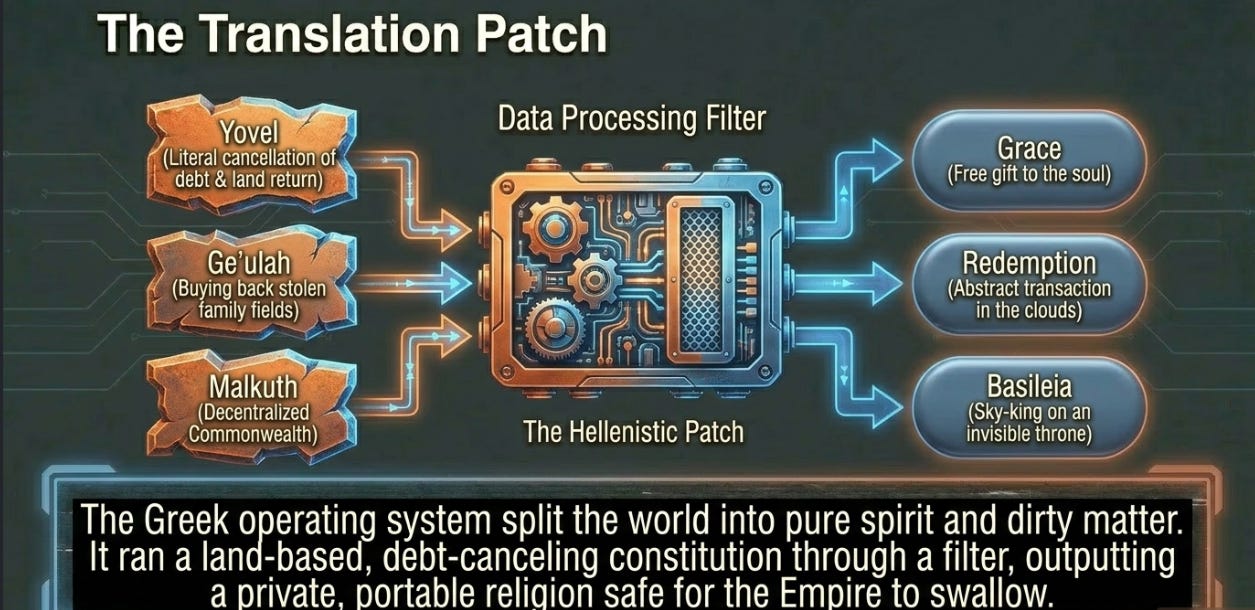
Yovel, the Jubilee, the literal cancellation of debt and the physical return of stolen land, goes into Greek and comes back out as grace. A free gift to the soul. The wagons of returned property turn into a warm feeling in the chest.
Ge’ulah, which named the buying-back of one particular family’s stolen field, goes in and comes back out as redemption in the abstract, a transaction settled somewhere above the clouds.
Yeshua, the deliverance of human bodies out of bondage, goes in and comes back out as the rescue of souls from a courtroom in the sky.
And Malkuth, the very word at the front of our phrase, the Malkutha in Malkutha di-Shamayya, a decentralized commonwealth where sovereignty is measured by the absence of poverty, goes into Greek as basileia, and the Western ear hears a celestial monarchy. A sky-king on a throne. Caesar, only bigger and invisible.
I have laid the long version of this out elsewhere, in the Record, footnotes stacked three deep, the German philologists and the whole genealogy of the exclusion set in order. Tonight you need only the short version, and here it is. The Greek was not the original. The Greek was the bridge, built for an audience that did not have the Aramaic in its ears or the Torah in its bones, and a bridge is a place where things slip over the rail and into the water.
Keep all of that in your head when I show you what happened to the phrase, because the same machine that ate the Jubilee and flattened the commonwealth into a kingdom is the machine I am about to show you eating a pun. The loss I am describing is not a coincidence you have to strain to believe. It is the single most predictable thing that could happen, given everything else this translation demonstrably did to everything else it touched.
So watch it happen to our phrase. Shamayya became ouranon. The heavens. The sky. A clean cosmological word that carries not one atom of the original echo. A Greek-speaking reader of Matthew, hearing the kingdom “of the heavens,” catches a single meaning. The realm above. The religious category, sealed shut.
The second hearing did not survive the border crossing. The call to the rigorists, if it was ever there, dissolved into the Greek and never came back out.
And here is the detail that lifts this from a parlor trick to something worth a footnote. Of the four gospels, Matthew is the one that clings to the “heavens” wording most stubbornly. Mark and Luke reach comfortably for “the realm of the Elohim.” Matthew, again and again, keeps “the kingdom of the heavens.” Scholars have noticed this for centuries and usually explain it as simple reverence, a careful writer avoiding the divine name.
The Archive suspects something deeper. Matthew held onto that exact word because the word itself carried freight the safer alternative could not. He was being faithful to a sound, a sound whose buried second meaning he may no longer have been able to explain to his Greek readers, a sound that mattered in the Aramaic in a way it simply could not matter in the Greek. He preserved the fingerprint and lost the hand that left it.
The scribes who came after him heard cosmic poetry. The hill-country ear the phrase was first built for heard a man calling his allies home.
That’s foothold thirteen. Now onto the next.
Foothold Fourteen | The Decrees
One more, because the architecture is not quite sealed without it.
In 47 CE, fourteen years after the crucifixion, supporters of Beit Shammai took advantage of the chaos after a royal death, seized the Temple, and forced through a set of hardline measures remembered as the Eighteen Decrees of Shammai. The rigorist current was still alive. Still militant. Still carrying the constitutional fire that the movement had been recruiting from the very beginning.
The invitation, if it was one, it seems was heard.
The trouble is that the House which answered it carried the very exclusivism Yehoshua had spent his campaign trying to file away, and the banner the rigorists picked up after him traveled somewhere he never meant it to go.
That is a story for another night. Foothold fourteen, and a door left open.
After Hours
Same honesty as last time. These are footholds, and they do not all bear the same weight.
The legal alignment is rock. The generational chronology is rock. The fact that two resistance streams, one inside the institutions and one outside them, ran in parallel for a generation, shared a slogan, shared a posture, and buried their respective anchors within a year of each other, that is rock.
The wordplay is moss. It might hold your weight. It might come loose when you lean. And the intention behind it, whether Yehoshua meant the second hearing or a sharp-eared listener supplied it for him, is something I cannot prove and will not pretend to. The record is silent on what was in the man’s head.
But here is what the architecture shows, once you lay it flat on the table.
A teacher whose every legal reflex matched the rigorist House of Shammai. Raised in the hill country that House drew its loyalty from. Speaking in the year that house buried its founder. Proclaiming a Commonwealth in Hebrew-Aramaic words whose closing syllables rang against that house’s own name.
To an ear tuned to hear it, that was not cosmic poetry. It was a hand reaching across the divide between the institutional resistance and the wilderness, saying the thing your House has been pointing toward for nearly 80 years is arriving now, and you are invited.
The Greek translation took the politics out and kept the poetry. The poetry survived two thousand years. The politics got buried under it.
The text holds the clues. It always has.
That is enough for one night.
The Archive of the Ebyonim welcomes good-faith correspondence and even generous disagreements. Your readership is deeply valued. If this article amused you, intrigued you, or provoked new thought, please consider amplifying this post by “Liking”, “Re-Stacking”, and sharing with others. If this post left you feeling bereft, tell us in the Comments. If this essay presents as concerning or otherwise misleading, we invite you to write a response or a disputation. The Archive does not show preference for praise, nor do we paywall for access.
This is our Covenant, laid out to the Commonwealth of YHWH.
Onward unto Jubilee. For the restoration of everything to the commons of the heavens.
Notes
[1] On Tzaddoq named as a Perushi and the founding of the Fourth Philosophy, see Josephus, Antiquities 18.1-10, 18.23-25; Jewish War 2.118. On the Shammaite and Qana’i continuity that the Archive extends, see Martin Hengel, The Zealots, trans. David Smith (Edinburgh: T&T Clark, 1989), 76-89.
[2] On Semitic paronomasia conventions in the prophetic corpus and the Qumran pesharim, see Scott B. Noegel, Wordplay and Translation Strategy (Leiden: Brill, 2013), 1-48; and James A. Sanders, “Hermeneutics in True and False Prophecy,” in Canon and Authority, ed. George W. Coats and Burke O. Long (Philadelphia: Fortress, 1977), 21-41.
[3] On the divorce and oath rulings as markers of the Shammaite and Hillelite division, and Yehoshua’s alignment within them, see the Archive‘s treatment in “Who Were the Pharisees?” and the Mishnaic disputes preserved at Gittin 9:10 and Eduyot 1.
[4] On the Eighteen Decrees and the Shammaite seizure of the Temple, see the Archive chronology and the parallel discussion in the Syndicate of the Freedmen dossier.
I am deferring to your vastly superior knowledge on the Hebrew language, Covenant issues, and the politics of the time. Your statements, when held up against my suspicions, and unanswered questions from my education in the Greek, hold up well. Read as a movie script, I'd green-light it for production. I will be doing some comparisons with my available reference material. The moss is mossy, but the rock held my foothold. And I have always been able to see things that others have trouble bringing into focus. To use my favorite Mr. Spock phrase - "Fascinating."
Fantastic read!